Bathroom Exhaust Run Time Calculator
Estimate how many minutes to run a bathroom exhaust fan after a toilet visit, bath, shower, or steam-heavy moisture event using room volume, fan CFM, duct length, elbows, and bathroom size.
■Bathroom presets
■Run time inputs
Your exhaust timer estimate
■Calculation breakdown
Runtime formula: room volume = length x width x height. Adjusted CFM = fan CFM / duct penalty. Run time = required air changes x room volume / adjusted CFM. If the fan is already running during the moisture event, the after-run timer subtracts that event duration.
■Fan reference table
| Bathroom type | Fan CFM reference | Use in this calculator | Runtime note |
|---|---|---|---|
| Toilet room or small powder room | 50 CFM | Short odor event, small volume | Often clears quickly when ducting is direct. |
| Small bathroom with shower | 80 CFM | Moderate moisture event | Use more minutes if the duct is long. |
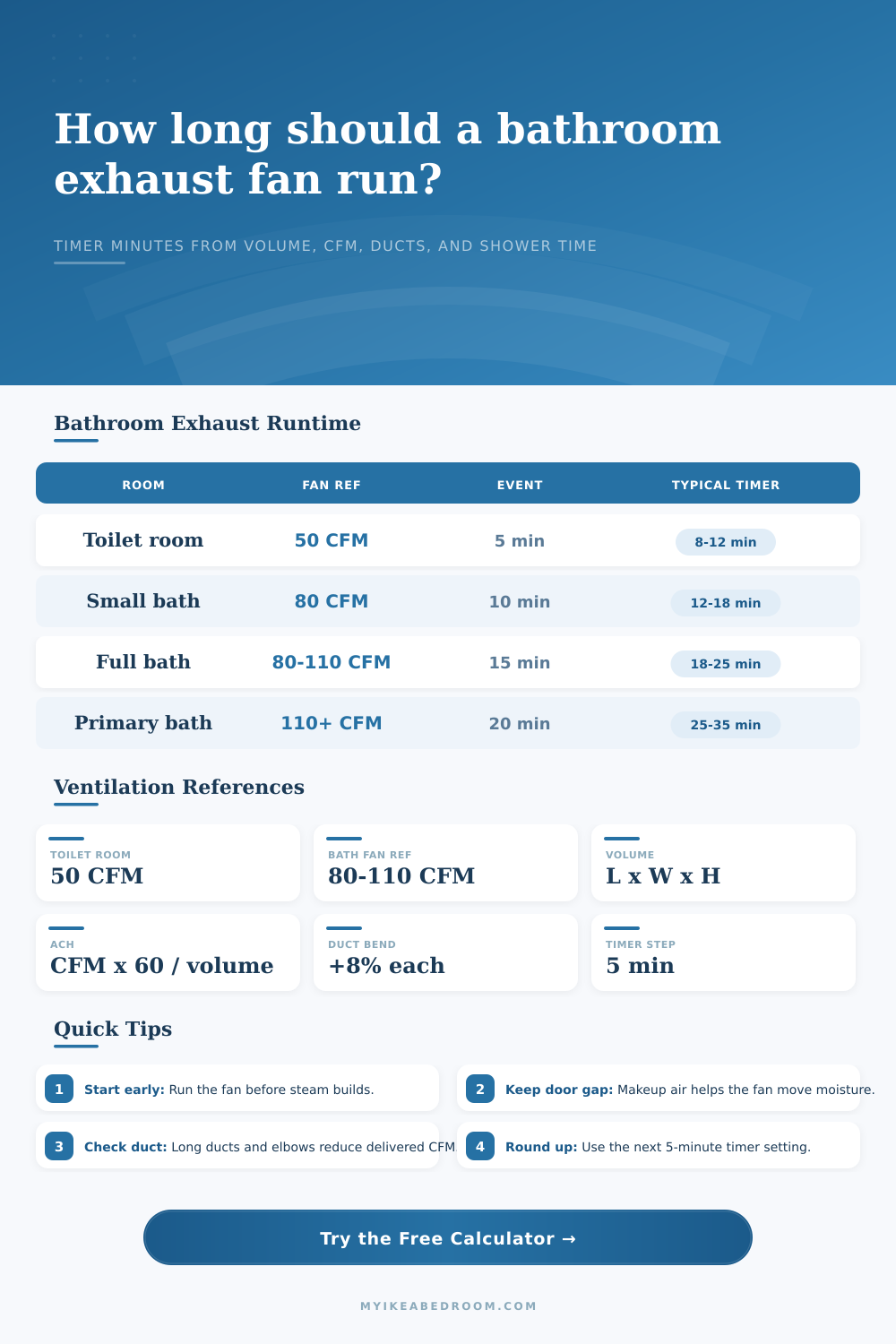
| Full family bathroom | 80-110 CFM | Standard shower or bath humidity | Timer usually lands above the shower duration. |
| Primary bath or high ceiling room | 110+ CFM | Larger volume or longer moisture event | Check that makeup air can enter under the door. |
■Preset comparison table
| Preset | Dimensions | Fan | Event |
|---|---|---|---|
| 50 CFM toilet room | 4 x 5 x 8 ft | 50 CFM | 5 min |
| Powder room | 5 x 6 x 8 ft | 50 CFM | 8 min |
| Small shower | 6 x 7 x 8 ft | 80 CFM | 12 min |
| Full bath 80 CFM | 8 x 6 x 8 ft | 80 CFM | 15 min |
| Full bath 110 CFM | 9 x 8 x 8 ft | 110 CFM | 18 min |
| Primary bath | 10 x 12 x 9 ft | 150 CFM | 20 min |
| Long duct run | 8 x 8 x 8 ft | 110 CFM | 18 min |
| Steam shower | 10 x 10 x 9 ft | 150 CFM | 30 min |
| Metric flat bath | 2.4 x 1.8 x 2.4 m | 85 CFM | 12 min |
■Runtime tips
■Formula notes
When you’re shaving, it’s fogged; when you take a long shower it’s hazy. Afterward, you flip on the fan to get rid of the moisture and want to know how long to let it run for. If you ask most folks, they thinks five minutes. That is rarely the case.
Residential bathrooms are riddled with mold growth from inadequate ventilation. The musty smells follow suit. It create a damp environment while you are in there and even after you leave.
How Long to Run Your Bathroom Fan
How long do I run my bathroom fan? Here’s a bathroom exhaust run time calculator. It uses your ductwork efficiency, fan capacity and room volume to estimate the right amount of time. It goes beyond guess work, it provides a data driven way to set your timer.
In the real world, an eighty CFM fan rarely supplies that volume of air. A lot happens to it between the fan and exterior wall, such as ductwork, which offers a huge amount of resistance to the system. Any kind of sharp bend or elbow in its route from the fan to the wall steal some airflow. That’s why the calculator penalizes the nominal CFM rating according to how many elbows/bends there is in your duct run, and also according to total length of the run.
This is where it gets important: you might under-vent the space if you size your timer by the sticker rating different than the delivered flow. Once you enter your particular layout into the tool, it will adjust down the nominal CFM rating automaticly, accounting for this penalty.
The other factor that’s also taken into account is room volume. Larger rooms will require more air changes then smaller rooms. For example, it takes far less time for a small powder room with low ceilings to clear compared to a primary bathroom with high ceilings and a large tub. People often overlook this simple math.
We’re trying to get rid of the moisture created by our bath or shower. How long does this event last? The longer the event, the more air changes we need. For example, running the toilet doesn’t require as many air changes as taking a twenty minute steam shower. The length of your event scale up or down the number of air changes necessary to do the job.
The second major error is makeup air. You can’t have an exhaust fan that pulls air out of a completely closed room. The fan is working against a vacuum as it tries to suck air out from behind a tightly shut door. There’s no new air to take its place, so it slows down.
By either leaving a small gap at the bottom of the door, or having some sort of vent in the door itself, you’ll let fresh air into the room to displace the moist air that you’re removing with the fan. That little thing makes a huge difference; sometimes a high-CFM fan can feel much more effective.
The tool assumes that makeup air exists. It won’t give good results unless it has free airflow into the bathroom.
There are also some preset buttons that will give you an instant read-out for most situations. Those presets correspond to most normal houses: small bathrooms, big bathrooms, small toilets, big toilets, etc. So you’ll see what your own particular situation would be.
A little toilet room (eighty CFM) with a short run of duct could require as few as twelve minutes. A major bath (powerful fan, long wavy duct run) could require upwards of twenty-five minutes. The reference table on the page shows all that in a table, how various sizes of fans combine with various sized rooms.
You’ll notice that the recommendation rounds the answer up to the next 5 minutes. Why? Better to have the fan run a bit longer than to leave residual humidity behind.
Consistency makes mold happy, so does moisture. Cycle all of the air to protect your ceiling tiles, paint, and drywall. If you left the fan on while taking a shower, this will also indicate how long you should of keep it running after the event. This will help you program a smart switch or a simple mechanical timer.
The numbers on this tool aren’t some abstract math exercise. They’re the work required to maintain a dry bathroom. Enter inputs based off what’s real for you. If you don’t know the exact length of your ducts, measure them. Count your elbows. Make an honest estimate about how long you actualy linger in the shower.
Get the math right, and you’ll eliminate the hidden cost of moisture damage. Your home’s structure will stay sound. The air will smell fresh. And the mirror won’t be fogged up.
It’s a small investment of time with big payoff in terms of both life span and comfortabully.