Bath Water Volume Calculator
Estimate how many gallons or liters a bath needs from the inside tub length, width, waterline fill depth, shape, and person displacement.
■Tub presets
■Water volume inputs
Measure inside the tub at the waterline. The calculator converts metric dimensions internally, then shows both gallons and liters.
Bath water volume result
■Formula cards
■Bath volume reference tables
| Preset | Shape and inside size | Fill depth | Water to add | Planning use |
|---|---|---|---|---|
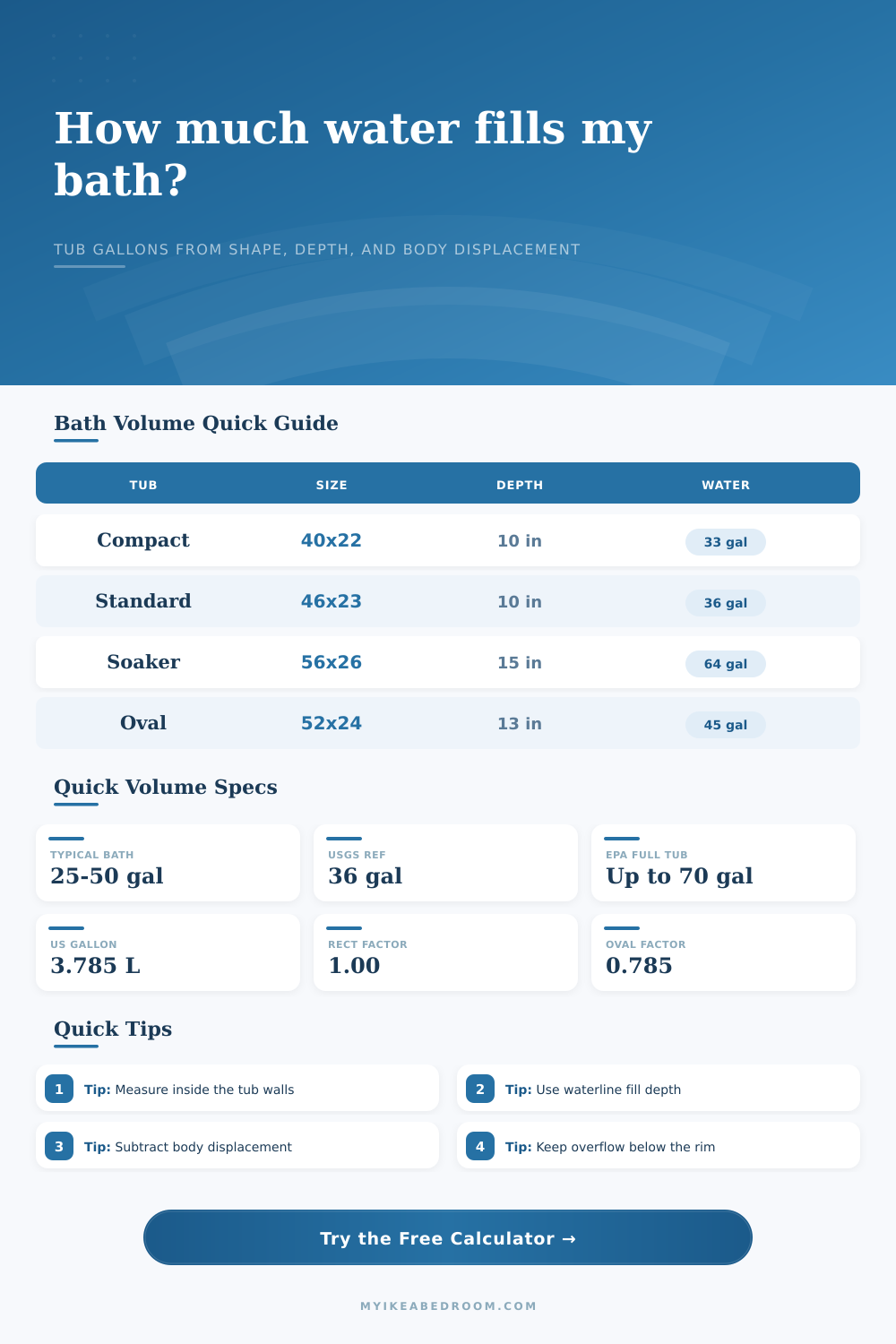
| Compact alcove | Rectangular waterline, 40 in × 22 in | 10 in | About 125 L / 33 gal after 5 gal displacement | Small bathrooms and children's bath planning. |
| Short apartment tub | Rectangular waterline, 44 in × 22 in | 11 in | About 144 L / 38 gal after 8 gal displacement | Compact alcove tubs with a moderate waterline. |
| Standard 60 in tub | Rectangular waterline, 46 in × 23 in | 10 in | About 136 L / 36 gal after 10 gal displacement | Typical five-foot bathroom tub water estimate. |
| Wide family tub | Rectangular waterline, 48 in × 24 in | 11 in | About 170 L / 45 gal after 10 gal displacement | Family bath or shower-over-tub layout. |
| Oval freestanding | Oval waterline, 52 in × 24 in | 13 in | About 171 L / 45 gal after 10 gal displacement | Rounded tubs where rectangle math would overstate volume. |
| Deep oval soaker | Oval waterline, 56 in × 26 in | 15 in | About 243 L / 64 gal after 10 gal displacement | Deep waterline soakers and larger water heater checks. |
| Long rectangular soaker | Rectangular waterline, 58 in × 24 in | 13 in | About 251 L / 66 gal after 12 gal displacement | Large tubs that often exceed typical bath water use. |
| Corner-style oval | Oval waterline, 54 in × 34 in | 13 in | About 262 L / 69 gal after 12 gal displacement | Rounded corner tubs with a broad water surface. |
| Metric apartment bath | Rectangular waterline, 115 cm × 55 cm | 28 cm | About 140 L / 37 gal after 10 gal displacement | Metric entry for centimeter-based bathroom measuring. |
| Tub shape | Water surface formula | Gallons formula | When to use it |
|---|---|---|---|
| Rectangular | Length x width | Length x width x fill depth / 231 | Straight-sided alcove tubs, drop-in tubs, and square-ended soakers. |
| Oval | Length x width x 0.785 | Length x width x 0.785 x fill depth / 231 | Freestanding oval tubs, rounded soaking tubs, and softened corner shapes. |
| Tapered tub | Use average waterline width | Average length x average width x depth / 231 | Measure a midpoint width when the foot end is narrower than the shoulder end. |
| Person displacement | Subtract gallons displaced | Water to add = filled volume - displacement | Use 8 to 12 gallons for a single adult planning allowance. |
| Metric measuring | cm / 2.54 = inches | Gallons x 3.78541 = liters | Useful when the bath spec sheet lists centimeters or liters. |
| Fill depth | Filled tub volume | After 10 gal displacement | Liter equivalent |
|---|---|---|---|
| 8 in / 20 cm | 36.6 gal / 139 L before displacement | 26.6 gal water to add | About 101 L to add |
| 9 in / 23 cm | 41.2 gal / 156 L before displacement | 31.2 gal water to add | About 118 L to add |
| 10 in / 25 cm | 45.8 gal / 173 L before displacement | 35.8 gal water to add | About 136 L to add |
| 11 in / 28 cm | 50.4 gal / 191 L before displacement | 40.4 gal water to add | About 153 L to add |
| 12 in / 30 cm | 55.0 gal / 208 L before displacement | 45.0 gal water to add | About 170 L to add |
| Reference point | Gallons | Liters | How to use it in this calculator |
|---|---|---|---|
| Typical comfortable bath planning band | 25 to 50 gal | 95 to 189 L | Use as a quick check for an occupied tub that is not filled to the overflow. |
| USGS household water-use estimate | 36 gal average full tub | 136 L | Good midpoint comparison for everyday bath water use. |
| EPA WaterSense bath comparison | Up to 70 gal | Up to 265 L | Useful reminder that a full bathtub can exceed ordinary shallow fills. |
| Single adult displacement allowance | 8 to 12 gal | 30 to 45 L | Subtract from empty-tub volume when estimating water added after getting in. |
| Deep or oversized soaker | 50 gal plus | 189 L plus | Check water heater capacity and overflow height before assuming a deep fill. |
■Bath measuring tips
I’m going to assume you already know that filling a tub with water is time consuming AND wasteful. But did you realize just how many gallons of water actualy fill that tub of yours? Or how much more water will you need once you hop inside?
It’s the ‘how much’ question that makes all the difference, knowing the answer prevents wasting money by heating unnecessary amounts of water and helps prevent running out of hot water mid-bath. This bath water volume calculator do the math for you (that is, the geometry), but here’s why it works…
How to Measure Your Bathtub Correctly
People are measuring the wrong thing, the outside of the tub. Bath manufacturers list exterior dimensions to fit and ship the tub. They is not listed for volume, nor do they account for the thickness of the walls. So when you go out and measure from outside edge to outside edge you’re taking into account the tub plus the deck around the tub plus whatever is under the tub and that’s a lot of empty space.
You want the inside dimensions at water line. So look at what the surface of the water would be if you had stepped in the tub. If the tub has tapered sides then estimate what the average interior width are at that water level.
Why does the calculator ask for inside dimension? Because it wants the volume of the space the water takes up (not the space the tub take up).
It also depends on shape: Freestanding tubs is rarely boxes (ovals, rounded rectangles, and soft edges are all common shapes). Because of this, calculating the volume for a standard rectangular alcove tub is simple: just multiply the length by the width by the height. However, when dealing with an oval tub, you should never assume it’s a rectangle (it would greatly over-estimate the volume if you did)! The oval tub shape factor account for the curved corners, which don’t hold any water. This is a little tweak to the equation, but it equates into dozens of liters of difference. So if you’re going to ignore that corner, you might of as well plan for water that doesn’t exist.
The human variable: Get in the full tub? Your body pushes the water aside, so now there’s more water than before. Fill it to the overflow line first, then get in, and water spills across floor right away. The tool allow you to subtract an amount equal to your own displacement. How much room does your body take up? Subtract that, and you’ll know exactly how much water you really should add to get back to your target height with you inside. There is no spill, and the water heater do not have to do extra work to make up for what you displaced.
Nearly every bathroom has an unspoken limitation: the size of the water heater. The standard household water heater usually come in sizes ranging from 40-50 gallons. That is all. You can turn the thermostat as high as you’d like, but if you’re soaking in a bath that requires sixty gallons of water and your tank only has fifty, you’ll get luke warm before you’re halfway done. Having an idea of exactly how much water will be used makes planning more realistic. You may discover you need a bigger tank (so now it’s not just a hope-it-worked guess). Or maybe you want to make do with less, and fill the tub up partway.
Depth is the most sensitive factor. Depending on the width of your tub, an extra inch can mean many gallons of water. Easy to underestimate how quickly that will add up. Knowing what the depth of your tub is, from the bottom to the overflow drain, is key. Filling beyond this is not only wasteful but risky. The calculator has a freeboard setting so you never fill over. Leaving a bit of space between the rim and the water is the only way to be sure. That bit of margin keeps your shower from becoming a surprise flood in your bathroom and keeps it all nice and dry.
Ultimately, it’s all about having control over the amount of water. By measuring correctly, you’re controlling the waste. By leaving enough room for the water to move, you’re controlling the mess. And by making sure there’s a lot of hot water, you’re controlling how comfortablely the soak will be. It’s not rocket science. It just takes accuracy, and that’s what separates the soakers from the guessers.
Because when you know exactly how much water fits inside your space, you quit guessing and begin relaxing, and that’s realy why we take baths at all.