
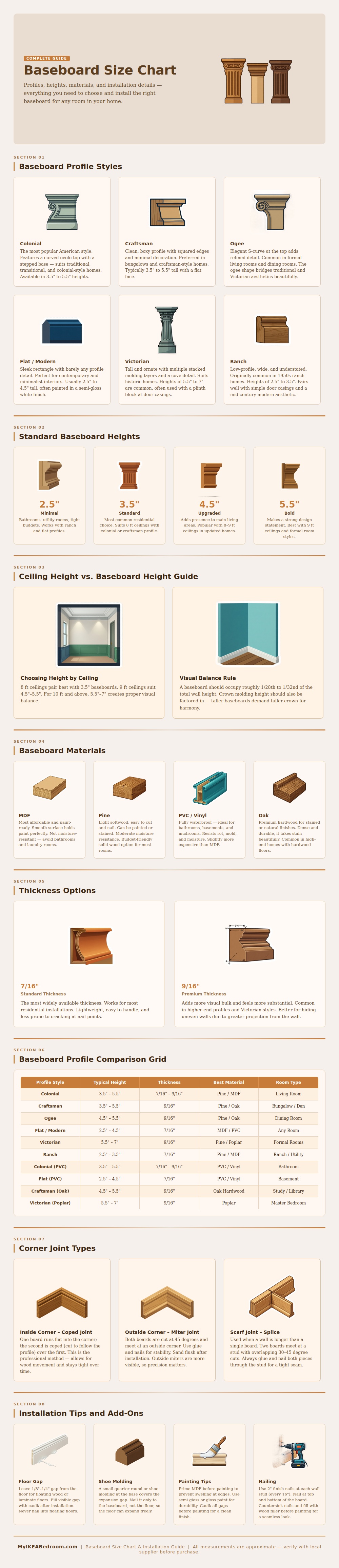
Baseboards is the trim pieces that are placed where the wall meet the floor in a room. Baseboards are used to fulfill the purpose of finishing a room. When choosing the baseboard for a room, you must take into consideration a few differents factors.
For example, the size of the baseboard can impact the way that the height of the room appear to those who view the room. If the baseboard is too large for the room, the room may appear heavy. However, if the baseboard is too small for the room, the room may appear as if it is unfinished.
How to Choose Baseboards
The profile style of the baseboards can impact the way that the baseboards matches the architecture of the room in which they is placed. For instance, one of the most common profile styles is the colonial profile, which feature curves that are relatively soft to the touch. These types of baseboard are typically used in older homes.
Baseboards with flat profile styles are common in moddern rooms; flat profiles are considered to be the simplest of the available baseboard profiles. Another of the most common baseboard profiles is a Craftsman profile, which features boxy, simple design. These types of baseboards are typicaly used in bungalows.
The profile style of the baseboards should complement the architecture of the room in which the baseboards will be install. Using a decorative profile on a small room may draw the viewers attention too much from the items in the room. The height of the baseboards should be chose based off the height of the ceiling in the room.
For instance, if the ceiling is eight feet in height, a tall baseboard may make the walls appear top-heavy. In this instance, it is better to use a shorter baseboard. A common baseboard height is one twenty-eighth of the height of the wall; however, this is merely a suggestion.
Baseboards can be made from a variety of materials. For instance, many people make baseboards of MDF (Medium Density Fiberboard). MDF is relatively inexpensive, and it take paint well.
Therefore, MDF baseboards are common in living rooms, which typicaly do not contain moisture. Baseboards that are made of pine can be stained to any color desire. Therefore, pine is a good material to use in rooms in which you would like to have the wood grain of the baseboard visible.
Another common material is PVC. Baseboards that are made of PVC will not swell when they are exposed to moisture. Therefore, these types of baseboard are typicaly used in bathrooms and basements.
The material of the baseboard should be chose based on the environment of the room; the type of finish for baseboards can be chosen once you select the material. The thickness of the baseboards may impact the visual appearance of the baseboards, as well as their installation in the walls. For instance, baseboards that are thicker than standard thickness will project further from the wall.
Additionally, thicker baseboards are better at concealing the unevenness of old plaster wall. Standard thickness of baseboards works best in the majority of rooms, while premium thickness baseboards are typicaly used in formal rooms in the residence. The method in which the carpenter join the baseboards at the corners can impact the longevity of the baseboards.
For instance, inside corner can be finished with coped joints because the wood expand and contract; coped joints are better at staying tight against the wall. Outside corners require miter joints. For long runs of baseboards, workers use scarf joints.
Scarf joints hide the seam of the baseboard over a stud; this joint makes the baseboard look like one long piece of baseboard. In order to properly install baseboards, a few installation step should be followed. The installer should nail the baseboards into the studs of the wall rather than the drywall.
In houses with floating floor, a small gap should be left between the baseboard and the floor. Shoe molding can cover this gap. The shoe molding should only be nailed to the baseboard.
Caulk every seam of the baseboards. MDF baseboards should be primed before painting; the edges of MDF boards absorb paint different than the rest of the baseboard. Finally, ensure that you understand the relationship between the ceiling, the wall, and the floor.
Your choices in baseboards will impact the visual appearance of the room.
