Bar Cart Size Calculator
Estimate the best bar cart width, depth, height, storage capacity, walking clearance, turning space, and loaded weight before placing a cart in a dining room, living room, kitchen, bedroom nook, or apartment corner.
Start with a realistic room and hosting setup, then adjust the cart dimensions, shelf clearances, bottle mix, and aisle target.
How the calculator judges size
Footprint uses body width and depth plus handles, rails, wheel brackets, and a wall gap.
Room fit compares that footprint with your available room depth and walking aisle target.
Storage fit estimates bottle and glass positions from shelf area, spacing gaps, and shelf count.
Load fit estimates a full cart load and compares it with the cart rating so the result is not just about dimensions.
| Cart type | Typical width | Typical depth | Best room situation |
|---|---|---|---|
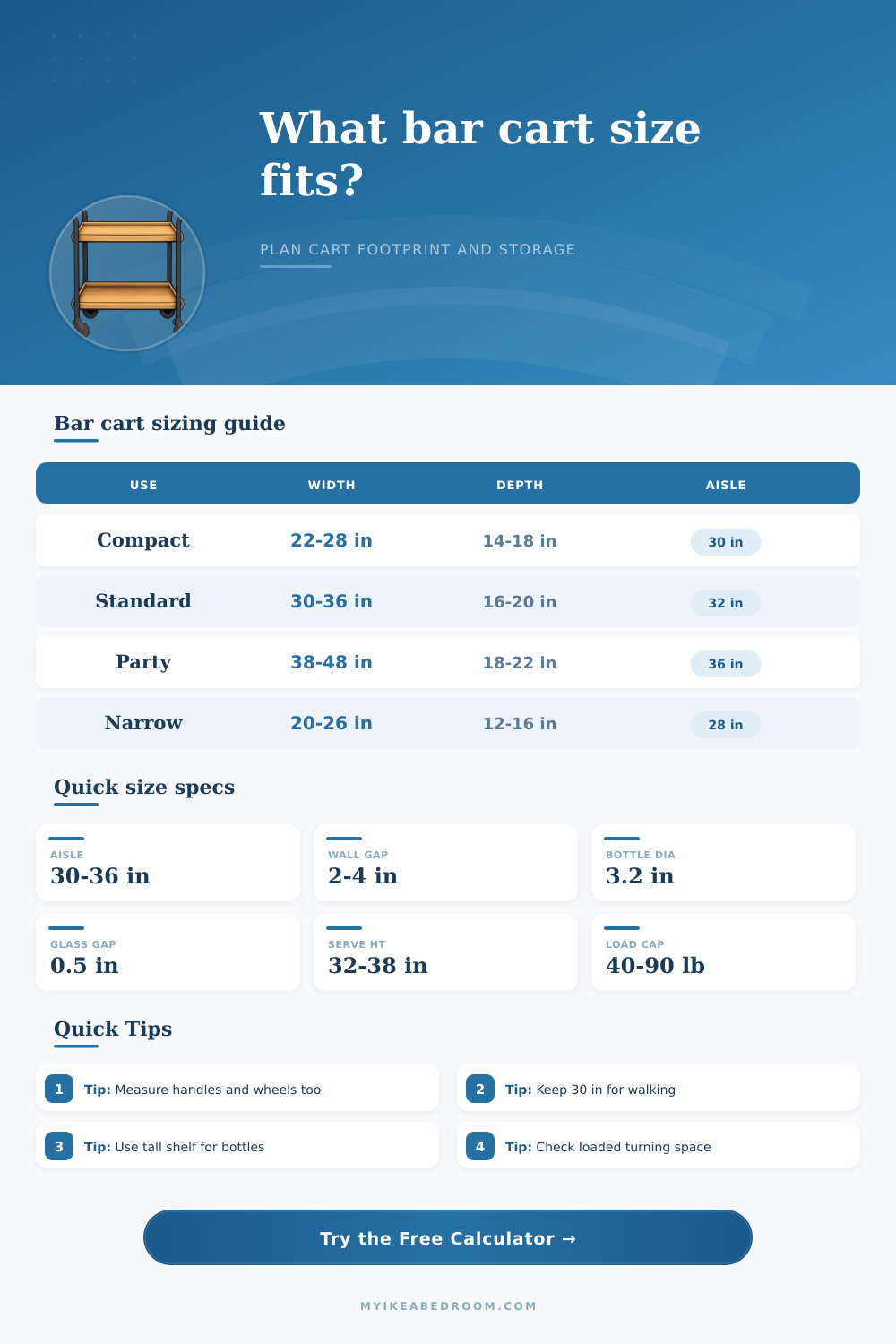
| Slim apartment cart | 20 to 28 in | 12 to 16 in | Small dining nook, hallway, studio wall, or tight living room route |
| Standard two-tier cart | 30 to 36 in | 16 to 20 in | Most dining rooms, living rooms, and kitchen-adjacent serving spots |
| Wide hosting cart | 38 to 48 in | 18 to 22 in | Open entertaining area where a 36 inch aisle remains clear |
| Round corner cart | 22 to 32 in diameter | 22 to 32 in | Open corner where a square cart would block chair movement |
| Tray-top cart | 28 to 40 in | 16 to 22 in | Serving drinks and snacks where top surface is more important than bottle count |
| Clearance item | Tight fit | Comfortable fit | Use when |
|---|---|---|---|
| Walking aisle in front | 28 to 30 in | 32 to 36 in | People pass the cart while drinks or snacks are being served |
| Back wall gap | 1 to 2 in | 3 to 4 in | Cart has wheels, a rear rail, baseboard trim, or cords behind it |
| Side access gap | 1 in each side | 2 to 4 in each side | Hands need to reach bottles or towels from the side |
| Turning circle | 40 to 44 in | 46 to 54 in | Rolling carts move between dining, kitchen, and seating areas |
| Top serving height | 30 to 32 in | 33 to 38 in | Mixing, pouring, garnish trays, or coffee service happens on top |
| Stored item | Average footprint | Useful shelf height | Planning note |
|---|---|---|---|
| Standard spirits bottle | 3.0 to 3.5 in wide | 11 to 13 in tall | Add a half inch gap so labels and shoulders do not collide |
| Wine bottle upright | 3.1 to 3.4 in wide | 12 to 13.5 in tall | Needs more shelf clearance than most low rocks glasses |
| Champagne bottle | 3.5 to 4.0 in wide | 13 to 14.5 in tall | Often drives the tallest shelf requirement |
| Rocks glass | 3.0 to 3.6 in wide | 3.5 to 4.5 in tall | Can usually double rows on a deep lower shelf |
| Wine glass or coupe | 3.2 to 4.2 in wide | 7 to 9 in tall | Use a larger footprint if bowls flare wider than bases |
| Item group | Typical count | Estimated load | Why it matters |
|---|---|---|---|
| Spirits or wine bottles | 8 to 14 bottles | 24 to 42 lb | Bottles quickly become the heaviest part of the cart |
| Glassware | 8 to 16 glasses | 6 to 14 lb | Glass count affects both load and shelf surface area |
| Mixers and tools | 4 to 8 items | 5 to 15 lb | Mixers, ice bucket, shakers, and trays add concentrated weight |
| Decorative display | 2 to 6 items | 3 to 10 lb | Books, bowls, lamps, and plants reduce usable serving capacity |
Measure the full rolling envelope. Handles, towel bars, tray lips, and caster brackets often add 2 to 4 inches beyond the published shelf width. Use the outside edge that would hit a chair, wall, cabinet pull, or sofa arm.
Size for the loaded cart, not the empty cart. Bottles and glassware raise weight and make small casters harder to steer, so a cart that technically fits may still feel awkward if the turning circle is too tight.
Keep the tallest bottle shelf honest. If one shelf has a rail, lip, or low underside, measure the opening after subtracting those parts. Champagne and tall mixers often need more clearance than standard spirits.
Leave front aisle room for serving. A bar cart used during gatherings needs space for a person to stand, pour, and step aside. Use a wider aisle target when the cart sits near dining chairs or a sofa route.
Then the heartbreak: You order, assemble, polish up your new bar cart. It’s beautiful… Right out of a fancy catalog. But when you attempt to put a bottle on it or reach for a glass? It are a disaster. There isn’t enough space for all those bottle. Glasses fall over. And forget about reaching for that Scotch. Your guests must walk an obstacle course around the cart just to fetch there cocktails.
Style-wise, the cart’s probably fine. Most of us is guilty of this: We consider only the cart’s width at checkout, forgetting its height and depth, not to mention how heavy the drinks inside will be once they’re full. The above calculator does the spatial math for you.
How to Measure for Your Bar Cart
Here’s why it matters: What do all of these inputs represents? Begin by entering size of your room. How much open wall space will the cart occupy? How much depth is available behind the cart? The measurement should of been from the wall to the piece of furnitures closest to the wall; don’t use distance to the middle of the room.
Next, enter size of the cart (body width and depth). This is where most calculations goes awry; the cart body represents just the portion of its footprint that sits on the ground. These include caster brackets, tray lips, handles, and towel bars. Extend beyond the edges of the frame. When using a measuring tape, stop when you reach edge of the shelves.
Oops! Already behind. Account for another few inches for this hardware. That thirty-two inch cart is now a problem waiting to happen in a narrow hallway.
Then think about how you’ll use it: What’s going into that thing? The tool asks for bottle count and average diameter because standard spirits bottles and wide champagne flutes occupies vastly different amounts of real estate. “That looks like plenty of room for ten bottles,” a shelf may appear. But what if six are big format wine or wide decanters? That quickly thins out the density.
Then there’s the matter of vertical space. Lots of carts features rails or lips on their shelves, shaving off an inch or two of usable height. In theory, a tall bottle of a mixer could fit into an opening with a fourteen-inch shelf height. In practice, it jam. The calculator compares your entered tallest shelf clearance versus the highest bottle diameter to avoid such frustration down the line.
Weight is another consideration in well-planned carts. A loaded up bar cart is not light. Small casters rolls dozens of pounds of glass and liquid around. Move that weight on un-rated casters and it will be more of a struggle than a glide. The tool considers how many glasses and bottles you have and what their combined weight would be. Then it compare it to the caster rating from the manufacturer.
In addition, it examines turning clearance. Easy enough to roll a cart forward, but not so easy to turn one in place when you’re holding a tray full of drinks. To pivot easily require more floor space than you might expect. This prevents you from knocking over a guest or a lamp.
Here’s how the page breaks down common sizes for different scenarios, from narrow apartment nooks to wide party setups. Keep in mind these are starting points, take out your measuring tape and rely on that more than anything.
For example, a typical dining room serving cart is 30-36″ across. That’s a pretty nice fit on most buffet walls. But what if you’re forcing yourself into some corner of your studio? That same 30″ across might take up the whole place. So walk-away rule is to find the right mix between the amount of stuff you need to store vs. How much room do you have (in terms of walking aisle). You want enough storage, but not so much that it feels like a moddern warehouse corridor in your livivng space.
First thing: Play around with the tool’s buffer settings. You can select a tighter fit. This saves floor space, but it is more difficult to serve from. You can also choose a wider one. This is more comfortabley, but it takes up more square footage. There is no such thing as a perfect setting. It is just the best trade off for your particular room.
When you plug in your number, check out the fit score…and then see how much available aisle space is left over. Adjust your inputs if the results reveal that you’ve got an overloaded weight capacity or a tight turn radius before purchasing.
You measured twice, calculated once…your new bar cart will look good while working hard.