Balusters Spacing Calculator
Dial in the gap, count, and order quantity for straight runs, stair rails, and multi-bay layouts without losing code-safe spacing.
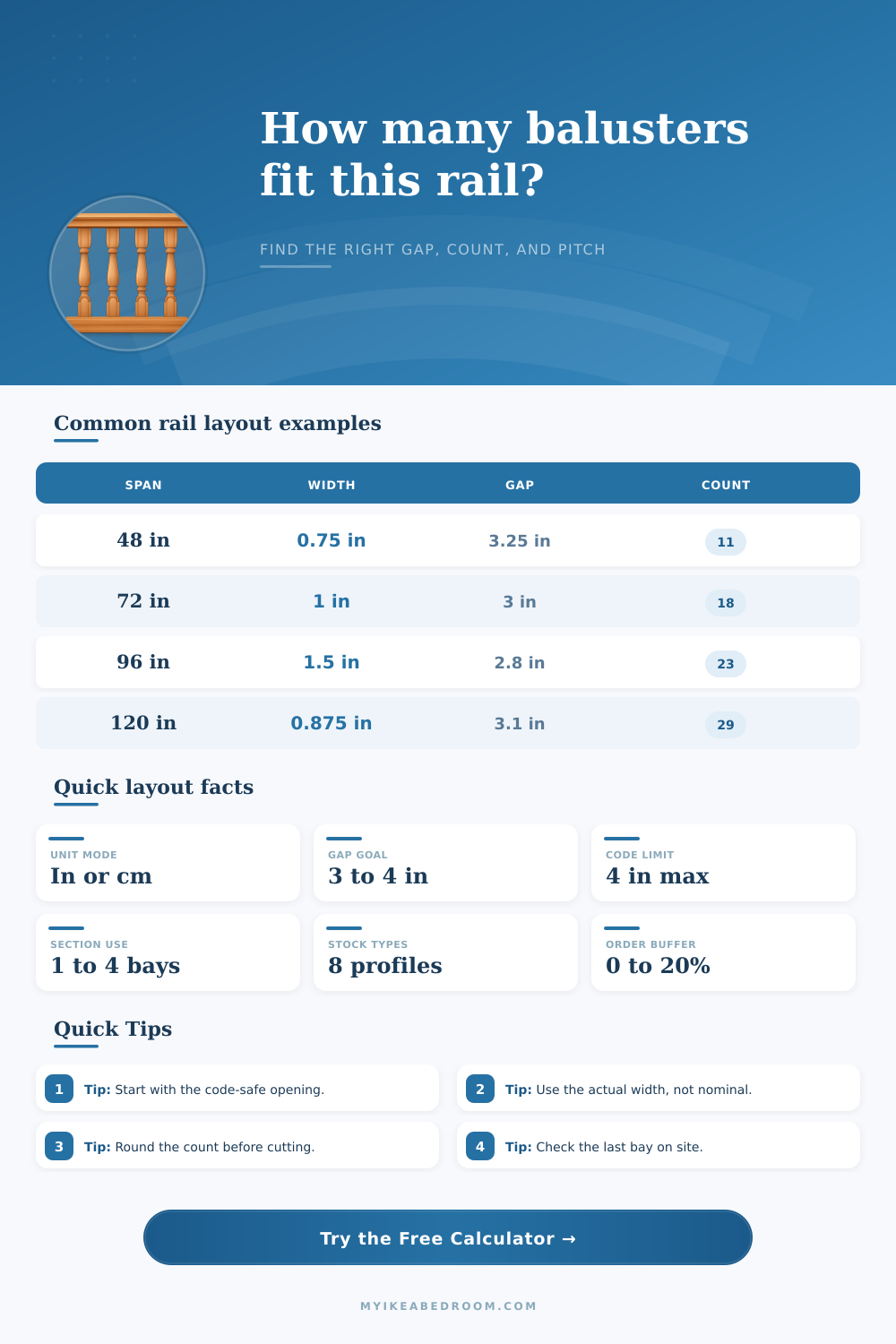
| Span example | Width | Gap | Count |
|---|---|---|---|
| 48 in bay | 0.75 in | 3.25 in | 11 |
| 60 in landing | 2.00 in | 2.50 in | 17 |
| 84 in screen | 1.25 in | 3.00 in | 21 |
| 120 in run | 0.875 in | 3.10 in | 29 |
| Stock type | Wt/ft | Typical width | Best use |
|---|---|---|---|
| Turned cedar | 0.38 | 0.75 in | Light bay |
| Pine baluster | 0.52 | 1.00 in | Paint grade |
| Aluminum picket | 0.33 | 0.75 in | Clean rails |
| Steel picket | 1.10 | 1.00 in | Rigid guard |
| Opening | Meaning | Visual feel | Use case |
|---|---|---|---|
| 2.5 in | Tight | Dense | Privacy |
| 3.0 in | Balanced | Even | Most runs |
| 3.5 in | Open | Airy | Wide bays |
| 4.0 in | Code limit | Max safe | Check local |
| Imperial | Metric | Imperial | Metric |
|---|---|---|---|
| 1 in | 25.4 mm | 4 in | 101.6 mm |
| 12 in | 304.8 mm | 36 in | 914.4 mm |
| 48 in | 1.22 m | 96 in | 2.44 m |
| 120 in | 3.05 m | 144 in | 3.66 m |
Code-first layout
Uses the smallest count that keeps the opening under the limit. Best when the rail must stay strict and predictable.
Balanced layout
Targets the chosen gap first, then adjusts count to fit the span. Best for a clean, symmetrical visual rhythm.
Dense layout
Pushes spacing tighter than the target gap. Best for a more closed look on short sections or decorative runs.
Open layout
Leaves more breathing room while staying within the opening cap. Best for wide spans that need a lighter finish.
Measure the actual baluster face, not the nominal label, then run the layout from the inside faces of the posts.
Snap a test line first, then check the last opening before cutting the full batch or ordering extras.
Baluster spacing is another important part of building a deck that ensures that the railing will be safe and visual appealing. If a person make the gaps between the balusters too wide, the railing may not meet building codes. However, if the gaps in the balusters are too narrow, the railing may look too clutter.
Professionals who builds deck railings will try to estimate the size of the gaps between the balusters by eye. However, estimating the gaps between the balusters by eye will often result in errors. To calculate the gaps between the balusters, a person must determine the space between the posts.
How to Space Balusters on a Deck
Balusters will sit in these gaps between the posts. To find the available space for the balusters, the measurement of each inset must be account for. Each railing will feature an inset on each end that allow for the balusters to attach to the railing.
The inset will be between one and two inch on each end of the railing. So the space available for the balusters will be the total space between the posts minus twice the width of the inset. Once a person calculates this number, the person must figure out the number of balusters needed to ensure the gaps between the balusters are no more than four inches.
Four inches is the maximum allowed gap size for most building codes. To find the number of balusters require, the carpenter must take the width of each baluster and the width of the railing section into account. If the balusters are thin, more balusters will be required than if the balusters are thick.
To determine the number of balusters required and the total weight of the balusters, a calculator will help the carpenter. It is important to know the weight of the balusters because iron balusters will be much heavier than cedar balusters. To create a visual appealing railing, the carpenter should use the same number of balusters throughout the railing.
Using the same number of balusters throughout the railing will save the carpenter time by preventing the need to recut balusters on the job site. Baluster spacing becomes more complicated when installing balusters on stairs. If the stairs has a thirty-five degree pitch, the height of the balusters will change which will alter the number of gaps between the balusters.
If the balusters are allow for gaps at the narrow end of the stairs, the gaps may become too large. For staircases that contain curved balusters or returns at the corners, the gaps between the balusters must be even so that the railing looks visually appealing from all angles. For these type of installations, a carpenter should use the same number of balusters in each bay of the stairwell to ensure that there is no waste in the lumber.
Additionally, the carpenter should order ten to fifteen percent extra balusters then the measurement calculated for the project. There are a few mistakes that a person can make when installing balusters. One of the most common mistake is failing to perform a dry fit of the balusters prior to installing them in place.
A carpenter should use a chalk line to mark the location where the first and last baluster will be installed. Another common mistake is not considering the material of the balusters. Aluminum balusters will be light and thin, steel balusters will be strong and rigid, and composite balusters will be resistant to the weather.
Each material will alter the number of balusters required for the railing. The visual density of the railing will depend on the size of the gaps between the balusters. If the size of the gaps between the balusters is two and half inches, then the balusters will provide a high level of visual density.
However, if the gaps between the balusters is three and a half inches, the visual density will be lower. Visual density is also affect by the maximum allowable gap of four inches between the balusters. In addition to the visual considerations, a carpenter must always make site checks prior to installing the balusters.
Environmental factors will impact the materials used to build the railing. Wood will expand when there is high humidity and metal will contract when the temperature is low. So measurements should be made with these alterations to the material in mind.
Additionally, local building codes might require the gaps between the balusters on a railing to be smaller than the standard four-inch limit. Finally, there should be a printout of the measurements of the balusters for the crew to review so that each member of the building crew knows the size of each inset, the number of balusters required, and the total number of balusters to be use in the construction of the deck railing. Its important to be accuratly prepared.
Youll also need to check the sofas length if your building near any furnitures. There is alot of work to do so you should of checked the plans twice.