🧱 Attic envelope planning
Attic Insulation Thickness Calculator
Estimate the installed depth needed to reach an attic R-value goal, account for settling, and see how much insulation needs to rise above the framing.
Use settled thickness for performance, then add a controlled overbuild for loose-fill depth markers and post-install checks.
Thickness results
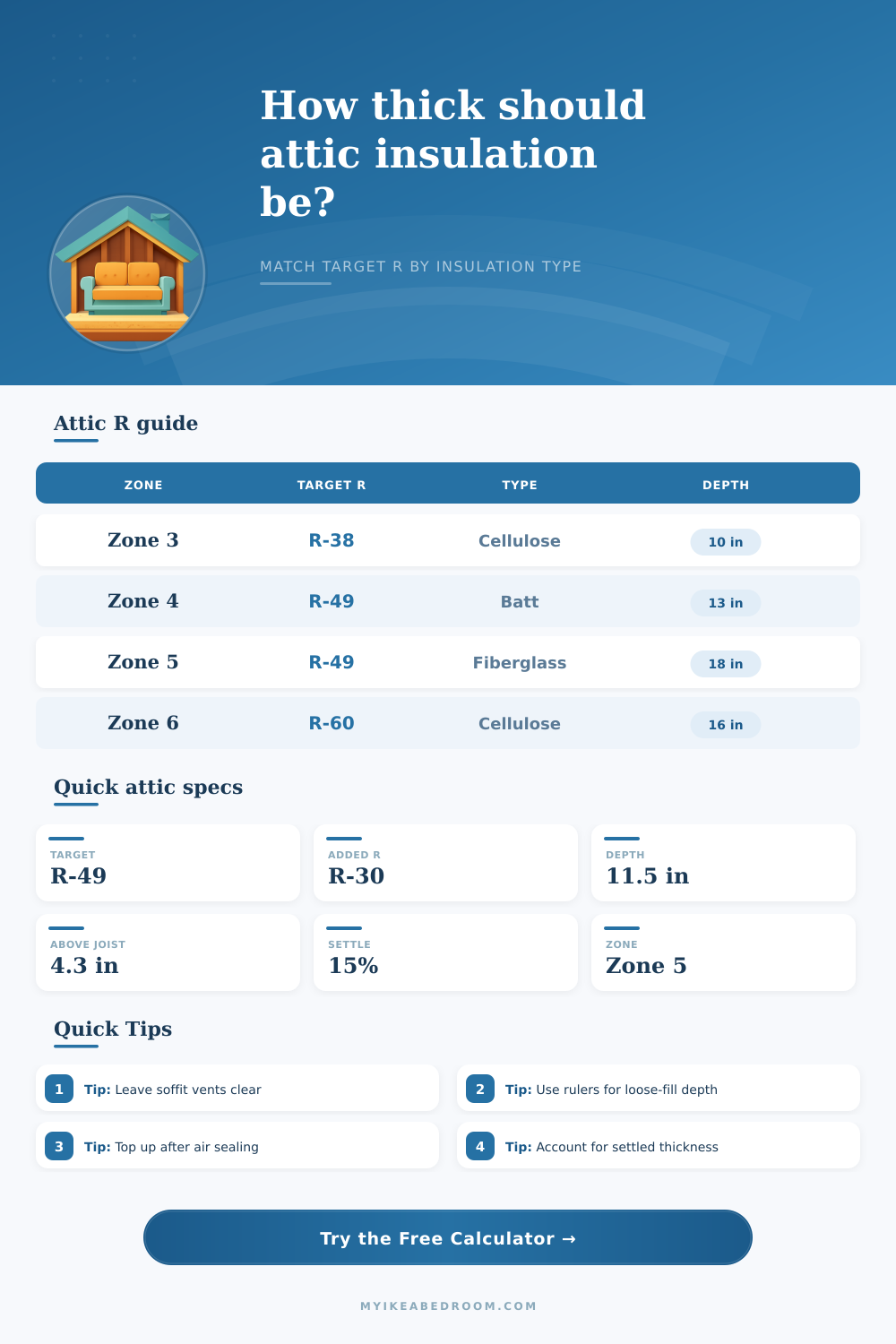
These values convert the target R-value gap into installed depth, then separate what fits inside the joist bay from what must sit above the framing.
| Insulation | Settled R/in | Typical attic fit | Field note |
|---|---|---|---|
| Fiberglass batt | 3.1-3.7 | Open joist bays | Keep full loft |
| Blown fiberglass | 2.2-2.7 | Loose-fill blanket | Check rulers |
| Cellulose | 3.2-3.8 | Deep top-up layer | Allow settling |
| Mineral wool | 3.0-4.2 | Batts or boards | Good fire band |
| Open-cell foam | 3.5-3.8 | Unvented decks | Air seals well |
| Closed-cell foam | 6.0-7.0 | Shallow cavities | High R per inch |
| Zone | Common attic target | Climate cue | Upgrade pattern |
|---|---|---|---|
| Zone 1 | R-30 to R-49 | Very hot | Top-up batts |
| Zone 2 | R-30 to R-60 | Hot-humid | Loose-fill plus air seal |
| Zone 3 | R-30 to R-60 | Warm mix | Cellulose top-up |
| Zone 4 | R-38 to R-60 | Mixed cool | Joist fill plus blanket |
| Zone 5 | R-49 to R-60 | Cold | Deep loose-fill |
| Zone 6 | R-49 to R-60 | Very cold | 2x10s need overfill |
| Zone 7 | R-49 to R-60 | Severe cold | Above-joist blanket |
| Zone 8 | R-49 to R-60 | Subarctic | Deep blanket plus baffles |
| Framing | Actual depth | 1 in vent left | 2 in vent left |
|---|---|---|---|
| 2x6 | 5.5 in | 4.5 in | 3.5 in |
| 2x8 | 7.25 in | 6.25 in | 5.25 in |
| 2x10 | 9.25 in | 8.25 in | 7.25 in |
| 2x12 | 11.25 in | 10.25 in | 9.25 in |
| Product | Typical add | Use when | Reason |
|---|---|---|---|
| Fiberglass batt | 0-3% | Cut batts tight | Little settling |
| Blown fiberglass | 15-20% | Loose attic blanket | Settles most |
| Cellulose | 10-20% | Retrofit top-up | Compacts some |
| Mineral wool | 0-3% | Batt layer | Holds shape |
| Open-cell foam | 0-2% | Roof deck spray | Stable depth |
| Closed-cell foam | 0-1% | Thin cavity work | Very stable |
Fiberglass batt
Best for: Straight joist bays
Depth habit: Usually flush to framing
Watch for: Compression at eaves
Blown fiberglass
Best for: Fast whole-attic coverage
Depth habit: Deep loose blanket
Watch for: Strong settling allowance
Cellulose
Best for: Top-ups over old insulation
Depth habit: More R in less depth
Watch for: Keep vents open
Mineral wool
Best for: Batts near heat sources
Depth habit: Stable and springy
Watch for: Deeper zones need layering
Air seal ceiling penetrations before chasing more thickness. A deeper blanket helps most after bypasses, top plates, can lights, and attic hatches stop leaking air.
Keep soffit baffles and wind-wash dams clear. If the calculator shows a high above-joist blanket, mark final depth with rulers so the eaves stay ventilated.
Attic insulation thicknesses refers to the depth of insulation that you will install in your attic. The insulation will prevent your heat from leaving your house through the roof and the ceiling. If the thickness of the insulation is too thin, your heat will leave your attic through the roof and the ceiling.
If the thickness of the attic insulation is too high, then attic vent will be blocked and moisture can build up in your attic. The climate in which your house is built will determine the R-value of the attic insulation you will use. Warm climate require thin insulation, such as the Gulf Coast area, which have an R-value of 38.
How Thick Should Your Attic Insulation Be
In cold climates, such as the Great Lakes areas, an R-value of 60 is required for attic insulation. This is because colder climates will cause more heat loss through the roof. Another factor that will determine the thickness of attic insulation you will use is the type of insulation.
If you use fiberglass insulation, the insulation will maintain the depth at which you install the batts. If you use cellulose insulation, the insulation will settle over time. You will have to install cellulose at a more greater thickness than the thickness at which the cellulose will settle.
You will have to install 15 to 20 percent more cellulose insulation than the target thickness of your attic. Mineral wool insulation will not settle like cellulose insulation, however, spray foam insulation will take up very thinly layers to provide you with the necessary attic insulation thickness. The different types of insulation will have different R-values per inch of thickness, so you will have to calculate the attic insulation thickness that you will require based off the insulation you will use.
The types of joists that your attic use will also affect the attic insulation thickness. For instance, 2×10 joists will not provide the 10 inch of space that the numbers suggest. There will be less space for insulation in the joist.
Furthermore, space must be left for the eaves of the attic roof. When installing new insulation, you will add the new insulation on top of existing insulation. Furthermore, you will have to install 5 or 6 percent extra insulation to account for any dip in the existing attic insulation.
Air sealing should be done before installing attic insulation. The attic should be sealed around any penetration in the ceiling such as lights or hatches. If these are not sealed, the attic insulation will not be as effective at retaining the heat from your home.
For attics that are vented, you must maintain a balance between the insulation in the attic and its ventilation. Soffit vents and ridge vents will allow air to circulate through the attic. This will allow moisture to leave the attic.
You will install baffles to ensure the vent remain open. However, if the attic insulation is too deep, the baffles will be covered. Furthermore, insulation should not be installed too thick in attics because it will block the air from moving through the vents.
This will cause mold or ice dam to form in your attic. Settling of insulation is a common problem. If attic insulation settles, the thickness of the insulation will change.
If you use cellulose insulation, the insulation will settle over time. You should not use the thickness of insulation as measured after you have poured the insulation into the attic. You should instead calculate for the settled thickness of insulation to ensure that the insulation will reach the ceiling to the required thickness.
Use rulers to mark the depth that you want the insulation to reach the attic ceiling. This will allow you to know when the insulation has reached the required attic insulation thickness. The cost of installing attic insulation is related to the attic insulation thickness that you choose for your home.
The cost will be correlated with the number of bag of insulation that you purchase. However, attic insulation that is too thick will reduce your heating costs by 20 to 30 percent in cold area of the country. Furthermore, there will be labor costs for installing the attic insulation.
For instance, if you use fiberglass insulation, it will be difficult to install the batts on the uneven floors of the attic. Furthermore, if you use cellulose insulation, there will be more labor cost since you will have to use machines to distribute the insulation. It isnt always easy to recieve the exact amount you want.
Youll also need to consider that the price can be different than you expect, and it might be alot more. If you dont plan ahead you could of wasted money on too much material. Make sure you check the rooms size and its depth properly.