🧱 Attic thermal planning
Attic Insulation R-Value Calculator
Compare existing and new insulation layers, check safe fill depth, and see how close your attic gets to common target R-levels without crowding vent space.
Attic insulation are a method of managing the amount of heat that flows through a building. Spesifically, attic insulation is used to keep the conditioned air within the living space of a building. When adding insulation to the attic, you must provide consideration to the R-value of the insulation that is to be used.
The R-value measure the resistance of the insulation material to heat flow; the more higher the R-value of the insulation, the more resistance the insulation materials will provide to heat flow. Additionally, you must also consider the way that the insulation will settle within the attic and how it will impact the attics ventilation system prior to an installation of attic insulation. While it may be thought that adding more insulation to the attic will increase the efficiency of the attic as a form of home heating or cooling, adding insulation that can be easily compressed will actualy lead to problems within the structure and function of the attic.
How to Insulate Your Attic
The compression of the insulation will reduce the R-value of the insulation material, preventing the attic from effectively retaining the heat that the living space of the home either requires to be released or contained. Furthermore, the wooden framing that forms the structure of the attic may allow heat to pass through the joists of the structure, continuing to reduce the total effectiveness of the insulation relative than the expected R-value. Ventilation within the attic help to control the moisture levels within the attic.
It is necessary to ensure that attic insulation doesnt obstruct the vents that allow for moisture to be released from the attic; moisture buildup within the attic may lead to the rot of the structure of that attic. Spesifically, soffit vents allows for cool air to enter the attic, while ridge vents allow for hot and humid air to exit the attic. Placing attic insulation over the eaves of the attic may lead to moisture buildup if the attic insulation blocks the soffit vents.
Baffles may be placed at the eaves to create an airway for air to pass through the attic, and to ensure that attic insulation does not obstruct such airflow. Depending upon the type of insulation that is to be used, the insulation may have different properties that must be considered when installing such insulation into the attic. For instance, people often blow cellulose insulation into attics, and cellulose insulation resist settling when blown into attics.
Fiberglass insulation is another type of insulation that is often used in attics, though fiberglass insulation is more likely to settle than cellulose insulation. Spray foam insulation is a third type that can be used; spray foam insulation can seal air leaks in the attic better than other forms of insulation. However, installing spray foam insulation require the use of professional to install the insulation to ensure that there are no void within the spray foam insulation.
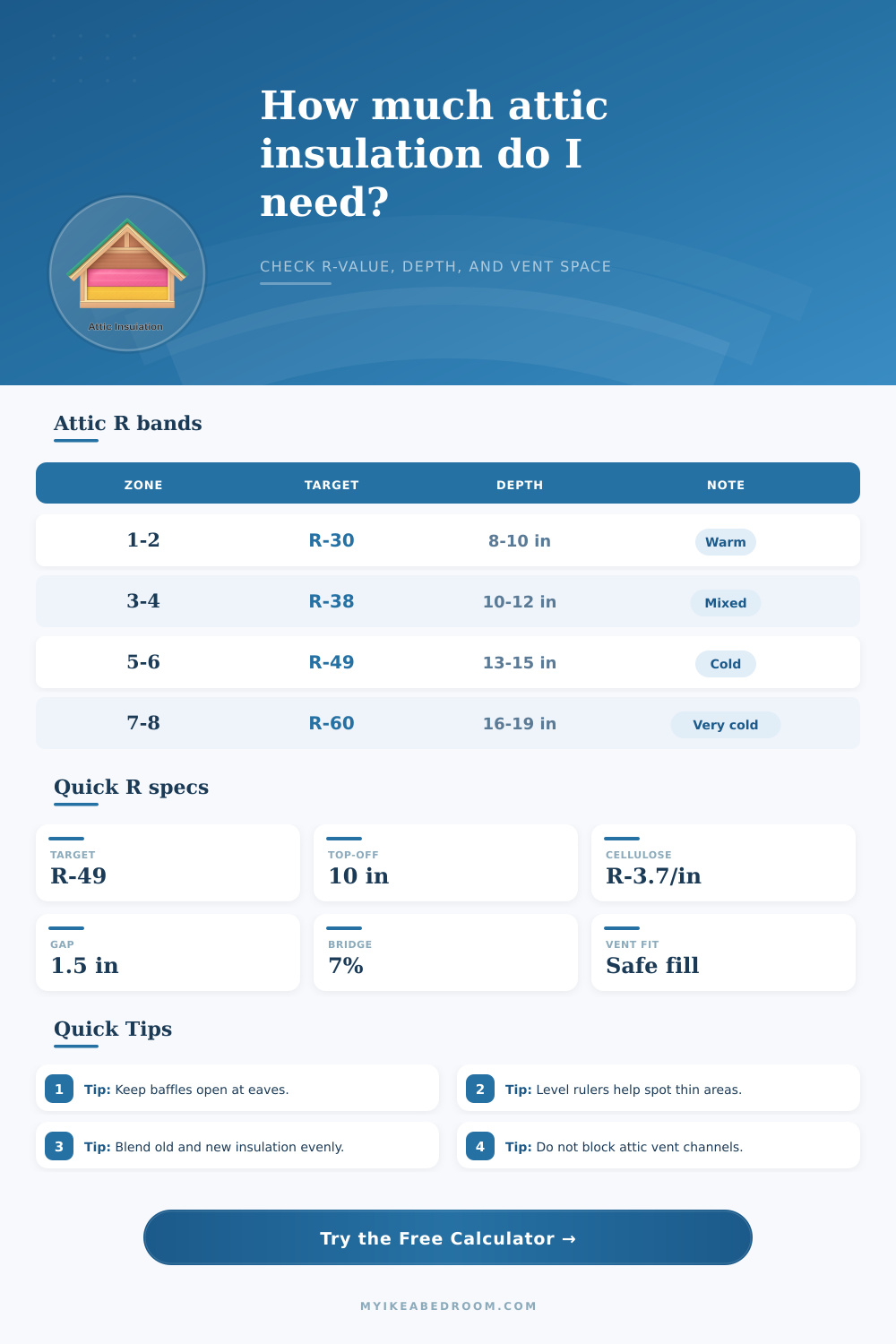
The amount of insulation that should be installed within the attic may vary according to the climate of the region where the home is constructed. Homes in warmer climates may not require as much insulation as homes in colder climates. For instance, attics in warm climates may only require R-values of 30, while attics in cold climates may require R-values of 49 or 60.
The total depth of the insulation that is required to provide such R-values can be calculated, though you must make consideration for any existing insulation within the attic. The existing insulation may have settled over time, reducing it R-value. In adding new insulation to an attic that already contains insulation, it is important to ensure that the attic is not overpacked with insulation.
Packing the attic too full with insulation may lead to the compression of the insulation. Such compression will reduce the R-value of the attic insulation. Additionally, it is important to ensure that there is enough space within the attic for ventilation near the eaves; insufficient ventilation may lead to moisture buildup within the attic and potential damage to the structure of the home.
Thus, a variety of factors must be considered in the management of attic insulation. Such factors include the R-value of the insulation, the type of insulation that is to be used, the climate of the region in which the home is constructed, and the requirement of the attic in regard to ventilation. Ensuring that the installation of insulation avoids both the compression of the insulation and the blocking of the attic vents will ensure that the insulation perform its important function of maintaining the temperature of the building.