🏠 Attic Insulation Calculator
Estimate attic top-up depth, bag count, loose-fill volume, and added weight with real attic presets and clear R-value comparisons.
📋Real attic presets
🔧Calculator inputs
📋Material comparison grid
📊Reference tables
💡Practical tips
📈Calculation results
Installing attic insulation is a method that can be used to prevent heat from escaping out of a house. By using attic insulation, a person can reduce the amount of money that they spends on heating and cooling there houses. Many older houses has insufficient amounts of attic insulation, as well as insulation that has settled into the house over time and lost some of its thicknes.
In these case, a person must calculate the amount of attic insulation that is needed for the house. If you buy the attic insulation in amounts that are too low, the house will remain too cold. However, if the amount of attic insulation is too high, then the individual will spend more money then they would of otherwise.
How to Measure and Add Attic Insulation
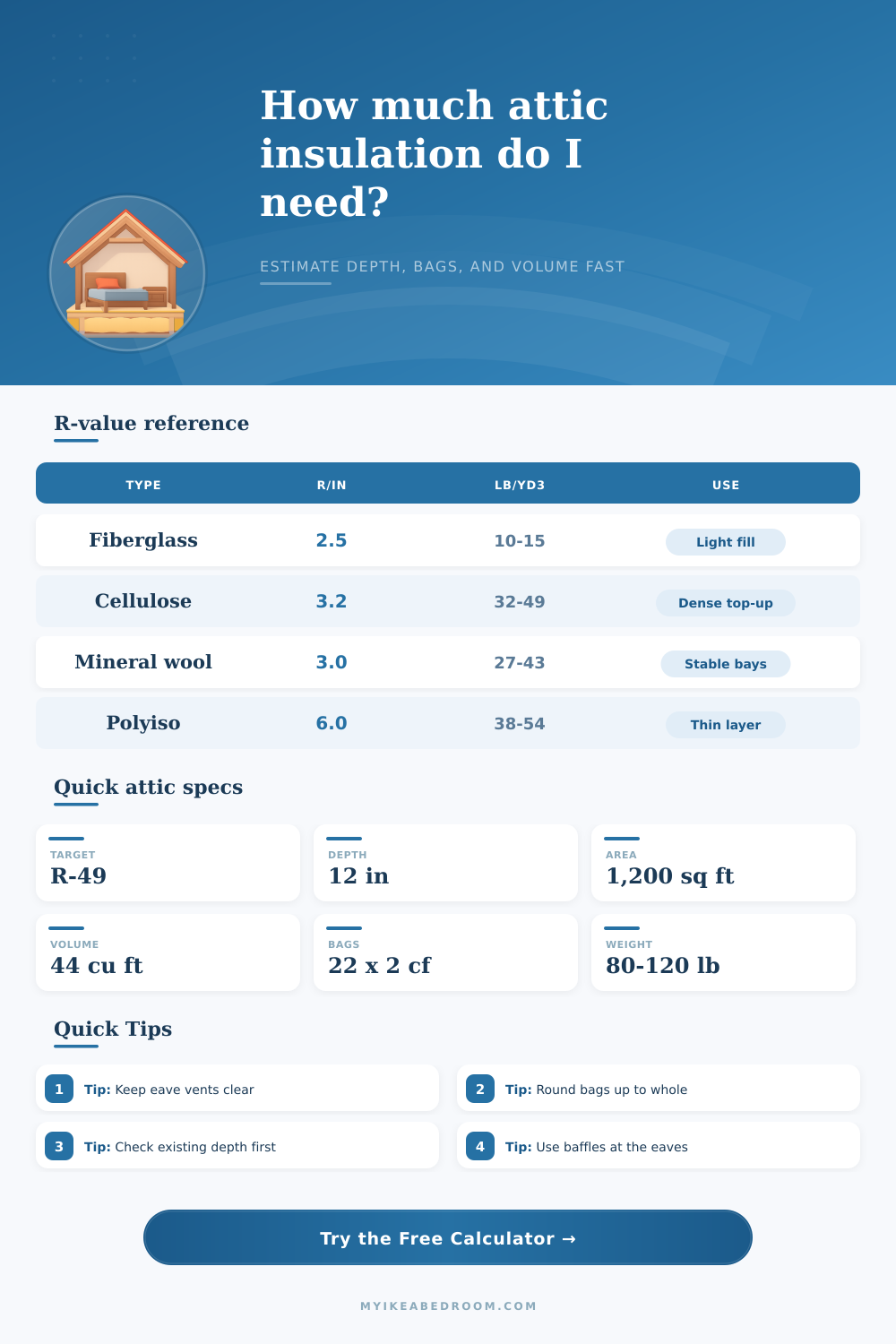
The R-value is a number that indicates the ability of a type of insulation to prevent heat from flowing through it. Additionally, the R-value is the most important number to consider when purchasing attic insulation. For instance, fiberglass insulation may have an R-value of 2.5 per inch of thickness, whereas cellulose insulation may have an R-value of 3.2 per inch of thickness.
Because each type of insulation have a different value of R, one inch of one type is not equal to one inch of another type. Furthermore, you should subtract the existing attic insulation from the total R-value that is needed. If this step is not taken, then the new attic insulation will not be of the apropriate thickness.
In order to calculate the amount of attic insulation that is needed, it is first necessary to calculate the area of the attic that needs to be insulated. For instance, if the attic is 40 feet by 24 feet, the area is 960 square feet. However, the shape of the attic may make it more difficultly to calculate the area of each section of the attic.
In addition, it is necessary to account for the settling of the attic insulation. For instance, loose-fill attic insulation may settle 10 to 20 percent of its total volume over time. Thus, it is necessary to purchase additional attic insulation to compensate for this settling over time.
In addition to calculating the area of the attic, it is also necessary to determine the depth of the existing attic insulation within the house. The existing insulation may not be very thick. For instance, many people may think that their house already has a thick layer of insulation, but as the name implies, the existing insulation has settled into the attic over time.
Thus, by measuring the thickness of the existing attic insulation, an individual can calculate the amount of new attic insulation that will be needed to reach the target R-value for the attic insulation. This target R-value can be based off the climate within which the house is located. For instance, the climates in the northern portion of the United States may require higher R-values than those in the southern portions of the country.
There are several type of attic insulation that can be used to insulate the attic spaces in houses. For instance, a person can blow loose-fill attic insulation, such as fiberglass or cellulose insulation, into the attic spaces. Additionally, fiberglass insulation is the lighter of the two types of insulation, whereas cellulose insulation is denser and heavier.
Another type of attic insulation is batts, which are rectangular pieces of insulation that are placed into the attics, though these batts should not be compressed. Additionally, there are spray foams that can be used to insulate attics, as well as rigid polyiso insulation boards of any needed thickness that can be placed into any area of the attic. In any attic, it is essential that attic insulation does not block the vents in the attic space.
If attic insulation do block these attic vents, the moisture within the attic can become trapped, and the trapped moisture may cause the roof of the house to rot. Additionally, you should also consider the total weight of the attic insulation. For instance, if a large amount of heavy cellulose insulation is to be added to the attic, it is possible that the added weight of the cellulose insulation may cause the floor joists of the house to sag under the additional load.
To calculate the amount of attic insulation that will be needed for the house, steps can be followed. First, calculate the area of the attic. Second, calculate the depth of the attic insulation that will be required.
Third, multiply these two values to calculate the number of cubic feet of attic insulation that will be required. Fourth, adjust for settling of the attic insulation. Fifth, divide the total amount of attic insulation that will be purchased by the number of cubic feet per bag of attic insulation.
The result will be the total number of bags of attic insulation that will be required to insulate the attic of the house. In general, installing proper attic insulation will result in the reduction in the amount of heat that is lost by the house. Consequently, the utility bills of the house will decrease, as will the amount of noise that enters the house.
When performing these steps to install the attic insulation, it is necessary to wear a mask to avoid the dust that is created by the attic insulation. Additionally, any gap in the attic or any recessed lights should be sealed with foam or covers in order to ensure that the attic insulation does not lose it’s R-value in these areas.