Art Height Above Console Calculator
Calculate wall fastener height, art bottom gap, center eye line, lamp clearance, and top wall zone for artwork above a console, sideboard, dresser, or entry table.
Choose a wall situation, then adjust console height, art size, lamp height, eye line, and ceiling clearance.
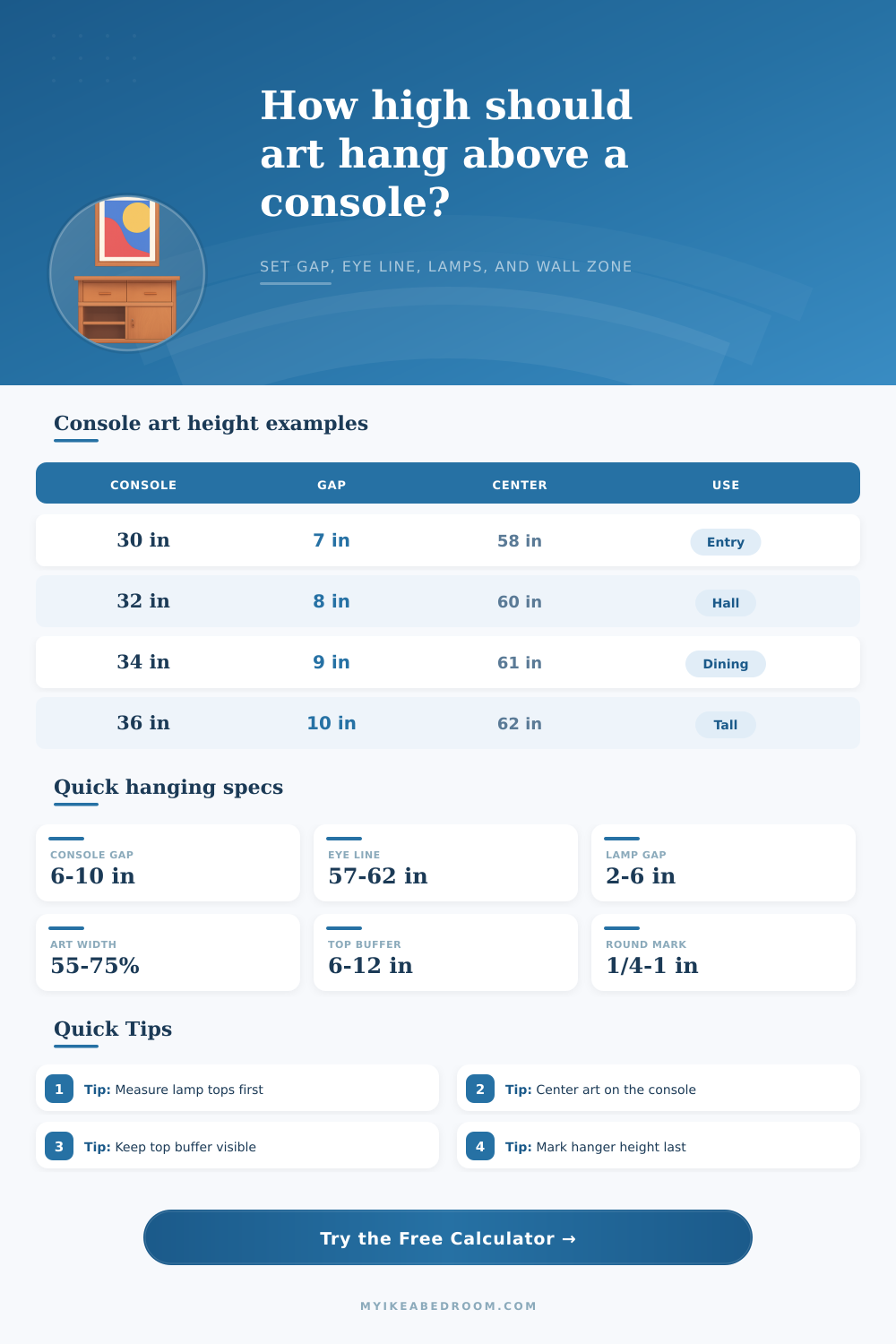
| Console height | Starting gap | Center target | Best use |
|---|---|---|---|
| 28 to 30 in | 8 to 12 in | 57 to 60 in | Low credenza, long landscape art, large canvas. |
| 31 to 33 in | 7 to 10 in | 58 to 61 in | Standard entry console, hallway table, bedroom chest. |
| 34 to 36 in | 5 to 9 in | 60 to 63 in | Dining sideboard, buffet, taller dresser, lamp pair. |
| 37 in and up | 4 to 7 in | 61 to 64 in | Tall cabinet top or mantel-like console zone. |
| Object height | Minimum art gap | Preferred clearance | Planning note |
|---|---|---|---|
| No objects | 6 to 8 in | Not needed | Use the console gap and eye-line target as the main drivers. |
| 10 to 16 in | 8 to 12 in | 2 to 4 in | Small vase, bowl, plant, or low lamp usually fits easily. |
| 17 to 24 in | 12 to 18 in | 3 to 6 in | Typical table lamps often push art above the normal gap. |
| 25 in and up | 18 in and up | 4 to 8 in | Use narrower art, move lamps outward, or reduce lamp height. |
| Ceiling or trim | Top buffer | Usable art top | When to adjust |
|---|---|---|---|
| 84 in | 5 to 8 in | 76 to 79 in | Choose shorter art if the console or lamps are tall. |
| 96 in | 8 to 12 in | 84 to 88 in | Most console art works with normal centerline and gap rules. |
| 108 in | 10 to 16 in | 92 to 98 in | Raise centerline slightly or use larger vertical art. |
| 120 in | 12 to 20 in | 100 to 108 in | Use scale from furniture width, not ceiling height alone. |
| Art width share | Visual read | Best for | Watch for |
|---|---|---|---|
| Under 50% | Narrow | Small print, sconce pair, strong objects on top. | Can look disconnected from the console below. |
| 55 to 65% | Balanced | Single print, mirror-like placement, compact halls. | Keep the art centered on the console. |
| 66 to 75% | Generous | Large landscape art, sideboards, low credenzas. | Confirm side lamps do not crowd the frame. |
| Over 80% | Very wide | Gallery sets and oversized statements. | Leave visible breathing room at both console ends. |
Best for: clean furniture relationship.
Starts at the console top plus the preferred gap, then checks eye line and wall zone.
Best for: open walls and low consoles.
Centers the art near viewing height, but can conflict with tall consoles or lamps.
Best for: styled sideboards.
Raises the bottom edge above lamp shades, vases, branches, or tall objects.
Best for: short ceilings or trim.
Keeps the top edge below crown, picture rail, ceiling line, or nearby trim.
Measure the tallest object on the console. A 20 inch lamp on a 32 inch console reaches 52 inches before any lamp clearance, so it can override a normal 8 inch art gap.
Mark the hardware height after the layout height. Set the art top and bottom first, then subtract the measured wire, D-ring, keyhole, or cleat drop to place the wall fastener.
When hanging art above a console table, the distance between the two are important. The distance between the console and the art is important in creating visual breathing room between the two pieces of furnitures. If the distance between the two is too small, the art will appear to be sit directly on the console.
If the distance between the two is to large, the art will appear to be floating away from the console. Therefore, a balance must be found between the distance between the console and art such that the art and console appears to be intentionaly placed together. Another consideration of the art placement is the height of the art relative to an individual’s eye level.
How to Hang Art Above a Console Table
If individuals typically sits in the room, the art should be hung lower to be visually balanced with the furniture. If individuals are typically standing in the area, such as in a hallway, the art should be hung higher. Additionally, the height of the console impact where the art should be hung relative to the floor.
Low consoles allow the art to hang lower relative to the floor, while tall consoles will cause the art to hang higher. Thus, tall consoles may make it necessary for the art to not appear to be too close to the ceiling. The object that will be placed on the console will also impact the placement of the art.
For instance, tall lamps will take up space between the console and the art. Thus, if any lamps will be placed on the console, the art will need to be hung higher to avoid contact with the lamp. In this situation, the height of the lamp will be the most important measurement of the items within the arrangement.
Additionally, the width of the art relative to the width of the console should also be consider. Art that is too narrow will appear small within a wide console table, while art that is too wide will appear to crowd against the ends of the console. To avoid this crowding, the art should be selected to have a width that is somewhere between half the width of the console to three-quarters of the width of the console.
Other factors to consider in hanging art above a console include the height of the ceiling and the presence of molding. In spaces with low ceilings, care should be taken to ensure that the art does not appearing to be crowded against the ceiling. In spaces with high ceilings, the art can be hung at a higher level.
Finally, any hardware on the back of the art will impact the placement of the art on the wall. The distance from the hardware to the top of the art frame will determine the placement of the nail in the wall. Therefore, it is important to ensure that the art is not hung lower than it is intended to be hung when the measurement are taken.
By considering the console, the art, the lamps on the console, and the ceiling in relation to one another, the individual can determine an arrangement of the item such that they appear to correctly fit within the room.