Area Rug Size for Queen Bed Calculator
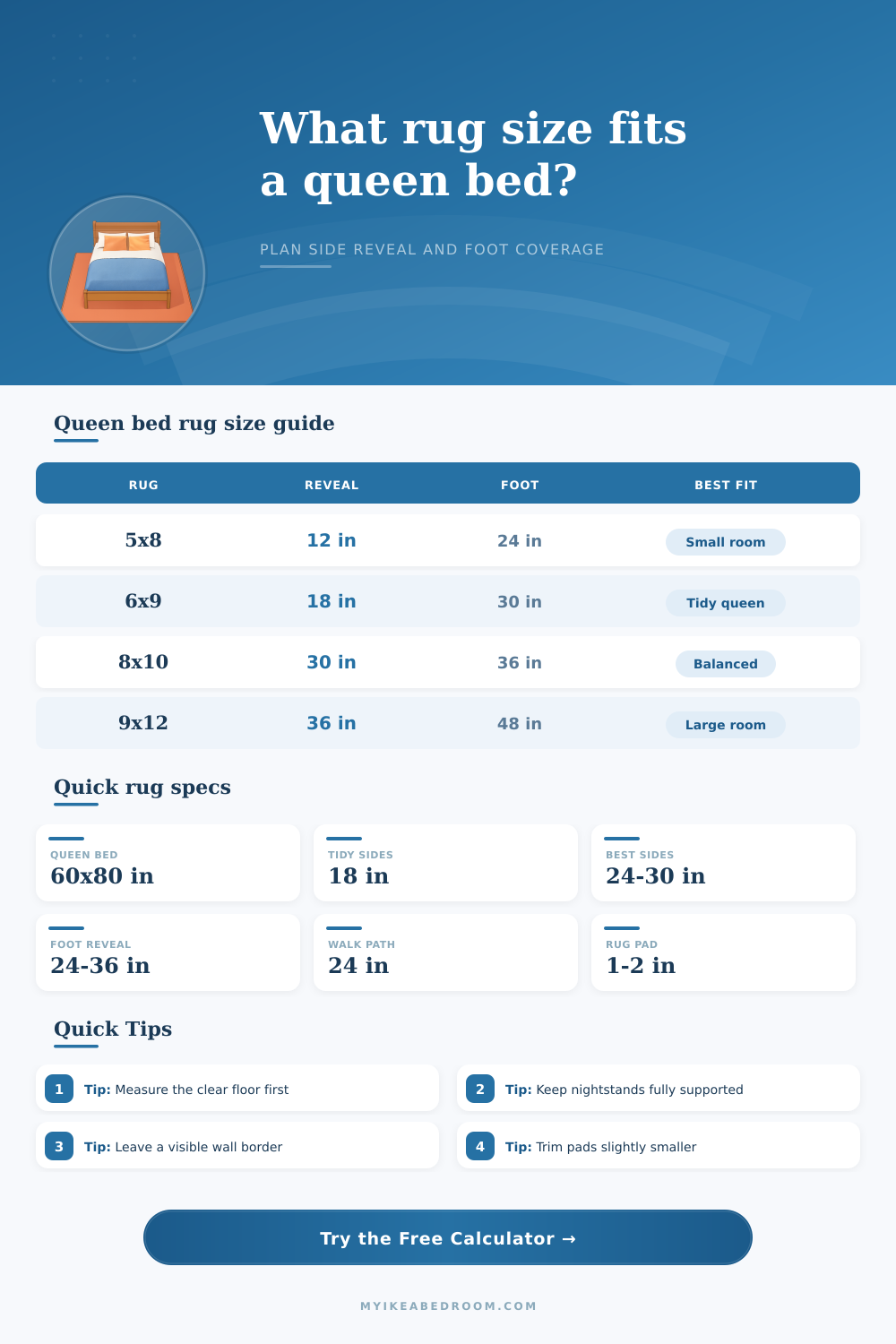
Match a queen bed to a practical rug size using room dimensions, bed placement, nightstands, bench depth, side reveal, foot reveal, wall borders, and rug pad trim.
Choose the bedroom layout closest to yours, then fine-tune the floor clearance, nightstand coverage, and reveal targets.
| Rug size | Area | Queen bed placement | Typical result |
|---|---|---|---|
| 4 x 6 ft | 24 sq ft | One side accent or very small floating foot rug | Not wide enough for a centered queen bed landing zone. |
| 5 x 8 ft | 40 sq ft | Lower bed only, little side reveal | Works in small bedrooms where a larger rug blocks door swings. |
| 6 x 9 ft | 54 sq ft | Lower two-thirds of a queen bed | Tidy side reveal with stronger foot coverage than 5 x 8. |
| 8 x 10 ft | 80 sq ft | Balanced queen bedroom layout | Usually gives 24 to 30 inches of rug on both sides. |
| 9 x 12 ft | 108 sq ft | Large queen room or full furniture grouping | Can support nightstands and a bench when the room has enough border. |
| 10 x 14 ft | 140 sq ft | Oversized suite layout | Only works when the room still keeps clear walking borders. |
| Target | Minimum | Comfort range | Use when |
|---|---|---|---|
| Side reveal | 12 in | 24 to 30 in | You want both feet to land on rug when getting out of bed. |
| Foot reveal | 18 in | 24 to 36 in | The foot of the bed faces open floor or a dresser wall. |
| Wall border | 8 in | 12 to 24 in | The rug should look intentional instead of wall-to-wall. |
| Foot walkway | 18 in | 24 to 36 in | You need clear circulation between bed, dresser, and door swing. |
| Placement style | Width logic | Length logic | Best for |
|---|---|---|---|
| Lower two-thirds | Bed width plus side reveal | Bed length minus head inset plus foot reveal | Most queen rooms and rugs from 6 x 9 to 8 x 10. |
| Full bed and nightstands | Bed, nightstands, and side reveal | Nightstand depth, bed length, and foot reveal | Large rooms where the rug anchors the whole bed wall. |
| Full bed only | Bed width plus side reveal | Bed length plus foot reveal | Clean layout where nightstands remain off the rug. |
| Side runners | Runner width beside each bed side | Bed length minus pillow zone | Narrow rooms where one large rug would crowd doors. |
| Floating foot rug | Bed width plus modest side reveal | Foot reveal and bench depth only | Rooms with limited clearance beside the bed. |
| Room setup | Clear room size | Likely rug | Why it fits |
|---|---|---|---|
| Small apartment bedroom | 10 x 11 ft | 5 x 8 or 6 x 9 | Keeps door swings and dresser paths from feeling crowded. |
| Standard queen room | 12 x 14 ft | 8 x 10 | Balances side reveal, foot reveal, and visible wall border. |
| Queen with bench | 13 x 15 ft | 8 x 10 or 9 x 12 | Extra length catches the bench legs without losing the walkway. |
| Large primary bedroom | 14 x 17 ft | 9 x 12 | Supports nightstands and a wider soft landing zone. |
| Narrow bed wall | 10 x 13 ft | Runners | Two runners preserve side comfort without forcing a wide rug. |
Protect the walkway. A smaller rug that preserves door clearance usually feels better than a large rug squeezed wall to wall.
Measure the full width. Add both nightstands before matching the standard rug size.
Add bench depth. The rug should catch the front legs while keeping foot traffic clear.
Trim inside the edge. A pad that is slightly smaller keeps the rug border from lifting.
Use clear floor dimensions. Subtract built-ins, radiator depth, and door-swing zones before trusting a large rug size.
Check the bed frame footprint. A thick upholstered frame can be several inches wider than a queen mattress.
Center the reveal. Uneven side exposure is more noticeable than a slightly shorter foot reveal.
Compare standard sizes. If two sizes work, choose the one that keeps the cleanest wall border.
Choosing an correct rug for a queen bed requires that you consider both the dimension of the queen bed and the dimensions of the surrounding floor space. The queen bed will occupy some amount of floor space within the bedroom, and the rug should accommodate not only the bed but also the item that surround the bed. These items may include nightstands, which the rug should support, as well as the walking path in the bedroom, which should remain clear from obstacles like rugs that are too large for the room.
If the rug is too small, the bedroom will feel unfinished. If, however, the rug is too large, the bedroom may begin to feel cramped. Rugs can serve a variety of functions within a queen bed bedroom.
How to Choose a Rug for a Queen Bed
Rugs can provide a soft surface for the feet of those who occupy the bed, as well as support the furniture within the bed. These functions, however, may not always align with one another. For instance, a rug that is too large may interfere with the swing of bedroom doors or dressers.
Additionally, a rug that is too small will cause the bed’s occupants to have their feet touch the cold bedroom floor when they exit the queen bed. A rug calculator is one tool that can assist those who are selecting a rug for there queen bed with determining the dimensions that the rug should reach. This calculator can take into account the dimensions of the bedroom, the bed, and the areas that the rug should reveal.
The placement of furniture in the bed can dictate the dimensions that the rug should have. For instance, if the occupant would like their nightstands to sit upon the rug, the rug must be wide enough to accommodate both the bed and the nightstands. Alternatively, if you will place a bed bench upon the rug at the foot of the queen bed, the rug must be long enough to accommodate the bed and the bench.
The placement of furniture within the bedroom may require the rug to have different dimensions than those that are required by another type of furniture layout. For example, a queen bed can be set up in a full bed layout or a lower two thirds layout. A full bed layout require more breathing room around the edges of the bed than a lower two thirds layout, which is often more suitable for rooms that are relatively tight and small in size.
The amount of floor that is left to be visible in a room once the rug is placed into the space is referred to as the reveal. The reveal can be measured at the foot of the bed or at the sides of the bed. The foot reveal is the amount of rug that extends past the foot of the mattress, while the side reveal is the amount of rug that extends past the sides of the mattress.
For instance, a side reveal of twelve inches is typically used to ensure that the rug is not too small in relation to the bed, but a side reveal of twenty four to thirty inches may be preferred for comfort when getting out of bed. A rug calculator can be used to determine a standard rug size that will fit within the room where the bed is located. Many people make mistakes when attempting to measure for a rug.
For instance, many people do not measure the correct dimensions of the bed. People may only measure the mattress, but the bed frame add to the width of a queen bed. Furthermore, people may measure the entire size of the room, but you must subtract the dimensions of any doors or radiators from the total room size.
Finally, people may not take into consideration any nightstands that may not sit on the rug if the queen bed is centered within the room. Rug pads are often necessary for ensuring that the rug remains within the floor space. A rug pad help to keep the rug in place within its area.
The rug pad should be cut to be slightly smaller than the rug to keep the rugs edge flat and even; otherwise, the rug may curl at the edges. The rug pad also helps to improve safety within the room by preventing the rug from shifting. Finally, people must decide what the rug must do within the room, and then select a rug based off the rugs dimensions to accomplish those task.