Anchor Pull-Out Load Calculator
Estimate the pull-out demand on wall restraints for dressers, wardrobes, and wall-hung bedroom storage using safety factor math and realistic load sharing.
📌Furniture Presets
⚖Load Inputs
Pull-Out Load Results
🧱Wall Fixing Screening Grid
Screening values are conservative working-load placeholders for comparison, not a replacement for the rating printed on the fastener package or the furniture instructions.
📊IKEA Bedroom Furniture Reference
| Furniture | Real product data used | Approx empty package weight | Wall restraint note |
|---|---|---|---|
| MALM 6-drawer dresser | 63 in wide, 19 in deep, 30 3/4 in high, 10.5 cu.ft storage, 10 5/8 in drawer pull-out | About 146 lb from three package weights | IKEA assembly warnings say the provided tip-over restraint should always be used. |
| HAUGA 6-drawer dresser | 54 3/8 in wide, 18 1/8 in deep, 33 1/8 in high, 7.6 cu.ft storage, 9 in drawer pull-out | About 133 lb from three package weights | IKEA lists included wall attachment hardware and requires restraint use. |
| BRIMNES 2-door wardrobe | 30 3/4 in wide, 19 5/8 in deep, 74 3/4 in high, rail holds about 20 shirts | About 144 lb from two package weights | IKEA says furniture with included restraints must be secured to the wall. |
| BRIMNES 3-door wardrobe | 46 in wide, 19 3/4 in deep, 74 3/4 in high, includes mirror door | About 191 lb from three package weights | IKEA notes the safety fitting is included for wall attachment. |
| PAX wardrobe frame | Common tall frames are 22 7/8 in deep and 79 1/4 or 93 1/8 in high | Varies strongly by width, doors, shelves, and drawers | IKEA advises wardrobes and closets should be attached to a wall. |
| BESTA wall-hung cabinet | 47 1/4 in wide frames use two suspension rails; shelf max load is commonly listed at 44 lb | Frame and contents vary by fronts, shelves, and drawers | IKEA states wall-hung capacity depends on wall material and brackets. |
🔧Anchor Rating Reference
| Wall or fixing category | Calculator working pull-out value | Safety factor target | Reference basis |
|---|---|---|---|
| Plastic drywall anchor, light duty | 25 lb per active restraint point | 4.0x | Low screening value for hollow drywall where pull-out is sensitive to board condition. |
| Self-drilling drywall anchor, rated flush load | 38 lb per active restraint point | 4.0x | Buildex notes some E-Z Ancor ratings are maximum project loads for flush-hung items, not additive per anchor. |
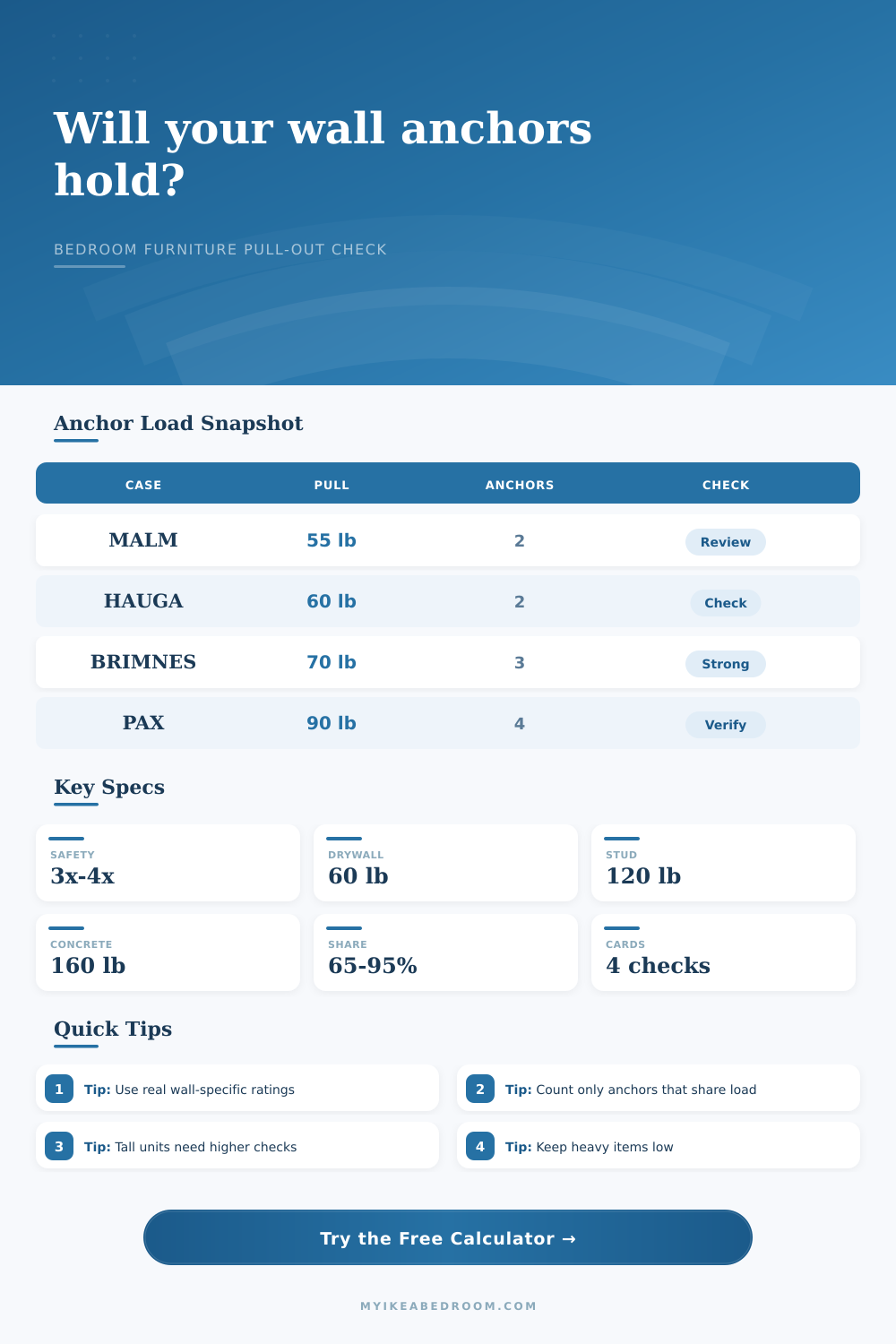
| Heavy hollow-wall toggle in drywall | 60 lb per active restraint point | 4.0x | TOGGLER lists high ultimate support in 1/2 in drywall and notes industry practice of using 1/4 of ultimate test load. |
| Screw into wood stud or blocking | 120 lb per active restraint point | 3.0x | Conservative screening value for a restraint tied into solid wood framing or blocking. |
| Sleeve or screw anchor in masonry | 140 lb per active restraint point | 3.0x | Conservative screening value for solid masonry with a rated mechanical anchor. |
| Concrete screw or expansion anchor | 160 lb per active restraint point | 3.0x | Conservative screening value; manufacturers publish much higher values for many concrete anchors when embedment is adequate. |
📐Lever Arm and Load Sharing Reference
| Check item | Typical bedroom value | Effect on pull-out | Calculator treatment |
|---|---|---|---|
| Low dresser pull height | 24 to 32 in | Creates moderate overturning moment | Moment equals outward pull multiplied by pull height. |
| Tall wardrobe pull height | 42 to 60 in | Creates larger overturning moment | Higher pull height increases total tension demand. |
| Two active anchors | Common dresser restraint pattern | Each point may not share perfectly | Uses an efficiency factor, then divides by effective anchors. |
| Three to four active anchors | Common rail or wardrobe pattern | Better distribution but still uneven | Applies a small sharing penalty above two anchors. |
| Center of gravity near wall | 35% to 45% of depth | Improves stabilizing moment | Credits only part of stabilizing weight for screening. |
| Center of gravity forward | 55% to 70% of depth | Raises restraint demand | Reduces stabilizing moment before safety factor math. |
📋Common Scenario Reference
| Scenario | Loaded weight assumption | Moment driver | Best use of result |
|---|---|---|---|
| Wide dresser with clothing | 190 to 260 lb | Drawer-front force around 24 to 32 in high | Check whether two restraints still meet the safety factor. |
| Tall wardrobe with hanging load | 220 to 330 lb | Higher pull point and tall restraint height | Compare stud, masonry, or toggle options by capacity margin. |
| Wall-hung cabinet | 90 to 180 lb | Load sits away from the wall face | Use the result as a demand check against rail/fixing ratings. |
| Forward-heavy drawers | Any dresser load | Center of gravity moves toward the front | Increase the center-of-gravity percentage and recalculate. |
💡Actionable Checks
So, here’s what you may think: I can hang a shelf with screws, so I can hang a wardrobe with those same screws. Wrong. Furniture doesn’t tip because of downward pressure. It tips because of leverage to rotate. If you yank a heavy drawer out or your kid jumps up on a dresser the furniture isn’t merely rising straight up; it’s rotating around its pivot point. The back digs into the ground, and the front lifts off the ground. That’s a lever arm that puts force onto the restraint in the wall.
Geometry is more valuable than pricey hardware. Load in your dimensions for the furnitures, and let the calculator do the math for you. No more guesswork about whether your anchors is good enough. But it’s not simply the weight of the wood that are the key input to the calculation. It’s how high off the ground that weight occurs, and how far out from the wall that weight is. A big wardrobe full of clothes, standing tall, has its center of gravity way out there from the pivot at the floor. That means it has a huge tipping force even if you only pull lightly on one of its drawers. Multiply that light outward pull on the drawer handle by the height and you have a tension load that no plastic drywall anchor can withstand.
How to Secure Your Furniture Safely
One common mistake people make is to assume their anchors are sharing the load evenly. They don’t. That’s why there isn’t perfect load sharing. The drywall around the screws crumble on the edges. The wood framing shifts. To account for this, the tool uses what’s called an efficiency factor. That is, it doesn’t assume that three anchors each carry a third of the load. It assumes one of the anchors will be the best aligned or the strongest and will bear more of the load. This is conservative, but keeps you safe.
If the calculation results in less than your target safety factor, don’t add another anchor to a crumbling wall! Alter how you fix the wall. Going from a hollow-wall toggle to a wood stud anchor drastically increases the capacity. You aren’t trying to add more of the same weak link. You’re looking for a strong link. On the page they lay it all out in the reference table and compare various wall materials and how much demand they can handle different than typical IKEA frames.
As you can see, concrete has a lot of capacity as long as you catch the solid core. Mounting into drywall over concrete block? Then you’re stuck with hollow wall conditions. It’s not so much about the surface itself but what’s behind it. Always know what’s behind the paint.
Another mistake I see often is failing to consider the load condition. An empty dresser is light and stable. A fully loaded dresser filled with toiletries, linens, and jeans is another matter entirely. Why does the calculator ask for the loaded weight? Because clothes add mass, sure, but more importantly, they change where that mass sits. Storing heavy items in the top drawers will raise center of gravity. This results in a longer lever arm. The restraint must do more work. Model the worst case. Assume that all drawer are full. Assume the child pulls the door open using both hands. Assume that the wall is no longer perfectly vertical.
Real world installations are messy so there are some safety factors. We want a 3x or 4x safety factor, which is to say the anchor should of hold three or four times as much as what we expect. This takes into account installation error, aging drywall, etc., and shock absorption. Don’t skimp on the margin. The margin is what makes it safe and secure, and what prevents disaster.
Don’t be intimidated if the directions tell you to do something different than what I’ve done. What I’m talking about here is the physics of a room. When you learn how leverage applies to furniture securing, you won’t have to guess anymore. You’ll know for sure, so that your furnitures doesn’t move when life gets crazy.