Air Purifier Room Size Calculator
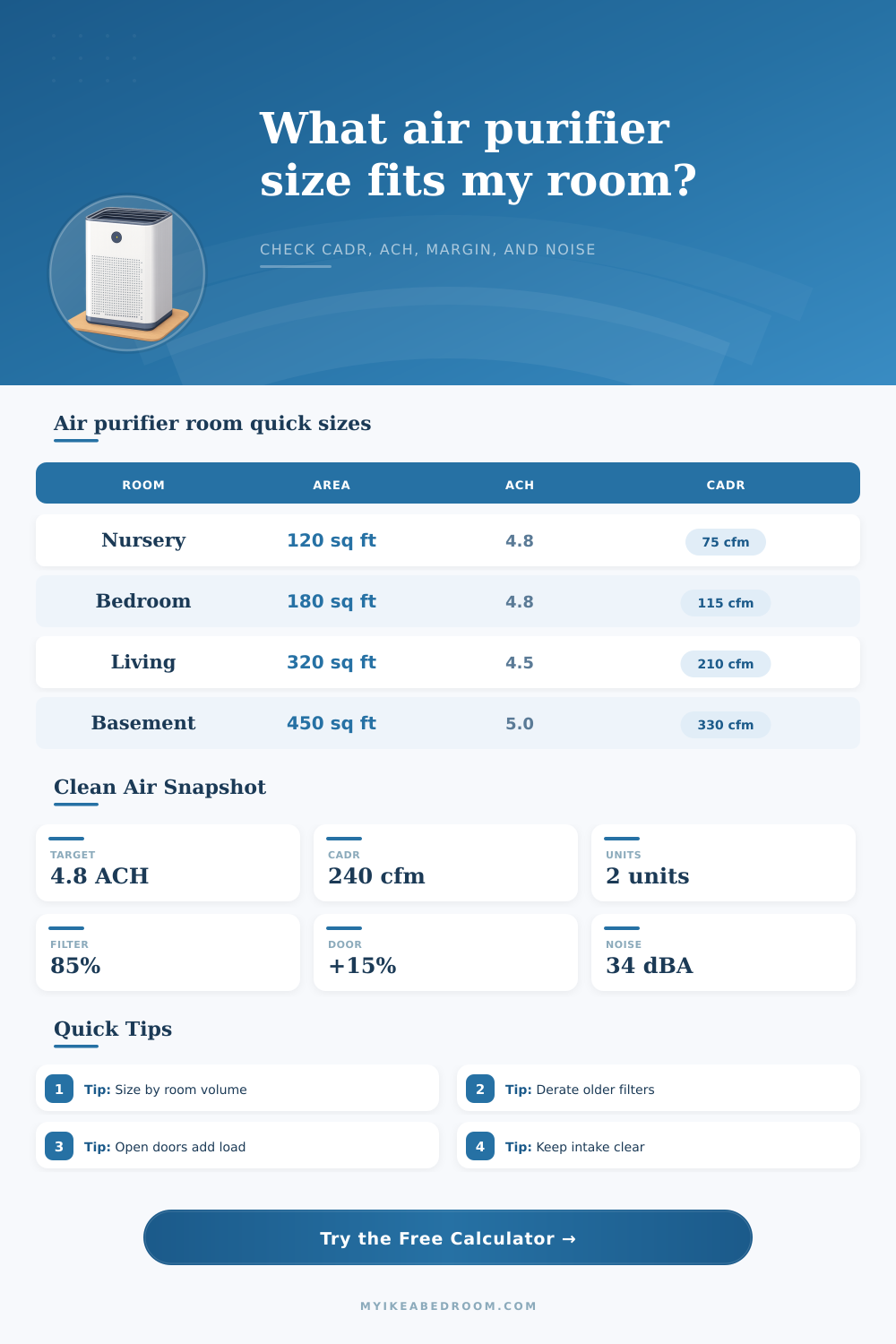
Estimate purifier CADR, target air changes per hour, effective coverage after filter derating, open doorway load, purifier count, and placement noise for one room.
Start with a realistic room scenario, then adjust dimensions, CADR, target ACH, filter condition, and doorway openness.
CADR and ACH breakdown
Enter values to calculate a purifier sizing result.
| Use case | Suggested ACH | Good for | Calculator note |
|---|---|---|---|
| Light background cleaning | 2 to 3 ACH | Low-traffic rooms with closed doors | Use when noise matters more than fast turnover |
| Everyday bedroom cleaning | 4 to 5 ACH | Sleeping spaces, offices, and compact rooms | A practical target for regular HEPA operation |
| Allergy or pet dust focus | 5 to 6 ACH | Pollen, dander, dust, and active rooms | Add filter derating if the purifier runs continuously |
| Smoke response room | 6 to 8 ACH | Fine particle events and short-term shelter rooms | Close doors and reduce open doorway factor when possible |
| Shared open zone | 4 to 6 ACH | Living areas connected to halls or kitchens | Doorway factor often drives the CADR requirement upward |
| Floor area | Room volume | 4 ACH CADR | 6 ACH CADR |
|---|---|---|---|
| 100 sq ft | 800 cu ft | 54 cfm | 80 cfm |
| 150 sq ft | 1,200 cu ft | 80 cfm | 120 cfm |
| 225 sq ft | 1,800 cu ft | 120 cfm | 180 cfm |
| 320 sq ft | 2,560 cu ft | 171 cfm | 256 cfm |
| 450 sq ft | 3,600 cu ft | 240 cfm | 360 cfm |
| Adjustment | Typical value | What it means | When to use it |
|---|---|---|---|
| Fresh filter | 100% | Rated airflow is mostly available | New filter, clean intake, clear exhaust |
| Typical used filter | 80% | CADR output is reduced in daily use | Normal maintenance cycle with some loading |
| Dusty filter | 70% | More resistance through the filter pack | Dusty rooms, pets, or delayed replacement |
| Open doorway | 20% | More air volume mixes with the room | Bedroom door open to hallway |
| Open-plan bleed | 50% | Cleaner air spreads beyond the measured room | Living rooms connected to kitchen or entry |
| Distance from listener | Approx change from 3 ft | Placement use | Airflow caution |
|---|---|---|---|
| 3 ft | 0 dB | Strong bedside cleaning | Keep outlet away from pillows and curtains |
| 5 ft | -4 dB | Bedroom dresser or office corner | Leave intake clearance on all sides |
| 6 ft | -6 dB | Balanced cleaning and noise | Avoid hiding the unit behind furniture |
| 8 ft | -9 dB | Living room side placement | May need more fan speed for circulation |
| 10 ft | -10 dB | Large room background cleaning | Watch for short-circuit airflow near doors |
Uses a higher demand factor because fine particles reward more frequent turnover and a tighter room boundary.
Works as the baseline for bedrooms, offices, basement rooms, and normal filter maintenance conditions.
Uses a slightly lighter factor when the room is closed and the goal is steady seasonal particle control.
Two smaller purifiers can improve mixing in long rooms when one large unit would sit too far from the listener.
When you purchase an air purifiers, it is possible that the air purifier dont effectively clean the air in the area in which it is used. Many individuals purchase an air purifier that are labeled as having a specific square footage that it can effectively clean. However, square footage is not a complete measurement of the amount of air that the air purifier will clean.
Square footage only measure the floor area of a room, not the three-dimension volume of the air within that room. Three dimensional measurements of the air in a room would include the height of the ceiling in that room. For instance, a room with ten foot-ceilings will contain more air than a room with eight foot ceilings, even if the square footage of the floor in each room is the same.
Choose the right air purifier and put it in the right place
Thus, you must account for the volume of air in the room that will be cleaned when purchasing an air purifier. To understand how an air purifier will effectively clean the air within a room, it is first important to understand the measurement of Air Changes per Hour (ACH). Air Changes per Hour measures the number of times that the air purifier will pass the entire volume of air within the room per hour.
If the air in the room contain high levels of particles to be removed, such as pollen or pet dander, it is important that the ACH is high. High ACH ratings mean that the air within the room will pass through the air purifier and filter at a rapidly rate. Thus, the particles will have less time to either settle into the carpet in the room or to be inhaled by the occupant of the room.
For rooms with low levels of particles in the air, however, low ACH ratings will be sufficient for cleaning the air in the room. Thus, there must be an ACH rating that is selected that meet the needs of the specific room that is to be cleaned. The next measurement of importance is the Clean Air Delivery Rate (CADR).
CADR is a measurement of the amount of air that the air purifier purifies and pushes into the room. The CADR ratings that is listed for air purifiers are obtained in the manufacturer’s laboratory when the air purifier has a new filter. However, over time, the filter will become loaded with the particles from the air that enters the air purifier.
Thus, the increase in resistance created by the loaded filter will reduce the CADR of the air purifier. This phenomenon is referred to as filter derating. Because air purifiers may experience filter derating, the CADR of an air purifier is not likely to be as high as the air purifier was when it had a new filter.
Thus, air purifier buyers should account for filter derating and purchase an air purifier with ACH ratings that will still meet the needs of the room even after the filter is derated. In addition to the CADR and the ACH ratings of the air purifier, the placement of the doors in the room can also impact how well the air purifier cleans the air in the room. If the doors in the room are kept closed, the air purifier will work to clean only the air within that room.
However, if the doors are left open, the air purifier will attempt to clean the air in any connected hallways or kitchens. This movement of air outside of the room that is being cleaned is referred to as air bleed. Air bleed increases the amount of air that the air purifier must clean.
Thus, if the air purifier does not appear to be effectively cleaning the air in a room in which it is located, it may be necessary to close the doors in the room. Another factor to consider is the placement of the air purifier within the room itself. It is common for air purifiers to be placed in the corners of the room or in areas behind furniture.
Air purifiers, however, should not be placed in corners of the room. Placing the air purifier in a corner of the room may block the air intake or exhaust of the air purifier. For the air purifier to effectively clean the air in the room, it must have clear access to both air intake and exhaust in order to create a circular movement of the air within the room.
Should the intake of the air purifier be blocked, the motor will have to work harder to move the air, resulting in a louder air purifier that does not increase the amount of air that the air purifier cleans. Air purifiers also create noise, and the amount of noise that they make is related to the CADR of the air purifier. Air purifiers that require high CADR ratings require fans that move at high speeds in order to move the amount of air necessary.
High speeds in the fans lead to the creation of more noise by the air purifier. To reduce the amount of noise that the air purifier makes, individuals can move the air purifier further away from their head. As the distance from the air purifier decreases, the amount of noise that is heard by individuals increases; thus, moving the air purifier further away from the listener will reduce the amount of noise that the air purifier creates.
The air purifier, however, should not be moved further away from the individual if that would result in the air purifier creating dead zone in the area. Additionally, if the room that is to be cleaned is long and narrow, it may be more effective to use two smaller air purifiers instead of one larger air purifier. Each of the two smaller air purifiers will be able to more evenly distribute the amount of air that is to be cleaned within each portion of the long and narrow room.
Furthermore, using two smaller air purifiers will result in lower noise levels than would be created by the larger air purifier that is running at high speeds to effectively move the amount of air necessary to clean the long and narrow room. Its also important to remember that air purifiers can be a great addition to any moddern home. You should of checked the room size first.
Most people find that a larger unit works better then a small one, and they can recieve better results. Air purifiers can helps you breathe easier and dont have to be expensive. If you want to feel comfortabley in your space, look at the furnitures size too.