Bedroom panel planning, reflection control, corner trapping, and ceiling cloud sizing
Acoustic Treatment Calculator
Estimate how many broadband panels, cloud modules, and corner traps a bedroom or compact listening room needs by matching room size, listening position, treatment goal, panel depth, absorber type, and available reflective surface.
These presets are all clickable and topic-specific. Each one fills the form, keeps the results below the input block, and recalculates a different bedroom or media-room treatment strategy.
The calculator keeps all results in the next section below this form, never beside it, so the inputs and outputs stay in separate rows on desktop and mobile.
Plan breakdown
Use the current room size with these material personalities to judge whether you want cleaner mids, more broadband density, or a lighter decorative treatment footprint.
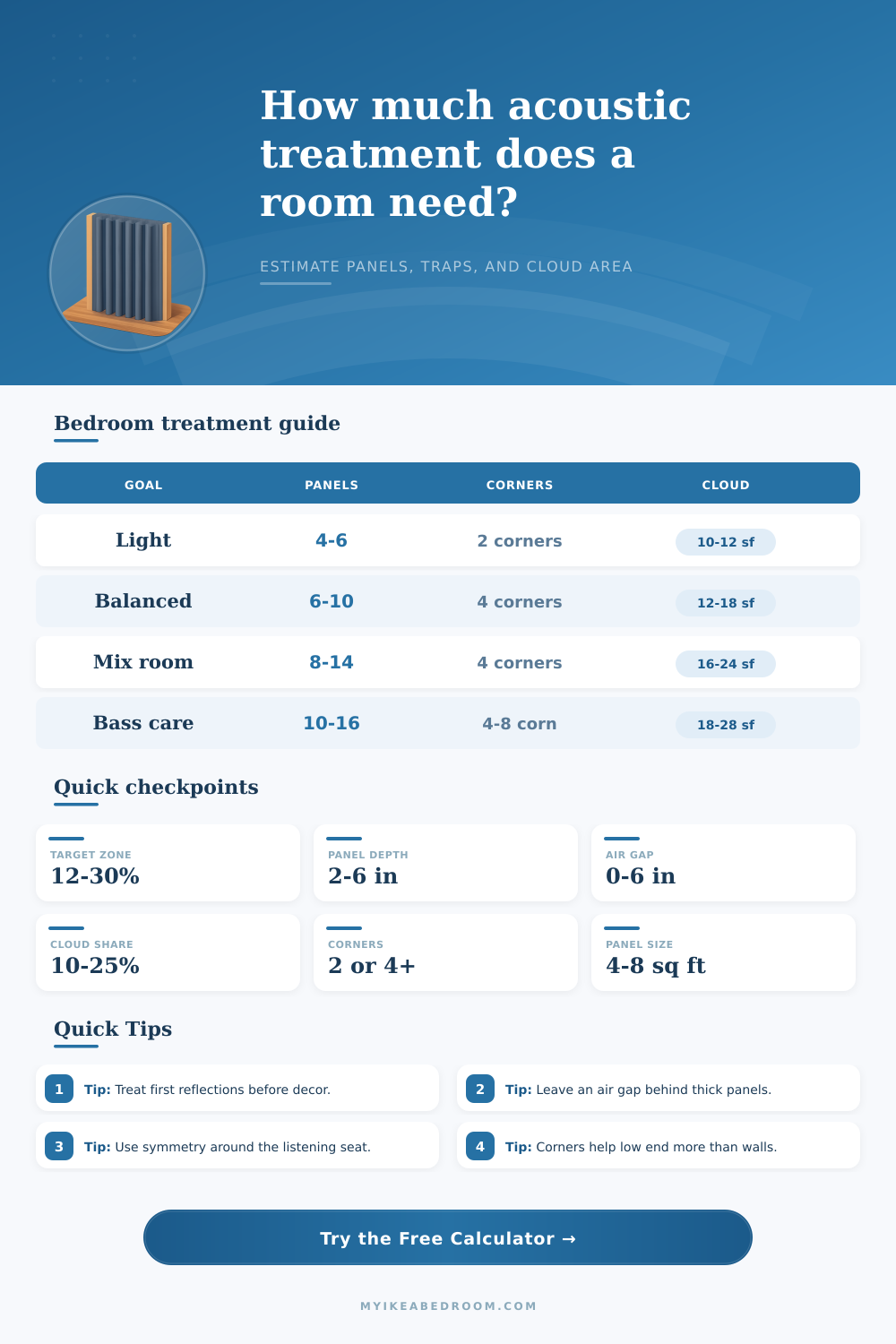
This grid recalculates the same room across four plan intensities so you can see how a light comfort setup differs from a mix-focused or bass-forward arrangement.
| Module | Face Area | Panels for 32 sq ft | Best Fit |
|---|---|---|---|
| 2 x 2 ft tile | 4 sq ft | 8 panels | Tight walls and compact cloud arrays |
| 2 x 3 ft portrait | 6 sq ft | 6 panels | Bed walls, narrow side walls, and doorside symmetry |
| 2 x 4 ft standard | 8 sq ft | 4 panels | Main side walls, rear wall pairs, and ceiling clouds |
| 600 x 1200 mm | 7.75 sq ft | 5 panels | Metric-friendly modular arrays and framed wool builds |
| Depth | Typical Gap | Strongest Band | Use Case |
|---|---|---|---|
| 2 in | 0-2 in | 250 Hz and up | Speech clarity, TV reflections, and flutter echo control |
| 3 in | 2 in | 200 Hz and up | Good middle ground for bedrooms with one desk wall |
| 4 in | 2-4 in | 160 Hz and up | Broadband listening rooms that still look residential |
| 6 in | 4-6 in | 125 Hz and up | Small studios, loft gaming rooms, and bass-heavy setups |
| Goal | Target Share | Wall Focus | Corner Priority |
|---|---|---|---|
| Light comfort control | 12% | Front half and first reflections | Low, usually one pair |
| Balanced listening | 18% | Side walls, cloud, and rear wall splash | Moderate four-corner start |
| Focused mix accuracy | 24% | Symmetry around the listening seat | Front corners first, then rear corners |
| Low-end heavy cleanup | 30% | Front wall, cloud, and thick rear-wall coverage | Highest priority for all usable corners |
| Layout | Area | Starter Panels | Trap Note |
|---|---|---|---|
| 10 x 11 desk room | 110 sq ft | 6 to 8 | Two front corners cover most bass gains |
| 12 x 14 bedroom | 168 sq ft | 8 to 10 | Use four corners if wardrobes do not block them |
| 13 x 16 suite wall | 208 sq ft | 10 to 12 | Add a wider cloud before doubling the rear wall |
| 14 x 18 loft | 252 sq ft | 12 to 16 | High ceilings reward deeper traps and larger clouds |
Acoustic treatment are used to control how sound act within a specific room. Acoustic treatment is necessary in bedrooms due to the standing of the walls and how sound often reflect off of these surfaces. These reflections of sound create echo that interfere with the original sound that emanates from the bedrooms sounds creating the sound within the bedroom to becomes muddled and lack clarity.
By utilizing acoustic panel, acoustic corner traps, and ceiling clouds within the bedroom, the bedroom can absorb the reflections of sound. The application of acoustic treatment to a bedroom should take into account the dimensions of the bedroom and the activities that occurs within the bedroom. For instance, acoustic treatment for a bedroom that contains a desk may be different than acoustic treatment for a bedroom that also contains a television.
Make Your Bedroom Sound Better
Small rooms often reflect sound in certain mode that impact individuals who play guitars or those who perform other mixing sounds within the bedroom. These same types of reflections occur within the corners of the bedroom. By treating the rooms for sound reflection, the bedroom can absorb certain sound paths.
However, care must be taken not to apply too much acoustic treatment to the bedroom. To determine the amount of acoustic treatment that is required for the bedroom, it is important to measure the length, the width, and the ceiling height of the bedroom. The surface area of the bedroom will indicate the amount of acoustic panels that are required for the bedroom.
The larger the bedroom, the more acoustic panels that will be required relative to the small room in which the sleeper rests. The listening position within the bedroom will also impact the placement of acoustic panels. For instance, if an individual utilizes a corner desk within the bedroom, bass trap will be required in the front of the bedroom.
In contrast, if the sleeper places their sleeping position in the center of the bedroom, acoustic panels will be required on each of the side wall of the bedroom. Finally, the goal for the treatment of the bedroom will also impact the amount of acoustic treatment that is applied to the bedroom. Individuals that utilize the bedroom for television viewing will require less acoustic treatment relative to those that use the bedroom to perform professional mixing of audio files.
Professional mixing require that approximately 24 percent of the surfaces within the bedroom are treated with acoustic treatment. Casual viewing of television media, however, may only require 12 percent of the treatment of the bedrooms surfaces. Acoustic panels comes in different sizes and thicknesses.
The size and thickness of the acoustic panels will impact the way that the acoustic panels absorb sound within the bedroom. 2-by-4-foot panels may be used for large portions of the bedroom. 2-by-2-foot tiles may be used in small portions of the bedroom.
Additionally, the thickness of the acoustic panel and the gap in the wall behind the acoustic panel will impact the way that the acoustic panel reflect sound. For example, a 4-inch thick panel with 2-inch gap behind the panel will reflect different frequency than a thin panel that does not contain such a gap. The material of the acoustic panel may also be an issue.
For instance, mineral wool panels will reflect more sound than acoustic panels made of foam. However, foam panels reflect high frequency rather than the mid and low frequencies that mineral wool reflects. Finally, it is important to consider the rooms that are difficult to treat within the bedroom.
For instance, windows and closets often reflect sound naturaly and may be difficult to treat in the same way as the remainder of the walls in the bedroom. Many rooms are not constructed in shapes that allow for even treatment of sound throughout the bedroom. Some rooms may also contain obstacles within the bedroom that prevent the installation of acoustic treatment in certain areas.
For instance, if a closet blocks one corner of the bedroom, you should apply acoustic treatment to the walls instead of the closet and corner. Symmetry in sound reflection within the bedroom is another issue to address when installing acoustic treatment. One common mistake is to focus on treating the bass reflections in the corners of the bedroom before treating the side walls.
Reflections within the side walls will lead to the smearing of the mid-range frequencies of music that is played within the bedroom. Additionally, it is also common for individuals to ignore the ceiling of the bedroom. If the ceiling is not treated for sound reflection, it may also create flutterly echoes within the bedroom.
When treating the bedroom with acoustic treatment, acoustic panels should be mounted at ear height to catch the first reflections of sound within the bedroom. A gap should be left between the acoustic panel and the wall. This gap allows the acoustic panels to reflect lower frequencies of sounds within the bedroom.
Bass traps should be placed in the corners of the room. Finally, ceiling clouds should be suspended from the ceiling with wires. Once the acoustic treatment has been installed in the bedroom, you can test the bedroom to determine if the acoustic treatment is working.
Various mobile application are available that will treat the bedroom with a sine wave signal to test whether the acoustic treatment is effective. If the bass within the bedroom sounds tight and the sound imaging of the speakers within the bedroom is clear, then the acoustic treatment has been successful. Overall, acoustic treatment can transform a bedroom from a space with echoes to one that is treated to allow individuals to listen to music or view media within the bedroom.