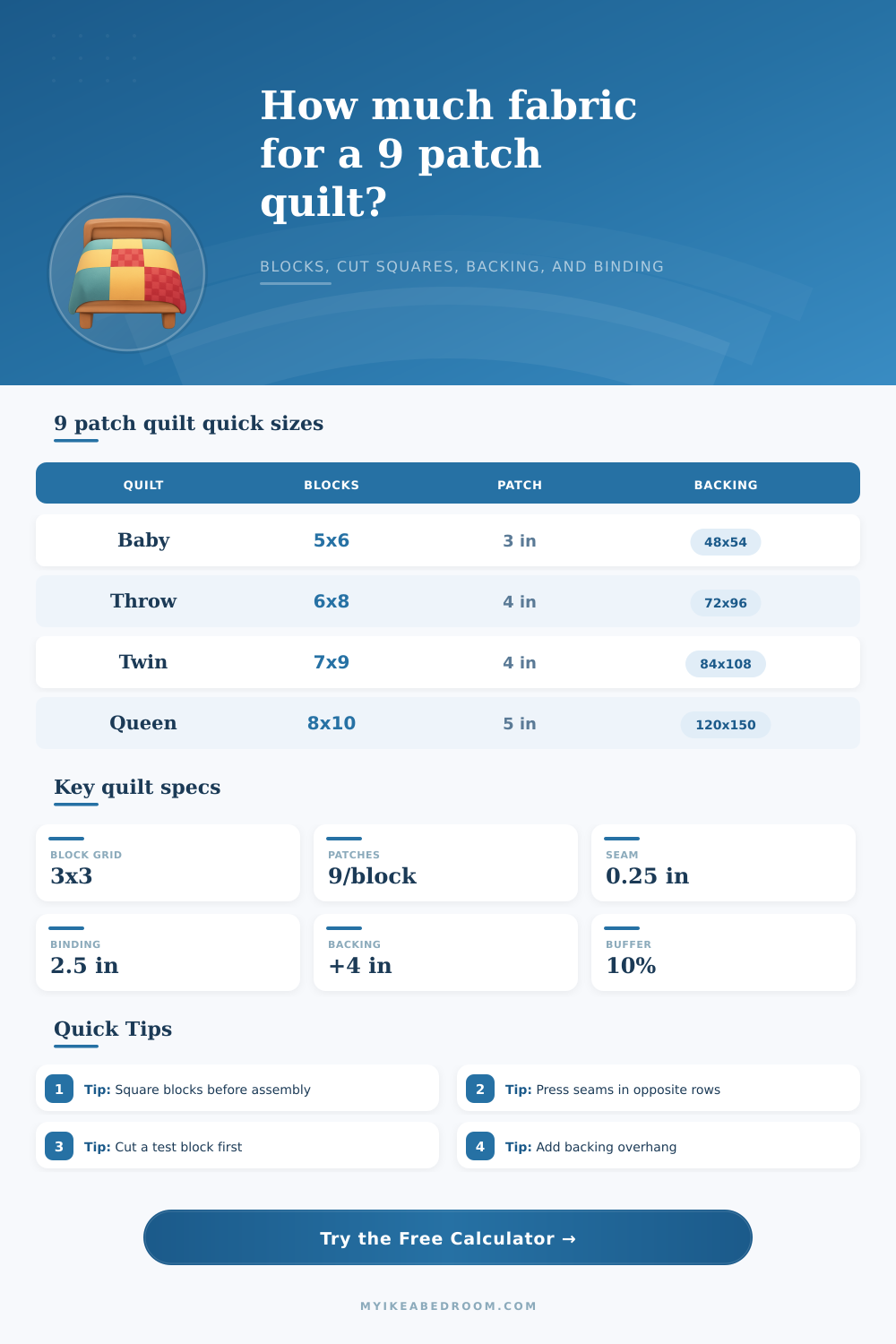
9 Patch Quilt Calculator
Plan a traditional 3 by 3 nine patch quilt from finished quilt size, block rows and columns, seam allowance, borders, sashing, backing overhang, binding width, and fabric balance.
Choose a familiar quilt size, then adjust blocks, borders, and color placement to match your bedroom or gift project.
| Finished block | Finished patch | Cut patch with 1/4 in seam | Best use |
|---|---|---|---|
| 6 in block | 2 in | 2 1/2 in square | Mini quilts, borders, pillow panels |
| 9 in block | 3 in | 3 1/2 in square | Baby quilts, small throws, charm-friendly layouts |
| 12 in block | 4 in | 4 1/2 in square | Throws, twin quilts, fast bedroom projects |
| 15 in block | 5 in | 5 1/2 in square | Queen and king quilts with fewer seams |
| 18 in block | 6 in | 6 1/2 in square | Large graphic quilts and quick bed covers |
| Quilt type | Finished size | Sample grid | Patch note |
|---|---|---|---|
| Baby | 36 by 45 in | 4 by 5 blocks | 9 in finished blocks keep cutting simple. |
| Throw | 60 by 72 in | 5 by 6 blocks | 12 in finished blocks create a balanced sofa throw. |
| Twin | 70 by 90 in | 6 by 8 blocks | Borders or sashing help tune bed coverage. |
| Queen | 90 by 108 in | 7 by 9 blocks | Larger patches reduce small-piece count. |
| King | 108 by 108 in | 8 by 8 blocks | Square layouts suit medallion or chain effects. |
| Fabric role | Calculator use | Yardage method | Planning caution |
|---|---|---|---|
| Dark or main | Corner and center patches in classic blocks | Patch count times cut patch area | Directional prints need extra for orientation. |
| Light or background | Side patches and alternating block space | Patch count times cut patch area | Low-volume fabric can show seam shadows. |
| Accent | Center squares, chain links, or scrappy focus | Accent count times cut patch area | Small accents disappear if contrast is too low. |
| Sashing | Finished strips between blocks | Total strip length times cut strip width | Cut strips straight so rows do not wave. |
| Border | Outer frame around patchwork field | Perimeter strips with piecing allowance | Measure quilt center before cutting borders. |
| Binding | Finished edge around the quilt | Perimeter plus join allowance divided into WOF strips | Round up strip count before yardage. |
5 dark / 4 light per block.
Best for a clear checker rhythm with one dominant fabric.
4 dark / 5 light per block.
Best when the background fabric should read larger.
1 accent square per block.
Best for fussy-cut centers, memory fabric, or feature prints.
Alternating chain and plain blocks.
Best for diagonal movement across a bedroom quilt.
Cutting tip: If the calculator shows rectangular patches, adjust rows, columns, borders, or sashing until the finished patch width and height are close enough for your design.
Yardage tip: The fabric estimates use area math plus your buffer. Add more buffer for directional prints, fussy cutting, prewashing shrinkage, or very scrappy fabric pulls.
The nine patch quilt gets its name from the mathematical structures located at the center of the quilt. A nine patch quilt block consist of nine individual squares that are arranged in a three-by-three grid. This mathematical arrangement of the nine squares allow a person to calculate the size of each patch before any cutting of the fabric.
Beyond the nine patch blocks, a finished quilt also include fabric for the borders, sashing, and binding of the quilt top. Once a finished size for the quilt is determined, the size of each patch can be calculated, the total number of patches can be determined, and the total amount of fabric that is require for the quilt can be calculated. The calculator will provide mathematical results for each of these calculations once the user enters the dimensions of the finished quilt, the number of blocks, the seam allowance, and the dimensions of the borders and sashing into the calculator.
How to Calculate Fabric for a Nine Patch Quilt
Each of these variables impact the other variables. For instance, if the size of the finished border is increased, the size of the nine patch area will decrease. If the size of the sashing are increased, the length of the strips of fabric will need to be increased to provide those borders.
If the size of the seam allowance is changed, the size of each patch that is to be cut from the fabric will change. In addition to the mathematical calculations for the fabric requirement for the quilt top, another consideration regarding the quilt is the fabric that will be used for the quilt’s backing and batting. Additionally, the calculator also will calculate binding for the quilt.
The calculator will determine the amount of fabric for the backing of the quilt by adding an overhang to each side of the finished quilt. An overhang are required for both longarm and home machine quilters. The binding for the quilt will also be calculated by the calculator, as well.
The quilter will divide the total length of the binding into strips of the width that the quilter chooses, and the calculator will report the total number of strips and yardage of binding. A common mistake can be made when calculating the amount of fabric to purchase for a quilt top with a nine patch design. For example, one common mistake is to use the size of the finished patch rather than the size of the patch that will need to be cut from the fabric.
The calculator will display both of these sizes next to one another. Additionally, it is common for a person to forget that the size of borders and sashing are measured in their finished size, but that the allowance for the sewing of the patches must be added only when cutting the strips of fabric. Tables of the sizes of the patches that are to be created will be provided, as well, so that each patch can be easily referenced according to existing quilting pattern.
Due to the potential for the fabric to behave in unexpected manners, the actual quilt that is created may not match the calculation of the amount of fabric that was required. For instance, pressing the quilt may stretch the fabric. Additionally, the quilt may shift during the sewing process.
In order to avoid error, it is always possible to sew a single test patch of the size that the calculator calculates. Any error in the size of the patch can be corrected before cutting the fabric for the quilt. There are a variety of different quilting layouts that is used within the nine patch quilt.
The quilter can choose each of these layouts within the calculator. For instance, each patch does not need to be of the same fabric. Each of the patches could be a different fabric altogether.
Additionally, an accent fabric can be chosen for one patch within the nine patch quilt block. An Irish chain layout is one alternative for the nine patch blocks, as are a variety of others. The layout alternative calculator will adjust the number of patches of each color to reflect the alternative layout that is chosen, and will calculate how many patches of each color will be require.
Another variable to consider is the fabric that will be used for the backing and batting of the quilt top. The calculator can also calculate the amount of this fabric that will be required. The calculator will add an overhang of the width of the quilt top to each side of the quilt top.
The overhang will allow both longarm and home machine quilters to secure the edges of the quilt while it is being quilted. Additionally, binding will be required for the edge of the quilt. The calculator will calculate this binding and report it to the user.
The length of the binding will be divided into strips of a certain width, which the quilter will choose. The calculator will report the total yardage and number of strips of batting to the user. The nine patch quilt pattern is popular due to its relative simplicity.
Each patch can be of the same fabric, two different fabrics can be used to create a checkerboard, or various scraps of fabric can be used to create an improvisational quilt. Each of these quilting alternatives will result in the same mathematical structure of the nine patch quilt. Once a quilter understand the relationship between the size of the finished patches, the number of patches of each color, and the seam allowance, the quilter is able to create an accurate plan for the quilt that will be sold.
The numbers that the calculator provides will allow the quilter to fully decide the appearance of the quilt that will be created.