🪵 Wood Moisture Content Calculator
Calculate moisture content %, convert between methods, and assess wood dryness for any application
| Wood Species | Correction Factor | Fiber Saturation Pt. | Green MC Range | Shrinkage (radial %) |
|---|---|---|---|---|
| Douglas Fir | 0.0 (baseline) | 28% | 37–115% | 4.8% |
| Red Oak | +0.7% | 28% | 69–80% | 4.0% |
| White Oak | +0.5% | 28% | 64–78% | 5.6% |
| Hard Maple | +0.9% | 28% | 58–70% | 4.8% |
| Southern Yellow Pine | -0.5% | 28% | 98–166% | 5.4% |
| Black Walnut | +0.6% | 28% | 73–90% | 5.5% |
| Western Red Cedar | -1.0% | 27% | 58–249% | 2.4% |
| Birch | +1.0% | 29% | 72–89% | 6.3% |
| American Cherry | +0.4% | 28% | 58–74% | 3.7% |
| Teak | -0.3% | 24% | 40–67% | 2.5% |
| White Ash | +0.8% | 28% | 46–52% | 4.9% |
| Sitka Spruce | -0.4% | 28% | 41–142% | 4.3% |
| Relative Humidity | 50°F (10°C) EMC | 70°F (21°C) EMC | 90°F (32°C) EMC | Typical Environment |
|---|---|---|---|---|
| 20% RH | 4.6% | 4.5% | 4.4% | Arid desert interior |
| 30% RH | 6.2% | 6.0% | 5.8% | Dry heated home (winter) |
| 40% RH | 7.8% | 7.5% | 7.3% | Average heated home |
| 50% RH | 9.4% | 9.0% | 8.7% | Typical indoor space |
| 60% RH | 11.3% | 10.8% | 10.4% | Coastal / humid interior |
| 70% RH | 13.5% | 13.0% | 12.4% | Unconditioned space |
| 80% RH | 16.5% | 15.8% | 15.1% | Unheated garage/shed |
| 90% RH | 21.0% | 20.1% | 19.2% | Near decay threshold |
| Board Thickness | Softwoods (months) | Hardwoods (months) | Density (low/high) |
|---|---|---|---|
| 3/4 in (19mm) | 1–3 | 3–6 | Low density dries faster |
| 1 in (25mm) | 2–4 | 4–8 | Rule: 1 yr per inch (hardwood) |
| 1.5 in (38mm) | 3–6 | 6–12 | Stack & sticker properly |
| 2 in (51mm) | 4–8 | 10–18 | Good airflow critical |
| 3 in (76mm) | 6–12 | 18–30 | End-seal to prevent checking |
| 4 in (102mm) | 8–18 | 24–48 | Consider kiln drying instead |
The moisture content of wood consists simply in the amount of water that finds itself in a piece of wood. One defines it as the mass of that water in the wood, divided by the mass of the wood itself. Some species of trees, just after cutting, truly can have more water by weight than the fibers of the wood.
Because of that the moisture content can pass 100 percent.
How Moisture Affects Wood
wood is a moisture-absorbing material. It absorbs and releases steam of water from the surrounding air. Therefore, its moisture content always changes according to the nearby climate.
In dry surroundings wet wood shrinks, while dry wood expnads in humidity. This process never stops, regardless of the age of the wood piece.
Eventually wood arrives to a state called balanced moisture content, where it stops winning or losing water. Imagine it like a wet shirt left outside. In a dry region like Arizona, it dries quickly.
In a humid area like the Pacific Northwest during winter, it stays somewhat damp, as long as won leaves it there. Similarly happens with wood used for ships. Wood stored outside usually has around 10 to 12 percent of moisture content.
In United Kingdom the outdoor balanced moisture content never drops below 12 percent during summer and reaches almost 20 percent in winter because of the wet surroundings.
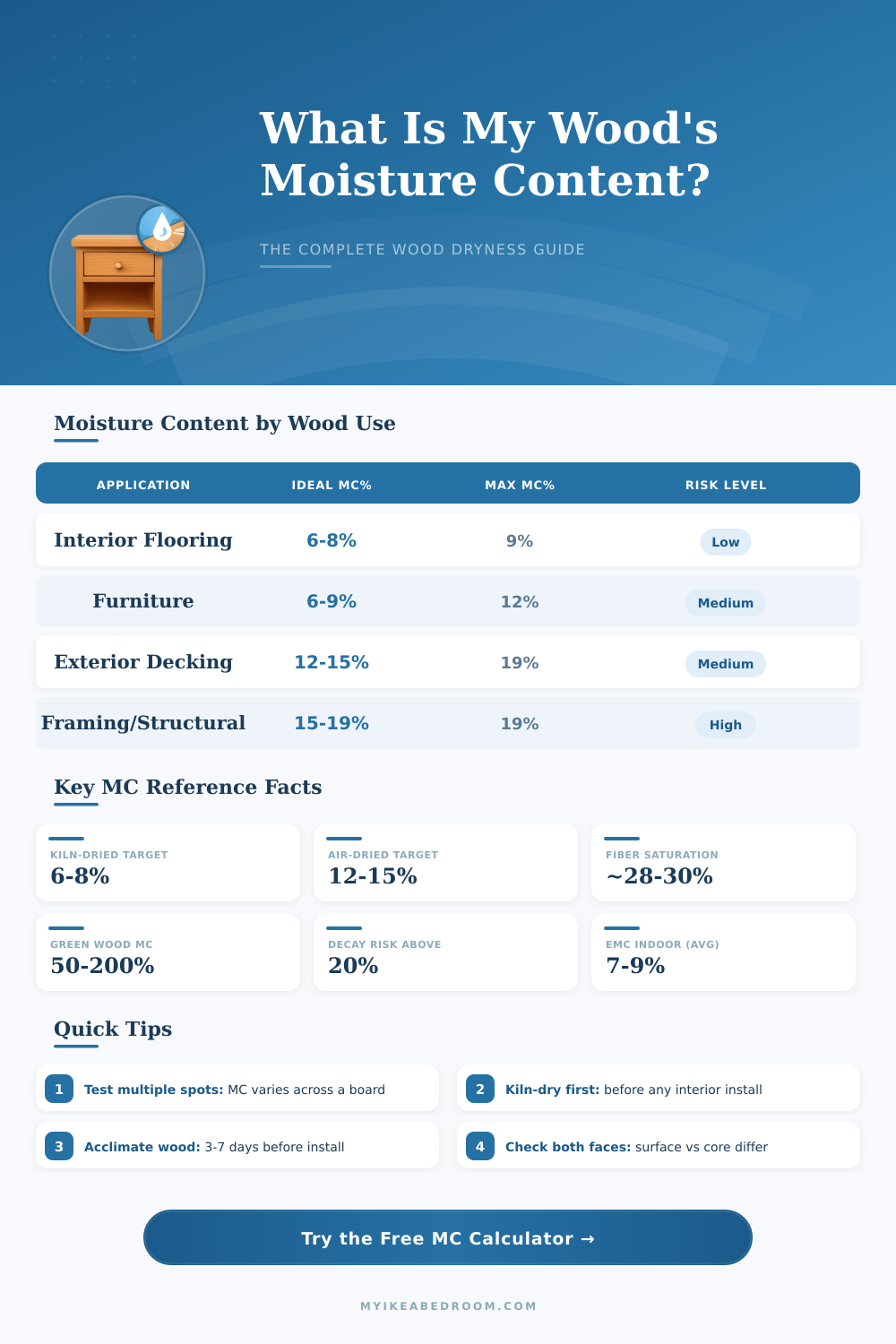
For buildings one requires wood kiln- or air-dried to about 19 percent of moisture. Kiln-dried wood for ships usually arrives at 18 to 19 percent. Wood at 15 percent of moisture counts as dry for use in practical builds.
Even so for furniture and inside work you need much lower levels, around 6 to 8 percent. In those ranges wood stays stable in size, so parts keep their form and tables stay flat.
Why is this so important? If the moisture content changes, wood can warp, bend and split. Too high humidity or frequent changes in the air can cause real damage over time.
Changes in humidity up and down cause swelling and shrinking. When wood did not balance before it becomes part of an object, the bits shrink, tables twist and cracks appear. Wood can require years to dry itself right before one uses it.
Recently cut green wood feels heavier because of its high moisture. For sale green wood must have proof of moisture content under 20 percent. Devices for moisture are handy tools for checking the levels.
They work by rating the electrical resistance in wood and using that to guess the moisture. Handy is checking wood already in your house, for instance trim or frame of door, tostrip the local balanced value.
Humidity also works on the strength. Wood with too much water tends to be wet and weaker than well dried wood. Green wood is more flexible, but one prefers dried because shrinking after building can cause warp.