🪵 Wood Expansion Calculator
Calculate exactly how much your wood will expand or contract with changes in moisture content
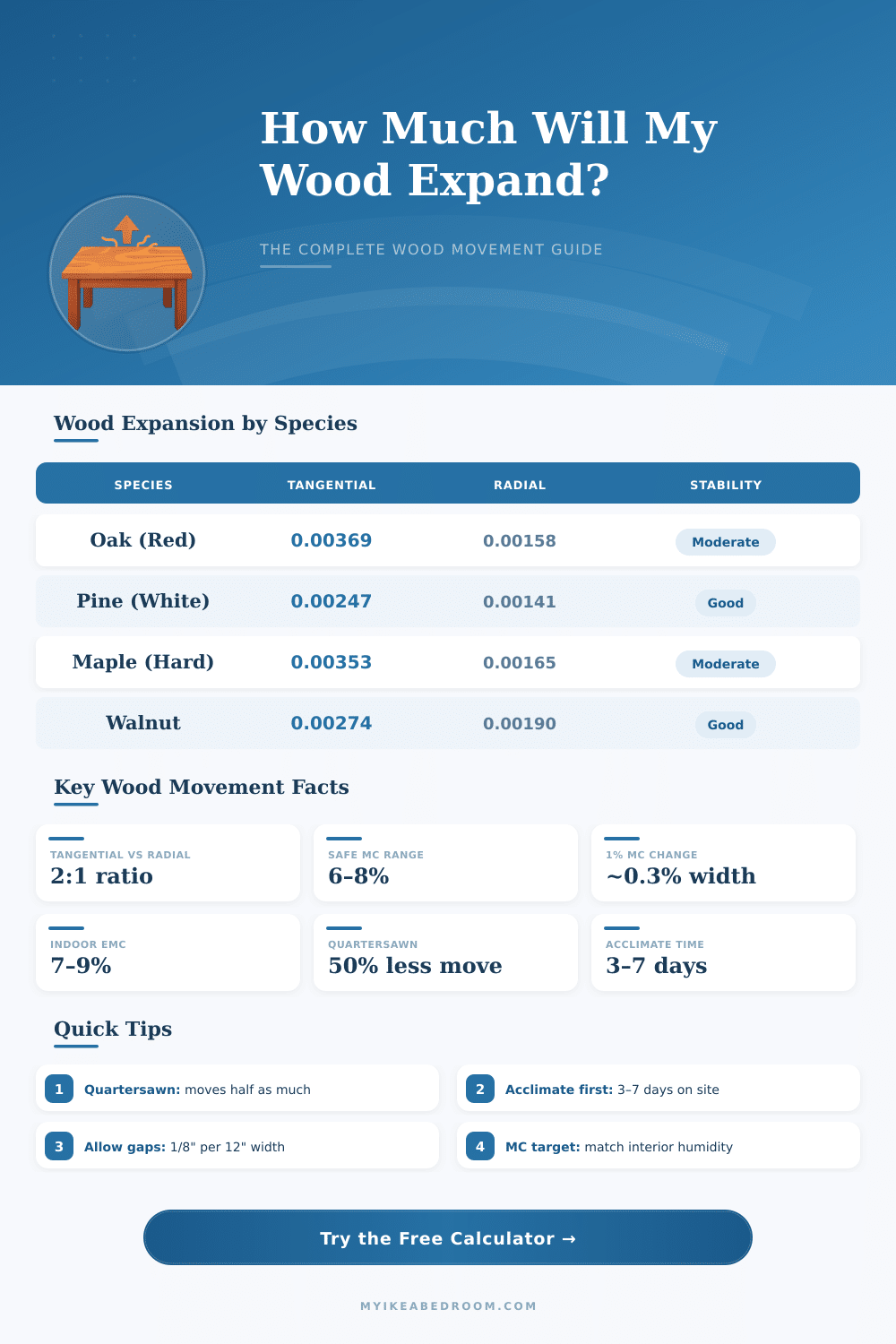
Coefficients represent fractional change in dimension per 1% change in moisture content (in/in/% MC or mm/mm/% MC)
| Species | Tangential (T) | Radial (R) | T/R Ratio | Movement Class |
|---|---|---|---|---|
| Red Oak | 0.00369 | 0.00158 | 2.34 | Large |
| White Oak | 0.00365 | 0.00178 | 2.05 | Large |
| Hard Maple | 0.00353 | 0.00165 | 2.14 | Large |
| Black Walnut | 0.00274 | 0.00190 | 1.44 | Medium |
| American Cherry | 0.00281 | 0.00150 | 1.87 | Medium |
| White Pine | 0.00247 | 0.00141 | 1.75 | Small |
| Yellow Pine | 0.00329 | 0.00192 | 1.71 | Large |
| Douglas Fir | 0.00292 | 0.00166 | 1.76 | Medium |
| White Ash | 0.00369 | 0.00181 | 2.04 | Large |
| Western Red Cedar | 0.00234 | 0.00108 | 2.17 | Small |
| Teak | 0.00252 | 0.00143 | 1.76 | Small |
| Yellow Birch | 0.00351 | 0.00219 | 1.60 | Large |
| Location / Use | Avg MC (%) | MC Range (%) | RH Range (%) |
|---|---|---|---|
| Interior — Dry climate (desert) | 6 | 4–8 | 25–35 |
| Interior — Normal climate | 8 | 6–11 | 35–55 |
| Interior — Humid climate | 11 | 8–14 | 55–70 |
| Covered exterior (porch, carport) | 12 | 9–14 | 55–70 |
| Exposed exterior (deck, siding) | 15 | 12–19 | 65–85 |
| Kiln-dried lumber (fresh from kiln) | 7 | 6–9 | 30–45 |
| Green / freshly cut wood | 28+ | 20–60+ | — |
| Board Width | Movement (inches) | Movement (mm) | Over 6% MC Change |
|---|---|---|---|
| 2 in (51 mm) | 0.0074" | 0.19 mm | 0.044" / 1.1 mm |
| 3 in (76 mm) | 0.0111" | 0.28 mm | 0.066" / 1.7 mm |
| 4 in (102 mm) | 0.0148" | 0.38 mm | 0.089" / 2.3 mm |
| 6 in (152 mm) | 0.0221" | 0.56 mm | 0.133" / 3.4 mm |
| 8 in (203 mm) | 0.0295" | 0.75 mm | 0.177" / 4.5 mm |
| 10 in (254 mm) | 0.0369" | 0.94 mm | 0.221" / 5.6 mm |
| 12 in (305 mm) | 0.0443" | 1.13 mm | 0.266" / 6.8 mm |
The nature of wood causes it to expand and contract when it takes or loses moisture. Even when a tree is already cut down its fibers always react to changes in humidity and temperature. One can not fully stop this movement.
When air is more wet, wood rises, during dry air it shrinks. Cover can slow the speed of those processes, but it never fully stops them.
Why Wood Expands and Shrinks with Moisture and Seasons
The weird cause is that wood commonly expands more during winter. This seems strange at the first look, but the main cause of expansion comes from moisture, not from heat. Winter usually brings more humidity in the air, so that wood absorbs water from it.
During summer, the air dries and wood loses its moisture, so it shrinks. Wood a bit expands because of warming, like many solids, but really it starts to shrink when the water in it dries up because of the heat.
Wood expands mainly across its grain, not really along the length. The expansion along length is so tiny, that it almost does not matter. The way of expansion depends also on whether the wood is cut straight or quarter sawn.
All boards react to increase of moisture, but the difference between those two cut styles lies in the direction of the moove.
Big bits of wood result in bigger total expansion. Because tables are wide, the move of wood in them causes more clear whole impact. Using boards along the short direction adds to the expansion and shrinking because of seasons and humidity.
If one extends them, fewer boards move, so the seasonal changes drop. Little wood pieces, stuck one to the other, less easily bend than one big block. Mixing the way of fibers helps to escape cupping, bowing and distortion.
To count the shrinking and expansion of wood, just multiply three values. Big issue is use well dried wood. Wood dried in a kiln for furniture should have around 6 to 12 percent of moisture, ideally 9 percent.
Wood for buildings or dried naturally has more, around 16 to 22 percent, which does not work for furniture.
When one builds anything, leaving space for expansion is key. Floors from hardwood, real hardwood floors and vinyl boards all need extra gaps around the edges. Even floors stuck or pinned on the ground need that space.
Mixing different kinds of wood or different grain directions in one project can create troubles, because trees react to moisture at different speeds. Use Z-shaped clips to hold the tabletop and allow that it moves freely. Wood, closed in epoxy resin, has almost no expansion, because epoxy resists water andblocks humid inflow.