🧵 Wave Curtain Fabric Calculator
Calculate exactly how much fabric you need for wave curtains — including fullness, drops, pattern repeat, and seam allowances.
Fullness
Fullness
Fullness
Fullness
Width
Width
Heading
Hem
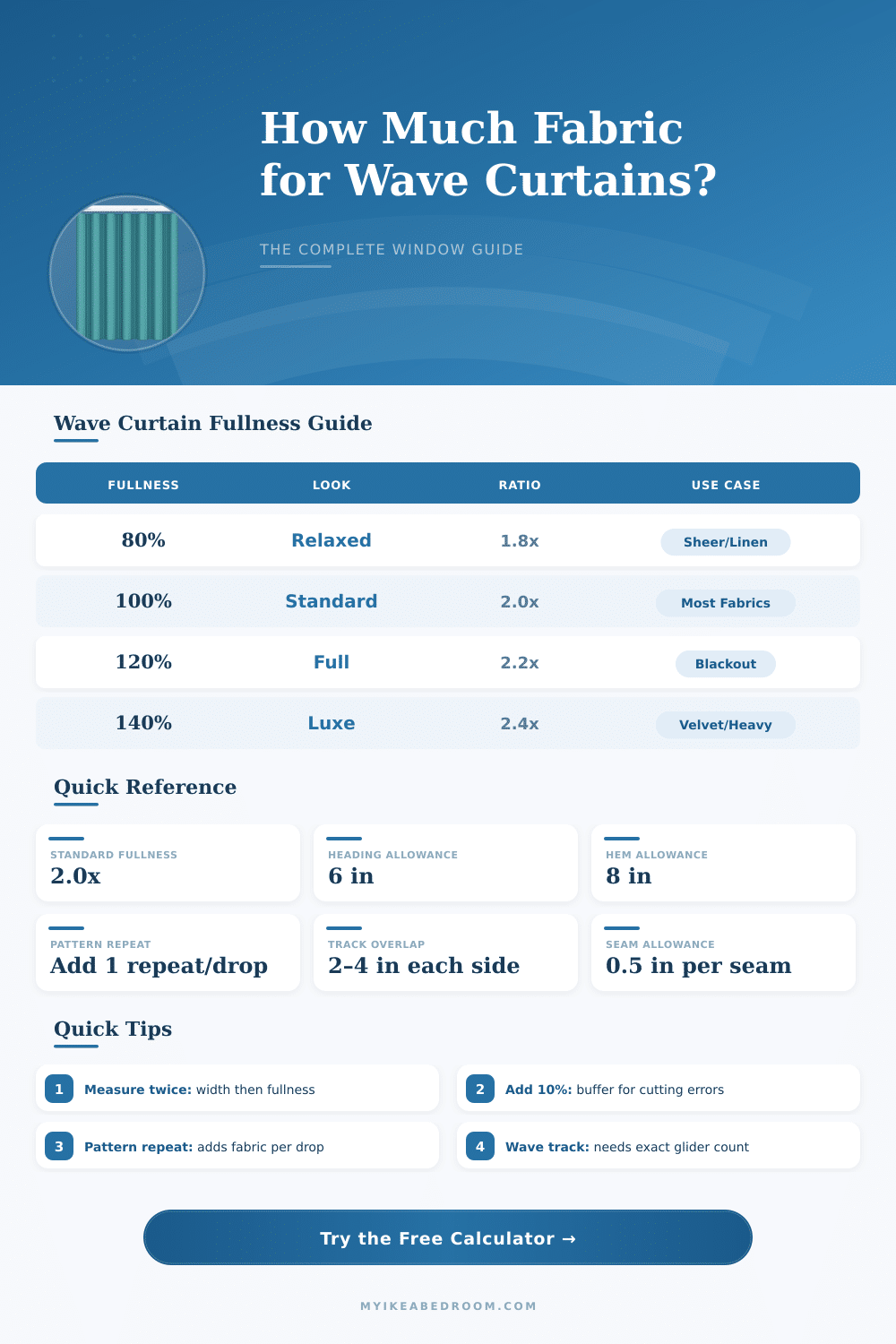
| Fullness Ratio | Look / Style | Best Fabric Types | Track Width 100 in → Fabric Needed | Track Width 150 in → Fabric Needed |
|---|---|---|---|---|
| 1.8x | Relaxed, minimal wave | Sheer, Voile, Linen | 180 in (5.0 yd) | 270 in (7.5 yd) |
| 2.0x | Standard wave — most popular | Linen, Cotton, Polyester | 200 in (5.6 yd) | 300 in (8.3 yd) |
| 2.2x | Full, deep waves | Blackout, Cotton, Jacquard | 220 in (6.1 yd) | 330 in (9.2 yd) |
| 2.4x | Luxurious, dramatic | Velvet, Heavy Drape | 240 in (6.7 yd) | 360 in (10.0 yd) |
| Roll Width | Metric Equiv. | Drops from 1 yd (36 in drop) | Drops from 1 yd (84 in drop + hems) | Best For |
|---|---|---|---|---|
| 54 in | 137 cm | 1 drop per width | 1 drop per width | Standard rooms |
| 60 in | 152 cm | 1 drop per width | 1 drop per width | Wider panels |
| 110 in | 280 cm | 3 drops per width | N/A (too narrow lengthwise) | Short windows, top-sewn |
| 118 in | 300 cm | 3 drops per width | 1 drop per width (floor-to-ceiling) | Floor-to-ceiling panels |
| Pattern Repeat | Metric | Extra Fabric Per Drop | Extra for 4 Drops | Extra for 8 Drops |
|---|---|---|---|---|
| 0 in (plain) | 0 cm | 0 in | 0 yd | 0 yd |
| 6 in | 15 cm | Up to 6 in | ~0.7 yd | ~1.3 yd |
| 12 in | 30 cm | Up to 12 in | ~1.3 yd | ~2.7 yd |
| 18 in | 46 cm | Up to 18 in | ~2.0 yd | ~4.0 yd |
| 24 in | 61 cm | Up to 24 in | ~2.7 yd | ~5.3 yd |
| Project | Track Width | Drop | Fullness | Fabric Needed (yds) |
|---|---|---|---|---|
| Small Bedroom | 60 in (152 cm) | 84 in (213 cm) | 1.8x | ~6.5 yd (5.9 m) |
| Standard Bedroom | 84 in (213 cm) | 96 in (244 cm) | 2.0x | ~9.5 yd (8.7 m) |
| Living Room | 120 in (305 cm) | 96 in (244 cm) | 2.0x | ~13 yd (11.9 m) |
| Patio / Sliding Door | 144 in (366 cm) | 108 in (274 cm) | 2.2x | ~17 yd (15.5 m) |
| Floor-to-Ceiling Luxury | 200 in (508 cm) | 120 in (305 cm) | 2.4x | ~28 yd (25.6 m) |
Wave Curtain Fabric gives a room a simple and elegant look, especially if they are modern. The material falls in nice, smooth folds that look like regular curtains, but with its own unique style. What makes them different is the way the fabric moves under the wave track system, forming even and bright folds that looks truly stunning on big windows, sliding doors or broad glass panels.
The secret truly lies in the setup of the track. The hooks of the Wave Curtain Fabric attach to wave gliders that sit regularly along the track. Here it gets clever: those gliders connect by means of strings, that keep the wave shape whether the curtains are fully open, half closed or stretched.
How Wave Curtains Work
A special cord system in the track makes sure that the material does not lose its form. When you open them, they stack up neatly. When you close, a nice smooth wave appears, that falls down.
Without that cord system that keeps the distance between folds, the fabric simply would fall in heaps or would slide to one side.
Even so, here the thing: wave curtains need more material than usual. You need a full ratio between 2.1:1 and 2.3:1 more or less, depending on the spacing of gliders and the depth of pockets. It is a lot of extra material, that goes into those nice waves.
Choosing the right fabric makes all the difference. Soft materials like linen or wool really show the wave shape well. Cotton and cotton mixes work also very well.
Sheer and some silk kinds can handle it. The test is too take a piece of the material, shape it into waves and watch how it falls, does it keep the form or lose it? Materials with soft touch and little stiffness give the best results.
Light choices create a bright, airy feel, while heavy materials provide full darkness and privacy. Common thermal and heavy linings work perfectly with wave curtains.
Even so, thick and heavy materials like velvet or dense fabric can work, but they maybe need a stronger track to bear the weight and ensure smooth movement. On the other hand, too stiff fabric makes the curtains look sharp and formal, as if in a hotel room, instead of loose and nice.
That style works well whether with plain colors or patterns, because any sharp crease breaks the smooth wave shape. It is also good as an upper layer for light curtains, hung behind on a double track, without taking a lot of space up. Pure linen in that style truly brings relaxed beauty.
The graceful motion of wave curtains changes the feeling of the room, bringing easy luxury. Interestingly, in United Kingdom one calls them wave curtains, but in UnitedStates you will hear ripplefold or S-fold.