🪟 Wainscoting Panel Calculator
Calculate panels, rails, stiles & top cap for any room — imperial & metric
(3/4 in)
(3/4 in)
(3/4 in)
(3/4 in)
(3/4 in)
(3/4 in)
per sq ft
per sq ft
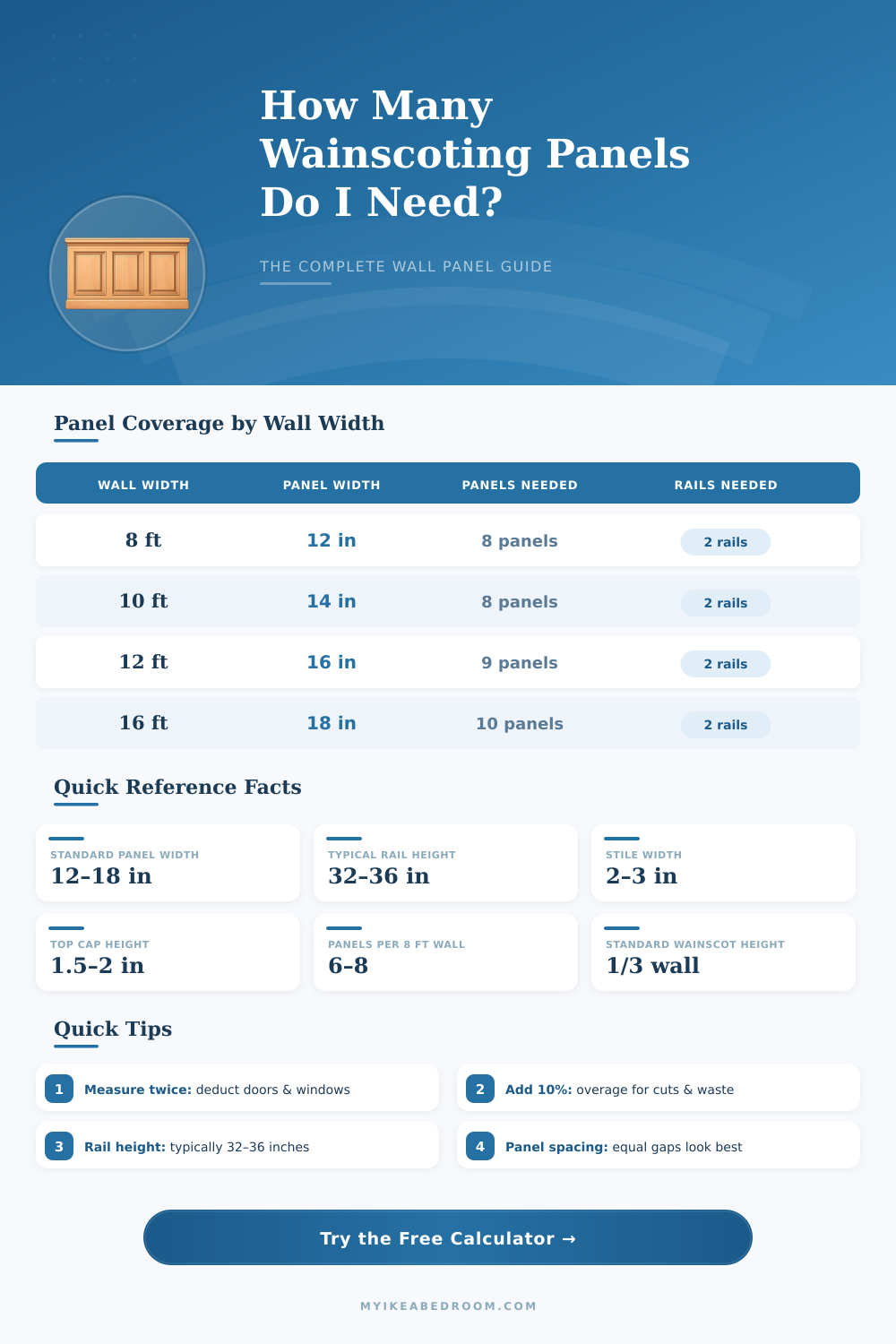
| Panel Width | Stile Width | Panels per 8 ft | Panels per 10 ft | Panels per 12 ft |
|---|---|---|---|---|
| 10 in (25 cm) | 2 in (5 cm) | 8 | 10 | 12 |
| 12 in (30 cm) | 2.5 in (6 cm) | 7 | 9 | 11 |
| 14 in (36 cm) | 2.5 in (6 cm) | 6 | 7 | 9 |
| 16 in (41 cm) | 3 in (8 cm) | 5 | 6 | 8 |
| 18 in (46 cm) | 3 in (8 cm) | 4 | 5 | 7 |
| Room Type | Typical Height | % of 8 ft Wall | Notes |
|---|---|---|---|
| Living / Dining Room | 34–36 in (86–91 cm) | 35–38% | Classic proportion |
| Bedroom | 30–34 in (76–86 cm) | 31–35% | Lower feels cozy |
| Bathroom | 36–48 in (91–122 cm) | 38–50% | Moisture protection |
| Hallway / Entryway | 36–42 in (91–107 cm) | 38–44% | Durability zone |
| Home Office | 30–36 in (76–91 cm) | 31–38% | Chair-rail height |
| Component | Quantity per Lin Ft | Standard Size | Notes |
|---|---|---|---|
| Bottom Rail | 1 lin ft | 3 in wide | Sits at floor level |
| Top Rail | 1 lin ft | 3 in wide | Below cap molding |
| Cap Rail (Chair Rail) | 1 lin ft | 1.5–2 in | Top finishing piece |
| Stile | 1 per panel gap | 2–3 in wide | Vertical dividers |
| Base Shoe | 1 lin ft | 3/4 in | Optional, covers gap |
| Room | Perimeter | Wall Area | Panels Needed | Linear Ft Rail |
|---|---|---|---|---|
| Bathroom 8x12 | 40 ft | 113 sq ft | ~24 | ~40 lin ft |
| Bedroom 12x14 | 52 ft | 147 sq ft | ~32 | ~52 lin ft |
| Hallway 6x8 | 28 ft | 79 sq ft | ~16 | ~28 lin ft |
| Living Room 15x20 | 70 ft | 198 sq ft | ~44 | ~70 lin ft |
| Dining Room 12x16 | 56 ft | 158 sq ft | ~34 | ~56 lin ft |
A wainscoting panel is a nice way to cover a wall, that usually covers the bottom half up to around three quarter parts of the wall height. It differs from average panels, that extend from the floor to the ceiling, by the fact that it is meant to end at a certain height up. Before it served a useful task: defend the walls against damage, especially against scrapes and bumps from wooden chair backs.
Only this high, the panels were enough to protect against this kind of use and wear.
What is a wainscoting panel?
In the United Kingdom, the word “wainscoting panel” historically meant oak wood itself. One used it to insulate and to protect plastered walls against damages. The structure of a wainscoting panel setup simply breaks down.
Up top is the cap rail or chair rail, under it a horizontal rail, then vertical poles and panels, and finally a base rail at the bottom.
When dealing with style, you have several choices. The flat wainscoting panel ranks among the most popular types. It works well for more dark more cozy places.
Gateways, dining rooms, living rooms, powder rooms, bathrooms, schools, home mantles, libraries. Beadboard is another solid choice, especially if easy setup matters for you (it does not require custom panels). Board-and-batten is commonly the easiest method and option for those that want something less strict.
There is also raised wainscoting panel, which requires much more design effort and time for setup.
The choices for materials stretch across quite a wide range. You can choose PVC, polyurethane, solid wood, MDF or polystyrene based on your needs and budget. Many types include handy features, resistance against humidity, rot, water or mold and fungus protection.
Urethane panels are especially lightweight and easily laid. For something more quality, humidity-resistant MDF can be custom cut to your liking. Some flat panel systems indeed come in eight-foot parts with different finish heights, and you choose between painted ore natural hardwoods.
Installing a wainscoting panel in home rooms, living spaces and hallways right away gives them more homely warmth and charm. It adds personality and raises the home value, while it keeps the bottom walls safe from everyday scuffs. Because the panels can be painted, you have totally free choice for color.
On walls with already existing texture, a lightweight MDF panel can go on first to form a smooth base before laying the wainscoting panel up.
Traditionally a wainscoting panel with mortise-and-tenon joints does not suit beginners… It means careful design, leveling work and joints. Squaring and leveling everything commonly counts among the most tricky parts.
Simpler forms become doable, if you are able to cut wood and use a jigsaw. Fitting panels around windows and doors needs a bit of thought, and commonlythe beams help to create visual harmony, that easily goes around those openings.