🏠 Wainscoting Height Calculator
Find the perfect wainscoting height, panel count, and rail placement for any room
| Room | Wall Height | Classic (1/3) | Tall (1/2) | Metric Classic |
|---|---|---|---|---|
| Living Room | 8 ft (96 in) | 32 in | 48 in | 81 cm |
| Dining Room | 9 ft (108 in) | 36 in | 54 in | 91 cm |
| Hallway | 8 ft (96 in) | 32–40 in | 48 in | 81–102 cm |
| Bathroom | 8 ft (96 in) | 48–54 in | 54–60 in | 122–137 cm |
| Foyer | 10 ft (120 in) | 40 in | 60 in | 102 cm |
| Bedroom | 8 ft (96 in) | 32 in | 48 in | 81 cm |
| Home Office | 9 ft (108 in) | 36 in | 54 in | 91 cm |
| Staircase | varies | 34–38 in | — | 86–97 cm |
| Wall Width | Stile 2.5 in | Stile 3 in | Avg Panel Width | Metric Width |
|---|---|---|---|---|
| 8 ft (96 in) | 4–5 panels | 4 panels | 16–20 in | 41–51 cm |
| 10 ft (120 in) | 5–6 panels | 5 panels | 18–21 in | 46–53 cm |
| 12 ft (144 in) | 6–7 panels | 6 panels | 18–22 in | 46–56 cm |
| 14 ft (168 in) | 7–8 panels | 7 panels | 18–22 in | 46–56 cm |
| 16 ft (192 in) | 8–9 panels | 8 panels | 18–22 in | 46–56 cm |
| Component | Standard Size | Placement | Metric |
|---|---|---|---|
| Chair Rail | 2.5–3.5 in wide | Top of wainscoting | 6.4–8.9 cm |
| Bottom Rail | 3–4 in wide | At floor level | 7.6–10.2 cm |
| Stiles | 2–3 in wide | Vertical dividers | 5.1–7.6 cm |
| Panel Bead | 0.5–1 in | Inside frame edge | 1.3–2.5 cm |
| Base Cap | 1–1.5 in | Above baseboard | 2.5–3.8 cm |
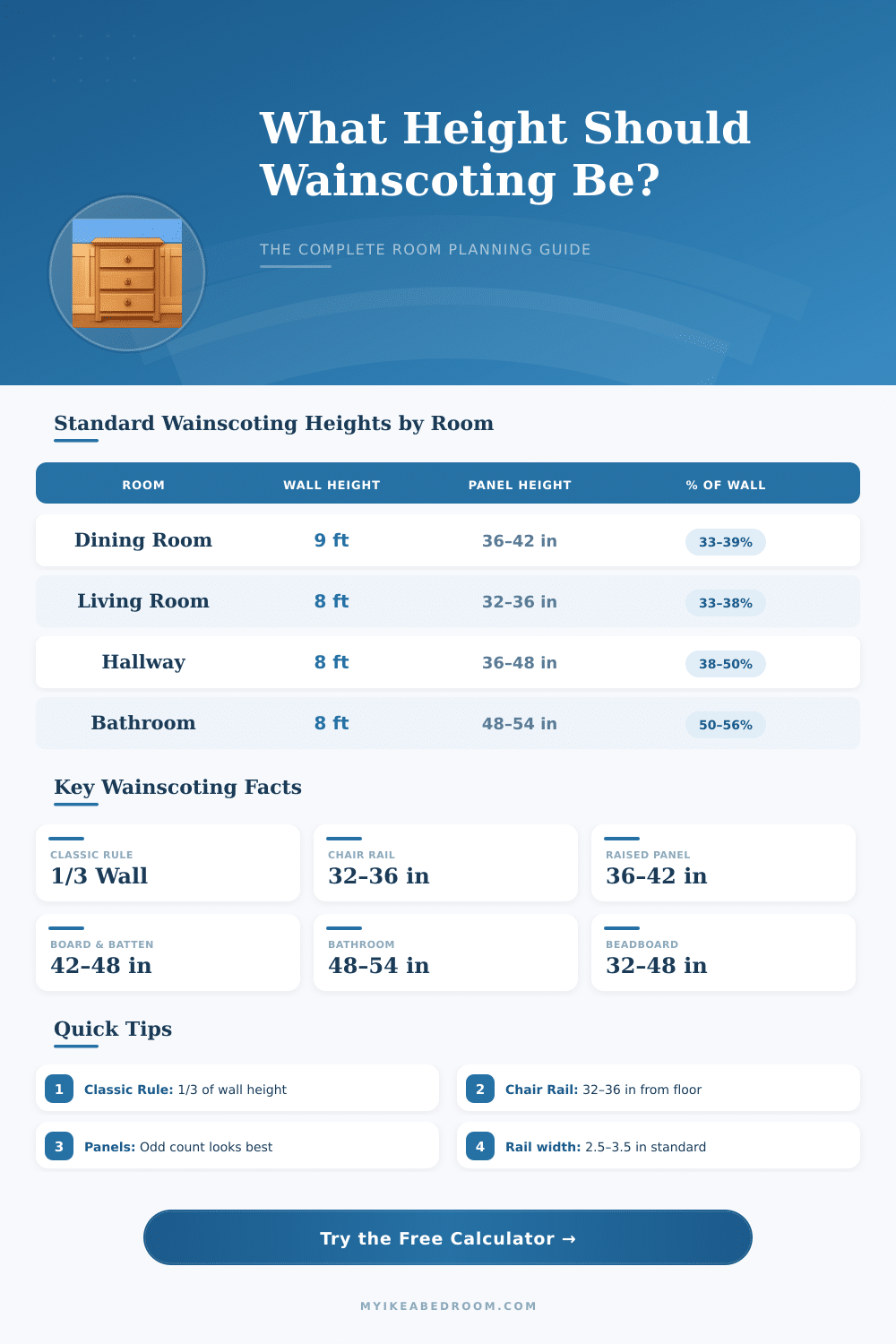
The wainscoting height is one of those topics that seems easy, but really needs a bit of attention. Most commonly one uses around 32 to 36 inches. Big advantage of 32 inches is that one can get three bits from an 8-foot board, what reduces the cost by cutting.
The standard wainscoting height usually ranges between 36 and 42 inches, or almost a third of the height of the wall.
What Height Should Wainscoting Be?
The rule of thirds is the starting point to go. We measure the room height and divide it by three. In a space with 9-foot ceilings that puts the wainscoting at 3 feet.
When the ceilings reach 10 feet, the discussion becomes more key. Some go for 32 inches, while others think that 24 inches give the room more height feelings.
Spaces with very high ceilings face their own problems. For a room with 15-foot high ceilings the third rule will put the wainscoting at 5 feet. However such height can seem wrong, because it pulls the look from the ceiling and reduces the impression of the spatial beauty.
One indeed calls high wainscoting a plate rail, and usual advice for it is two-thirds of the ceiling height.
Wainscoting under 30 inches on average walls can appear unfinished, as if it lacks the upper edge. Whatever passes 50 percent of the wall height starts to seem more like full paneling. Hence an ideal target exists too reach.
In a basement, where the ceilings are low, keeping the wainscoting height at only 24 inches makes sense. On the other hand, a room with 13.5-foot ceilings could use 40 inches for wainscoting, tied to an 11-inch baseboard and 3.5-inch chair rail. One must also consider the bottom setup, because the baseboard adds to the whole height of the wainscoting.
When the living space has furniture that touches the walls, like wingback chairs sitting against them, the two-thirds height option works more well. Like this the furniture does not hide the wainscoting, and the panels really get attention. Some home owners choose board and stick style of wainscoting in 48 inches, what fits well with the space.
The size of panels matters also. Use panels in around 14 to 16 inches broadly fits with the golden ratio, when the whole wainscoting height rests in the 36 to 40-inch range. The default starting height for wainscoting panels is 34.5 inches without the upper cap.
The finished wainscoting ends up somewhere between 32 and 36 inches, depending whether it goes behind the baseboard below or is covered by chair rail up. All this fitswell with a third of the wall.