🧱 Tile Backsplash Calculator
Calculate exactly how many tiles you need for your backsplash project — with overage built in.
tiles per sq ft
tiles per sq ft
tiles per sq ft
tiles per sq ft
tiles per sq ft
tiles per sq ft
tiles per sq ft
tiles per sq ft
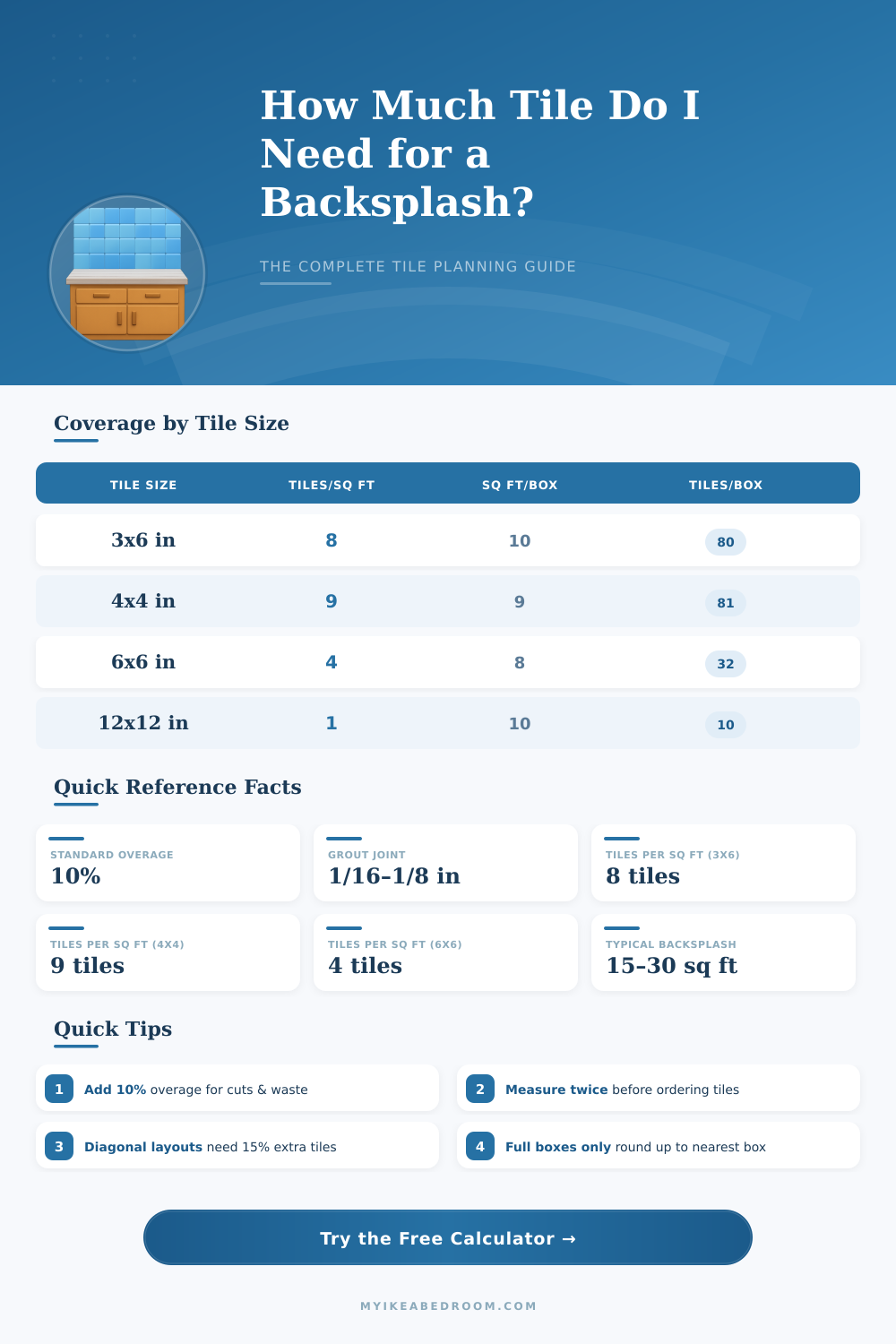
| Tile Size | Tiles / Sq Ft | Tiles / Sq M | Sq In / Tile | Typical Box Coverage | Tiles / Box (typical) |
|---|---|---|---|---|---|
| 3x6 in (7.6x15.2 cm) | 8.0 | 86.1 | 18 | 10 sq ft | 80 |
| 4x4 in (10.2x10.2 cm) | 9.0 | 96.9 | 16 | 9 sq ft | 81 |
| 6x6 in (15.2x15.2 cm) | 4.0 | 43.1 | 36 | 8 sq ft | 32 |
| 4x12 in (10.2x30.5 cm) | 3.0 | 32.3 | 48 | 9 sq ft | 27 |
| 12x12 in (30.5x30.5 cm) | 1.0 | 10.8 | 144 | 10 sq ft | 10 |
| 2 in Hexagon | ~46 | ~495 | ~3.5 | 5 sq ft | ~230 |
| 1x1 Mosaic Sheet | 144 | 1550 | 1 | 12 sq ft (sheet) | 1728 |
| 4x8 in Subway | 4.5 | 48.4 | 32 | 9 sq ft | 40 |
| 6x12 in Porcelain | 2.0 | 21.5 | 72 | 10 sq ft | 20 |
| 24x24 in (60x60 cm) | 0.25 | 2.7 | 576 | 10 sq ft | 2–3 |
| Grout Joint | Metric | Best For | Layout Extra Needed |
|---|---|---|---|
| 1/16 in | 1.6 mm | Rectified / Polished Tiles | +0% |
| 1/8 in | 3.2 mm | Standard Ceramic / Porcelain | +0% |
| 3/16 in | 4.8 mm | Handmade / Rustic Tile | +1–2% |
| 1/4 in | 6.4 mm | Natural Stone / Large Format | +2–3% |
| Diagonal Layout | — | All tile types | +15% |
| Herringbone | — | Subway / Plank tiles | +15% |
| Running Bond | — | Subway / Rectangular | +5% |
| Project | Typical Size | Area (sq ft) | Area (sq m) | 3x6 Tiles Needed (+10%) | 4x4 Tiles Needed (+10%) |
|---|---|---|---|---|---|
| Small Kitchen | 30" x 15" | 3.1 | 0.29 | 27 | 31 |
| Standard Kitchen | 36" x 18" | 4.5 | 0.42 | 40 | 44 |
| Large Kitchen | 48" x 18" | 6.0 | 0.56 | 53 | 59 |
| Full Kitchen Wall | 96" x 18" | 12.0 | 1.11 | 106 | 119 |
| Bathroom Vanity | 36" x 16" | 4.0 | 0.37 | 35 | 40 |
| Bathroom Full Wall | 60" x 48" | 20.0 | 1.86 | 176 | 198 |
| Bar Backsplash | 36" x 18" | 4.5 | 0.42 | 40 | 44 |
| Fireplace Surround | 48" x 24" | 8.0 | 0.74 | 70 | 79 |
| Laundry Accent | 24" x 16" | 2.7 | 0.25 | 24 | 27 |
Behind your sink, stove or counter find a protective Backsplash that not simply protects against water, fat and splashes, it also gives a chance to add style to the room. Here is the point of a Backsplash. One finds them mostly in kitchens and bathrooms but also in sinks or other wet places.
Here is what makes a Backsplash interesting to think about: the choices of materials truly do not have an end. Tile from ceramics, china, glass, marble, natural limestone, stainless steel and metals all work well. Glass Tile can truly grab attention and create strong visual impact.
How to Choose and Install a Backsplash
If you want something fancier, marble adds elegance. China sits somewhere in the middle, it is nice, sturdy and really easily cleaned. Even so, there is one important spot: unglazed Tile absorbs marks, if one does not seal them before.
Frosted Tile? They are much more easy in that regard.
When talking about style, Tile opens a whole world of ideas. You have the classic subway Tile… They are popular not without reason.
There also exist long hexagons, triangle forms that extend from floor to ceiling, and mosaic Tile on mesh support. Even so, that mesh version needs attention. It can get wet, and Tile will move, if you do not press them well in fresh glue right away.
It is a bit difficult, but possilbe.
Peel-and-stick Tile fully changed the game for renters and for any who hesitate about lasting setup. Most of them handle warmth and humidity, skip grout fully and come off clean when one removes them. Apply wall paper on the wall before laying them helps too lower risk of wound to the base surface.
Simply a warning: some peel-and-stick types however need grout, while others do not. Check before purchase.
The timing of your setup matters more than one could believe. Wait with the Backsplash until after your cabinets are in place and the counter is set. Like this the Tile sits well against those surfaces, and grout fills the spaces without gaps or wrong edges.
Start from the bottom part… Any slice that you do ends hidden up, where none truly notices. Before starting, measure carefully to check, does your counter with the upper edge line up.
Hint: they commonly do not line up.
About the preparation of the wall, sometimes one can Tile directly on painted drywall, but removing the paint and priming with thinset mortar works better. Backing board is another solid option. One even can Tile above already existing Tile, although the treatment of edges later becomes really tricky.
Your Backsplash does not have to match everything visible. Choose a neutral tone with bits of colour threw accents. Full-high Backsplash that matches your counter is another way.
The final choice depends on Tile type, size, pattern and whole look. It truly works as a first project, if you feelcomfortable about measuring, cutting and leveling of things.