🪜 Stair Runner Calculator
Calculate exactly how much stair runner fabric you need — imperial & metric, with pattern repeat & overage
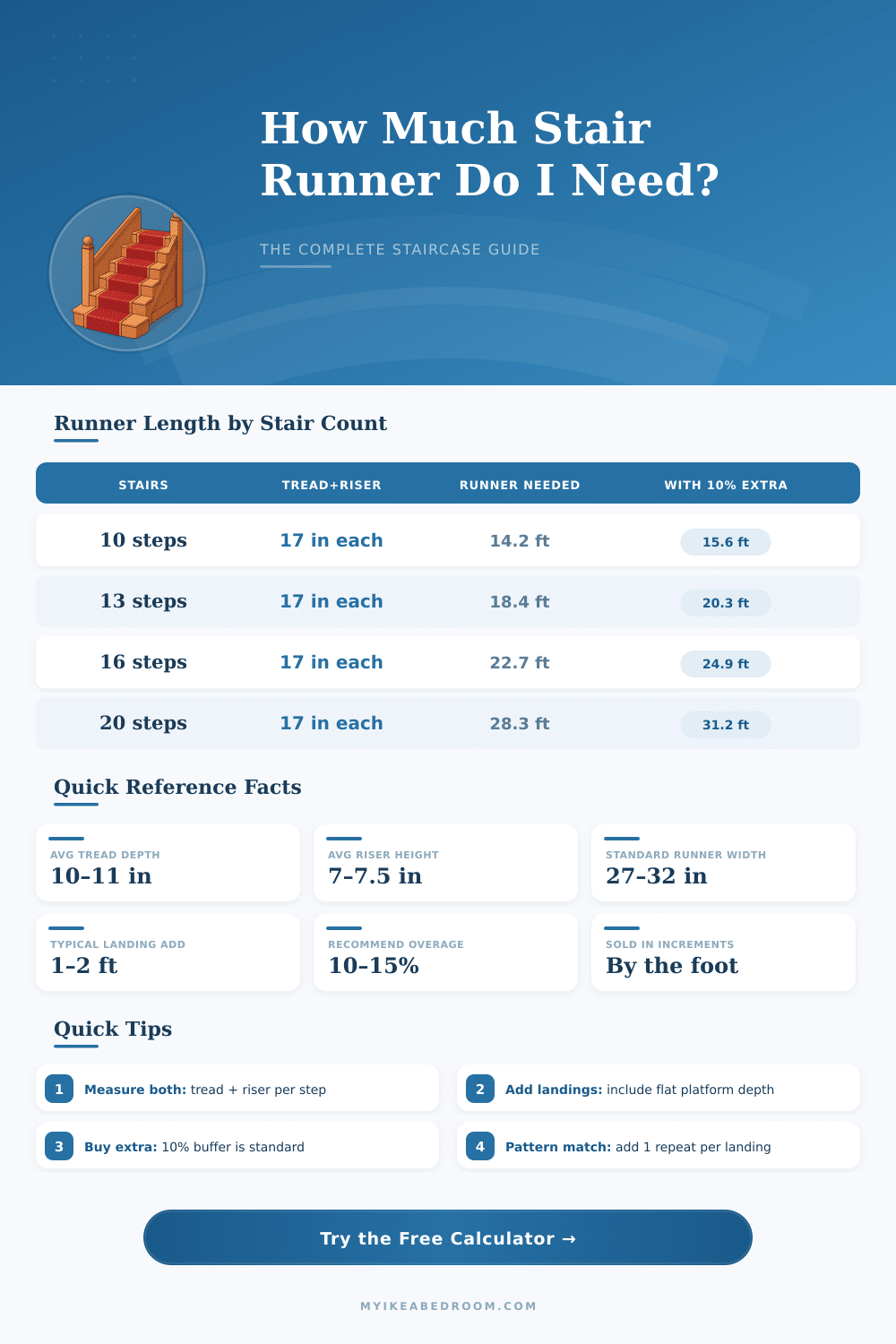
Based on standard 10" tread + 7.5" riser = 17.5" per step. Includes 10% overage.
| Steps | Base Length (ft) | +10% Overage (ft) | Metric (m) |
|---|---|---|---|
| 8 steps | 11.7 ft | 12.8 ft | 3.91 m |
| 10 steps | 14.6 ft | 16.0 ft | 4.88 m |
| 12 steps | 17.5 ft | 19.3 ft | 5.87 m |
| 13 steps | 18.96 ft | 20.9 ft | 6.37 m |
| 14 steps | 20.4 ft | 22.5 ft | 6.84 m |
| 16 steps | 23.3 ft | 25.6 ft | 7.81 m |
| 18 steps | 26.25 ft | 28.9 ft | 8.80 m |
| 20 steps | 29.2 ft | 32.1 ft | 9.77 m |
| Measurement | Min (Code) | Standard | Comfortable |
|---|---|---|---|
| Tread Depth | 9 in / 22.9 cm | 10 in / 25.4 cm | 11 in / 27.9 cm |
| Riser Height | 4 in / 10.2 cm | 7.5 in / 19 cm | 7 in / 17.8 cm |
| Tread + Riser | 13 in / 33 cm | 17.5 in / 44.5 cm | 18 in / 45.7 cm |
| Stair Width | 36 in / 91 cm | 42 in / 107 cm | 48 in / 122 cm |
| Runner Width | 24 in / 61 cm | 27–32 in / 69–81 cm | Full width –2 in |
| Width | Sq Ft / Linear Ft | Sq Meters / Linear M | Best For |
|---|---|---|---|
| 22 in / 56 cm | 1.83 sq ft | 0.17 m² | Narrow stairs |
| 24 in / 61 cm | 2.0 sq ft | 0.19 m² | Budget standard |
| 27 in / 69 cm | 2.25 sq ft | 0.21 m² | Most common width |
| 30 in / 76 cm | 2.5 sq ft | 0.23 m² | Wider treads |
| 32 in / 81 cm | 2.67 sq ft | 0.25 m² | Standard wide |
| 36 in / 91 cm | 3.0 sq ft | 0.28 m² | Grand staircases |
| Pattern Repeat | Extra per Landing | Extra per 10 Steps | Recommended Overage |
|---|---|---|---|
| No pattern (solid) | 0 in | 0 in | 5–10% |
| 9 in repeat | 9 in | ~9 in | 10% |
| 13.5 in repeat | 13.5 in | ~13.5 in | 10–15% |
| 18 in repeat | 18 in | ~18 in | 15% |
| 27 in repeat | 27 in | ~27 in | 20% |
| Custom repeat | 1 full repeat | Varies | 15–20% |
A Stair Runner is made up of a strip of carpet or small carpet, that lies along the centre of your stairs so that bare wooden parts stay visible on both sides. Beyond their nice look, they have real benefit, these coverings protect your feet, reduce the sound of steps and help to preserve the stairs against wear over the years. There is also a safety benefit, that must not be ignored.
The extra cushion ensures lower risk of sliding, and it is useful for children, that could fall. Even older pets with stiff joints seem to climb stairs more easily, when a runner lies under them.
Stair Runners: Safety, Comfort and Style
Most of such Stair Runner coverings have width between 27 and 36 inches. About the length you have a lot of freedom, stores usually offer rolls of around 10 feet until almost 100 feet, so fitting it to your specific stairs should not create big troubles. Many of them already come finished, with edges and cuts to size, so that they can go directly on your stairs.
When the sizes do not match, there is the option to order a custom Stair Runner, that matches your exact sizes instead of simply using what is available in stock.
The options for designs are truly wide. Runners with angled borders give an elegant, polished impression and cover everything from classical styles to modern models. Besides that, there are solid colours, strips, flowery patterns, herringbone patterns, and the list does not end here.
Regarding materials, wool versions are available, but there are also synthetic ones. One thing deserves too mind, if you have cats or dogs: curly fibers form perfect targets. Their claws will destroy them quickly.
Installing a runner does not require experience of a professional… Beginners manage it commonly. A stapler simplifies the whole thing.
One method skips the trouble of full uncovering of the stairs, using a kicker for carpets, that strains the material, and later clamping it at the line between step and vertical part. Extra non-slip pads help stop slipping. Rods for stairs offer an alternative, although they require bearing holes for screws in the wood.
Style choices play a role also, the waterfall method lets the carpet easily go down over every step, while the Hollywood style folds it flatly against the vertical part and sets it left.
A practical tip, that does work, is to use cheap rugs from stores like IKEA. Arrange several small pieces over separate steps, setting them by means of staplers, and there you have something, that looks custom, without the high price. Some users did that by means of SÖLLINGE rugs for less than 85 euros intotal.
The main disadvantage? The wood under your Stair Runner will change its look differently than the bare parts, that you see daily. Over time, the colour contrast becomes clearly visible.
Also, using the Stair Runner requires often vacuuming and washing, what adds tasks. Even so, when one considers the comfort, safety and the nice visible improvement, there is hardly reason against its installation.