😴 Sleep Score Calculator
Get your personalized sleep quality score based on duration, efficiency, and sleep habits
| Age Group | Recommended Hours | Minimum | Maximum |
|---|---|---|---|
| Newborn (0-3 mo) | 14-17 hrs | 11 hrs | 19 hrs |
| Infant (4-11 mo) | 12-15 hrs | 10 hrs | 18 hrs |
| Toddler (1-2 yr) | 11-14 hrs | 9 hrs | 16 hrs |
| Preschool (3-5 yr) | 10-13 hrs | 8 hrs | 14 hrs |
| School Age (6-13 yr) | 9-11 hrs | 7 hrs | 12 hrs |
| Teen (14-17 yr) | 8-10 hrs | 7 hrs | 11 hrs |
| Young Adult (18-25 yr) | 7-9 hrs | 6 hrs | 11 hrs |
| Adult (26-64 yr) | 7-9 hrs | 6 hrs | 10 hrs |
| Senior (65+ yr) | 7-8 hrs | 5 hrs | 9 hrs |
| Efficiency % | Rating | Score Impact | Notes |
|---|---|---|---|
| 95% + | Excellent | +25 pts | Very restorative sleep |
| 85 - 94% | Good | +18 pts | Normal healthy range |
| 75 - 84% | Fair | +10 pts | Room for improvement |
| 65 - 74% | Poor | +4 pts | Affects daytime function |
| Below 65% | Very Poor | 0 pts | Consult a sleep specialist |
| Latency (min) | Rating | Wakings/Night | Impact on Score |
|---|---|---|---|
| Under 10 min | Excellent | 0 times | +15 pts |
| 10 - 20 min | Good | 1 time | +12 pts |
| 20 - 30 min | Moderate | 2 times | +6 pts |
| 30 - 45 min | Poor | 3 times | +2 pts |
| Over 45 min | Very Poor | 4+ times | 0 pts |
| Sleep Stage | % of Night | Duration (8 hr) | Function |
|---|---|---|---|
| NREM Stage 1 (N1) | 2 - 5% | 10-24 min | Transition to sleep |
| NREM Stage 2 (N2) | 45 - 55% | 3.6-4.4 hrs | Memory consolidation |
| NREM Stage 3 – Deep (N3) | 13 - 23% | 1.0-1.8 hrs | Physical restoration |
| REM Sleep | 20 - 25% | 1.6-2.0 hrs | Emotional processing |
Sleep points compress whole overnight rest in one simple figure which is very easy to understand. Problem is that various tools and apps estimate this value according to their own methods, and that matters more than one could believe. ResMed, important player in Sleep therapy, launched one more detailed and individual Sleep rhythm.
It simply comes to that: the points estimate the amount of Sleep and the quality, as far as well you truly slept.
How Sleep Points Work and Why They Differ
Fitbit’s Sleep point uses data about heart rhythm, time passed restless or awake and the Sleep phases you reached. Time in various Sleep stages affect the result likewise as did your heart rhythm slow quite a lot overnight and how many hours you total slept. One finds it by tapping the Sleep summary in the Today tab or clicking the Vital section.
Apple Watch access differs, it considers the whole Sleep duration, as far as regular your Sleep schedule was recently and how many occasions you woke overnight. To see that on Apple Watch, you require watchOS 9, which confines to Series 6 or newer, SE second generation or fresher or one from the Ultra models.
Here everywhere it becomes tricky, even so. Sleep points are not truly precise in any important sense. The basic data that feeds the point, like heart rhythm.
Can be reliable. But the piont itself? It is a simple average made up.
Every company reads “good Sleep” differently, and those readings adjust according to the device that you wear.
Folks mention big differences always. Some reach 85 and feel themselves entirely bad, while another reaches 50 and wakes up full of energy. Nights between 77 and 85 commonly give wonderful feeling, but nights of 87 until 95 occasionally leave you sleepy.
Moreover their are those awkward devices, swearing that you Sleep while you actually were awake and read hours long. The main conclusion? Always compare your point with your real feeling.
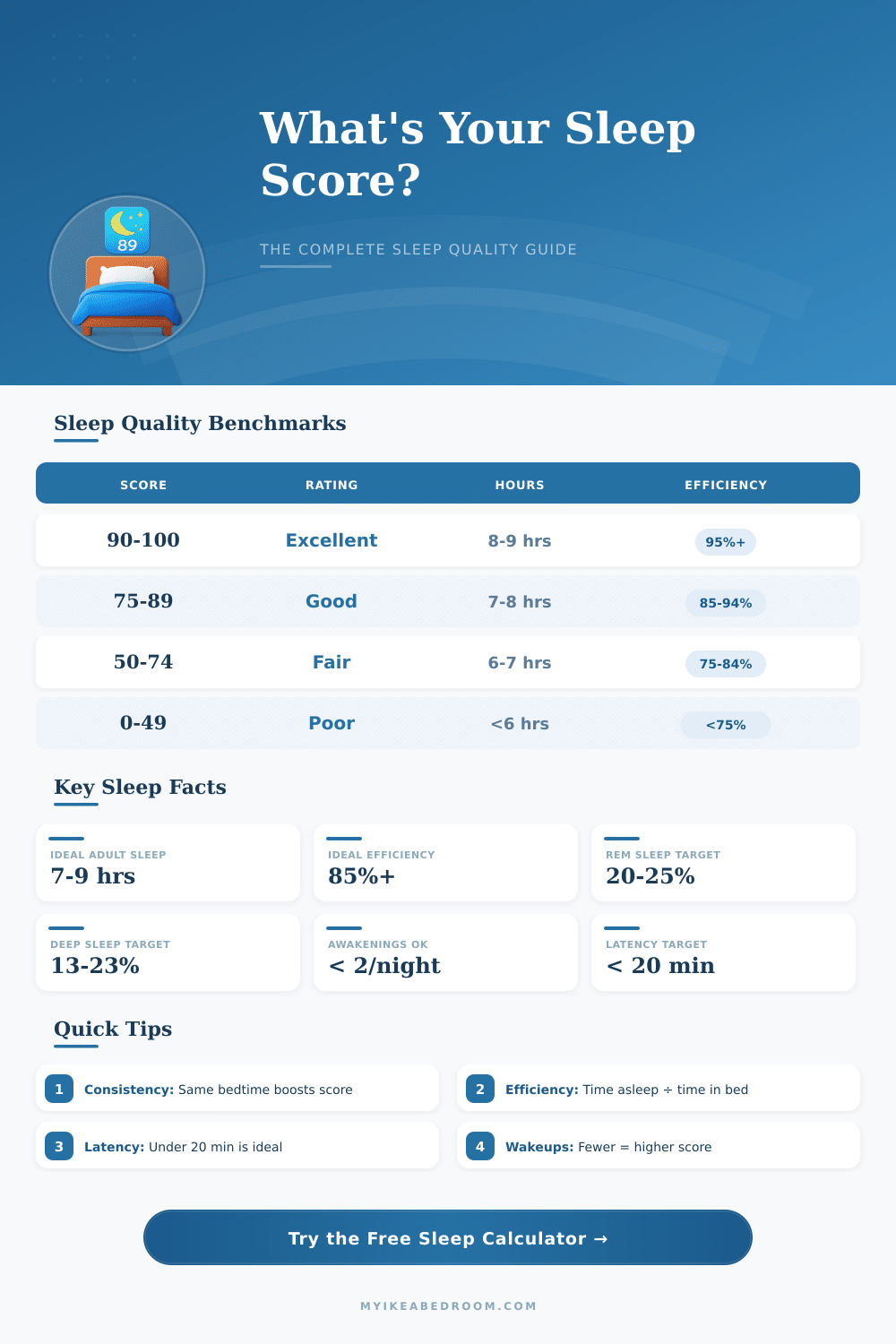
Most commonly average points move somewhere between 72 and 83. Everything above 85 one considers great, while under 60 shows that your Sleep requires a bit of help. Sleep duration has big influence on how one counts the point.
After reaching around six hours, your point usually climbs through the 70s to 85. Your Sleep target also matters a lot… And all this is personal.
If you set target at six hours, you will receive higher points than intending eight. So comparing points between people widely does not count. The point is meant to follow your own Sleep nightafter night.
IKEA ran one of the biggest world Sleep surveys, using data from 55 000 folks from 57 lands. Their Sleep points range from 1 until 100, based on five factors, each weighing until 20 spots. The results showed a surprising image.
Folks with financial troubles reached 54, the LGBTQ+ community 57 and folks with disabilities 56, all behind the world average. Urban China led the rank at 74, with Indonesia at 71 and Egypt ending the third place at 70.