💤 Sleep Schedule Calculator
Find your ideal bedtime or wake-up time based on natural 90-minute sleep cycles
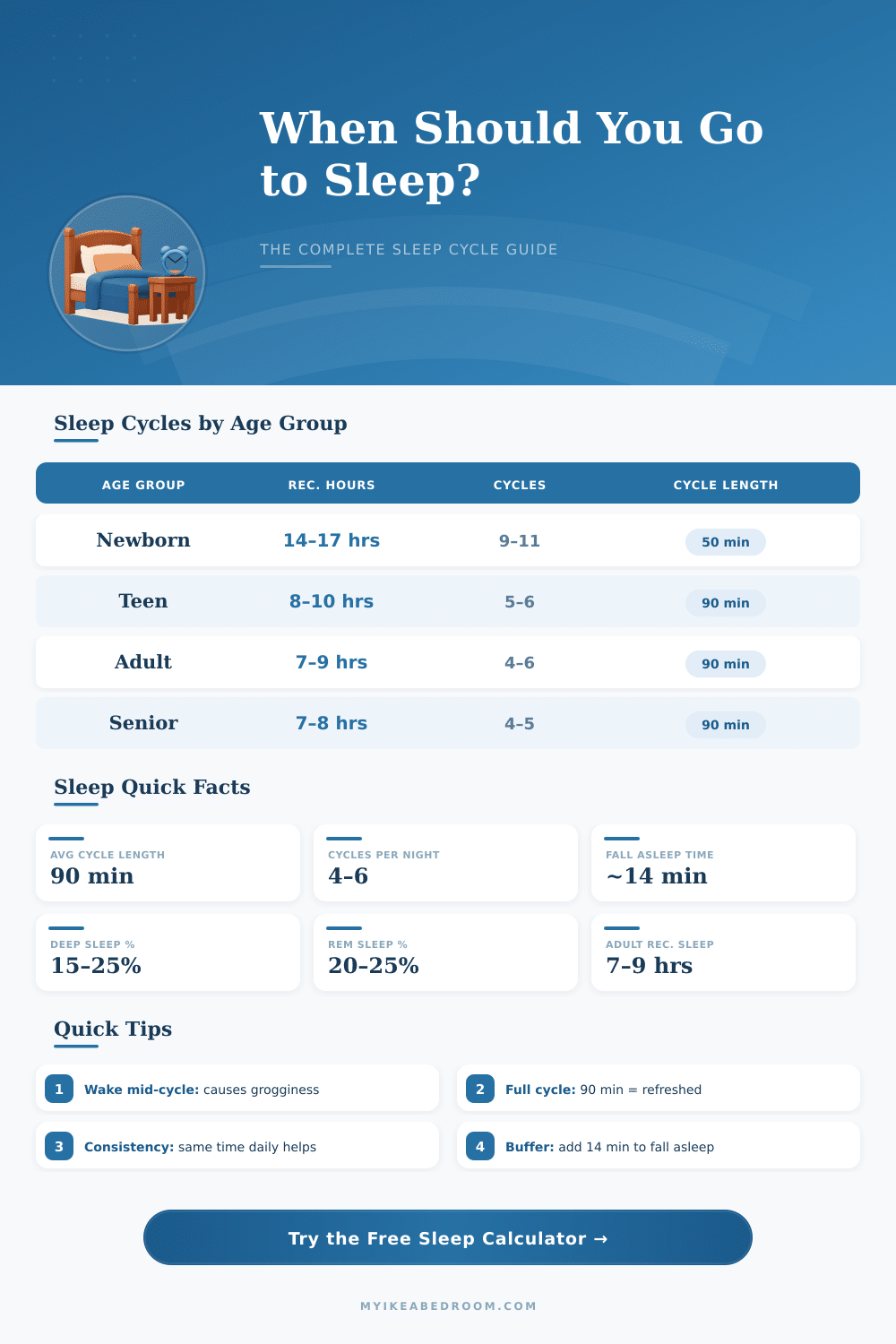
| Age Group | Age Range | Rec. Hours | Typical Cycles | Cycle Length |
|---|---|---|---|---|
| Newborn | 0–3 months | 14–17 hrs | 9–11 | ~50 min |
| Infant | 4–11 months | 12–15 hrs | 8–10 | ~50 min |
| Toddler | 1–2 years | 11–14 hrs | 7–9 | ~60 min |
| Preschool | 3–5 years | 10–13 hrs | 6–8 | ~75 min |
| School Age | 6–12 years | 9–11 hrs | 6–7 | ~90 min |
| Teen | 13–18 years | 8–10 hrs | 5–6 | 90 min |
| Adult | 18–64 years | 7–9 hrs | 5–6 | 90 min |
| Senior | 65+ years | 7–8 hrs | 4–5 | 90 min |
| Bedtime | 4 Cycles (6h 14m) | 5 Cycles (7h 44m) | 6 Cycles (9h 14m) |
|---|---|---|---|
| 9:00 PM | 3:14 AM | 4:44 AM | 6:14 AM |
| 9:30 PM | 3:44 AM | 5:14 AM | 6:44 AM |
| 10:00 PM | 4:14 AM | 5:44 AM | 7:14 AM |
| 10:30 PM | 4:44 AM | 6:14 AM | 7:44 AM |
| 11:00 PM | 5:14 AM | 6:44 AM | 8:14 AM |
| 11:30 PM | 5:44 AM | 7:14 AM | 8:44 AM |
| 12:00 AM | 6:14 AM | 7:44 AM | 9:14 AM |
| 12:30 AM | 6:44 AM | 8:14 AM | 9:44 AM |
| Phase | Stage | Duration | % of Cycle | What Happens |
|---|---|---|---|---|
| NREM 1 | Light Sleep | 1–5 min | ~5% | Transition, muscle twitches |
| NREM 2 | Light–Moderate | 20–30 min | ~45% | Heart rate slows, memory consolidation |
| NREM 3 | Deep Sleep | 15–30 min | ~25% | Body repair, immune boost, growth hormone |
| REM | REM Sleep | 10–60 min | ~25% | Dreaming, emotional processing, learning |
Most folks realize that they should follow a schedule for sleep, but how hard can that be? That is another cause. Here is the main point; there is no one same recipe that works for all.
Your perfect sleep rhythm is mostly personal. The most important cause is that you wake up feeling truly rested, without anything bothering your head during the night, and that the first moments after waking are calm and smooth.
Find Your Best Sleep Schedule
Great sleep truly changes everything. The usual advice shows around 7 to 9 hours at night, but 8 hours form a good point to start. From that base you can adjust the time by steps of 30 minutes, to find your ideal amount.
Maybe 7.5 hours are enough, or maybe you need a bit more near 9. Your genes and the amount of motion during the day both seriously affect how much rest you truly need.
Calculators for sleep often surprisingly help to find the right time to retire. Some of them work off cycles of 90-minute cycles of sleep, based on when you plan to wake up. Others simply use the basic eight-hour standard.
Assume that you must rise at 6 in the morning, count backwards 7.5 hours, and you get 10:30 at night as target for sleep. Then one should turn off the lights and prepare for the rest. It forms a useful tool to start, but mind: the sleep cycles of people do not always have the same length, so maybe a bit of tweaking will be needed.
The most important part to create a reliable sleep habit is to rise always at the same hour, every day. Yes, even after a night when you slept little. Yes, also during the weekends.
Like this your body adjusts to that rhythm. Setting the time to retire matters, but hear what surprises, if you must stay awake more than planned, stay faithful to your usual time to rise, instead of sleeping longer to make up.
Some folks slip into such a pattern, that they go to bed at 5th, 6th or even 7th in the morning, so their whole day flips. One good way to restart is to stay awake whole day and night. From the next evening your body will be fully tired and ready for normal sleep.
After that, good sleep habits help to set everything. Dim the lights, drop your devices, wash up, brush the teeth, maybe read something from fiction. That sends strong signals to your brain, they help you fall asleep easy.
You can also change your internal clock slowly, moving it forward each around 30 minutes daily. Another way is to not eat until your intended time to rise, then taste a good breakfast and get a bit of morning sunshine.
Young people and teens naturally prefer to stay awake more long and sleep in the morning. Through history folks also used split sleep, they split the rest into two or more parts with awake time between them. Adding extra sleep during weekends or doing short naps helps to repay the sleep debt of the work-week.
You can even have different rhythms forwork days than for holidays. Apps for sleep focus on your devices also reduce distractions right before and during the sleep time.