🧵 Quilt Size Calculator
Calculate exact fabric yardage, batting, and backing needed for any quilt size
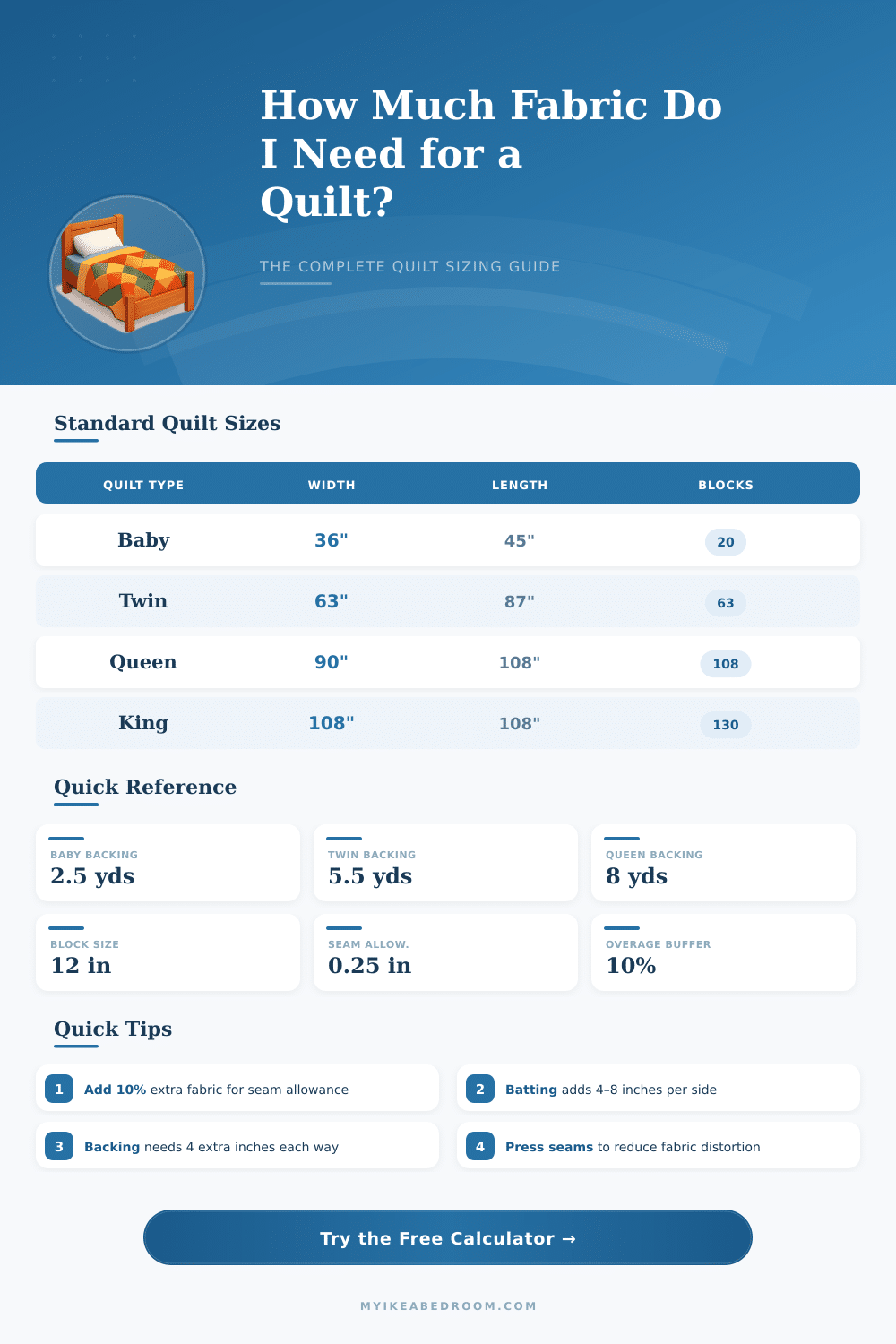
| Quilt Type | Width x Length | Sq Inches | Metric (cm) |
|---|---|---|---|
| Baby / Crib | 36" x 45" | 1,620 sq in | 91 x 114 cm |
| Toddler | 42" x 58" | 2,436 sq in | 107 x 147 cm |
| Lap / Nap | 54" x 72" | 3,888 sq in | 137 x 183 cm |
| Throw | 60" x 80" | 4,800 sq in | 152 x 203 cm |
| Twin | 63" x 87" | 5,481 sq in | 160 x 221 cm |
| Full / Double | 81" x 96" | 7,776 sq in | 206 x 244 cm |
| Queen | 90" x 108" | 9,720 sq in | 229 x 274 cm |
| King | 108" x 108" | 11,664 sq in | 274 x 274 cm |
| Cal. King | 108" x 114" | 12,312 sq in | 274 x 290 cm |
| Quilt Size | 44" Fabric (yds) | Wide 108" (yds) | Extra Allowance |
|---|---|---|---|
| Baby 36x45 | 2.5 yds | 1.5 yds | +4" each side |
| Lap 54x72 | 4.5 yds | 2.5 yds | +4" each side |
| Throw 60x80 | 5 yds | 2.75 yds | +4" each side |
| Twin 63x87 | 5.5 yds | 3 yds | +4" each side |
| Full 81x96 | 7.5 yds | 3.5 yds | +4" each side |
| Queen 90x108 | 8 yds | 3.75 yds | +4" each side |
| King 108x108 | 9 yds | 4 yds | +4" each side |
| Block Size (finished) | Cut Size (+seam) | Blocks Per Yard | Yds for 100 Blocks |
|---|---|---|---|
| 4" x 4" | 4.5" x 4.5" | ~72 blocks | ~1.4 yds |
| 6" x 6" | 6.5" x 6.5" | ~42 blocks | ~2.4 yds |
| 8" x 8" | 8.5" x 8.5" | ~25 blocks | ~4 yds |
| 10" x 10" | 10.5" x 10.5" | ~16 blocks | ~6.3 yds |
| 12" x 12" | 12.5" x 12.5" | ~12 blocks | ~8.4 yds |
| 14" x 14" | 14.5" x 14.5" | ~9 blocks | ~11.1 yds |
| Batting Package | Dimensions | Quilt Size Fits | Overhang Each Side |
|---|---|---|---|
| Crib | 45" x 60" | Baby / Toddler | 4-5 inches |
| Throw | 60" x 60" | Lap / Throw | 3-4 inches |
| Twin | 72" x 90" | Twin Bed | 4-5 inches |
| Full/Queen | 90" x 108" | Full & Queen | 4-5 inches |
| King | 120" x 120" | King / Cal King | 6 inches |
Choose the right size of quilt is not as difficult as it could appear first. From tiny wall hangings until big royal quilt, including throw quilt, lap quilt baby quilt. Truly, that variety can confuse you at first.
The fun part? Standard sizes help to escape the need of random guessing in that choice.
How to Choose the Right Quilt Size
There is a bit of flexibility in the standard sizes of quilt. Based on the layout of your blocks and their own sizes, the measures can range from four until eight inches in any direction. Even so, they stay near known marks.
For instance, baby quilt commonly reach around 45 by 60 inches, although one finds them also in 36 by 52 inches. Throw quilt or lap quilt normally are about 50 by 65 inches. Twin quilt tend to around 65 by 97 inches.
Full quilt come in 84 by 90 inches. Queen quilt measure about 86 by 102 inches. And for royal size, one considers around 104 by 102 inches.
Throw quilt… Typical at around 45 by 45 inches… Lay well on a sofa and are much less hard than making a whole bed cover, especially if you work against time.
From my experience, quilt in teh range of 60 by 70 inches work the most useful. They lay nicely folded across a sofa and even can cover a bed, if one turns the direction.
Here is where the sizes of beds matter. Full mattress measures 54 by 75 inches. A quilt at around 84 by 90 inches gives about 15 inches of fabric, that hangs down on both long sides and the foot end.
Queen quilt? It covers both queen and full beds without problems, and you can be sure, that your feat do not stick out. Royal quilt works for big sleepers, that stretch, and honestly, it well serves to cover the whole family on a sofa during movie night.
One important point to note, modern mattresses are thicker than before. That raises the upper surface higher from the floor, which changes, how much drop you truly need. Because of that change, the standard sizes for twin, double, queen and royal quilt were fixed, to make up for that bigger overhang.
Before you start planning, take time to truly measure your bed. Think, whether you want, that the quilt lay under and above the pillows, and decide, how far down it should hang along the sides. Some quilt makers like square quilt for full and queen beds, because they hang equally on three sides.
Sleeping habits also matter, if some toss and twist during the whole night, bigger quilt escape cold areas.
Baby quilt at 36 by 36 inches work great for belly-time. Many quilt makers choose 64 by 64 inches as a square option, because the math gets easier with simple block setups. Even if queen size requires 90 by 90, adding some extra inchesfor more drop always is worth the effort.