🧵 Quilt Border Size Calculator
Calculate exact border widths, strip counts, and fabric yardage for any quilt project
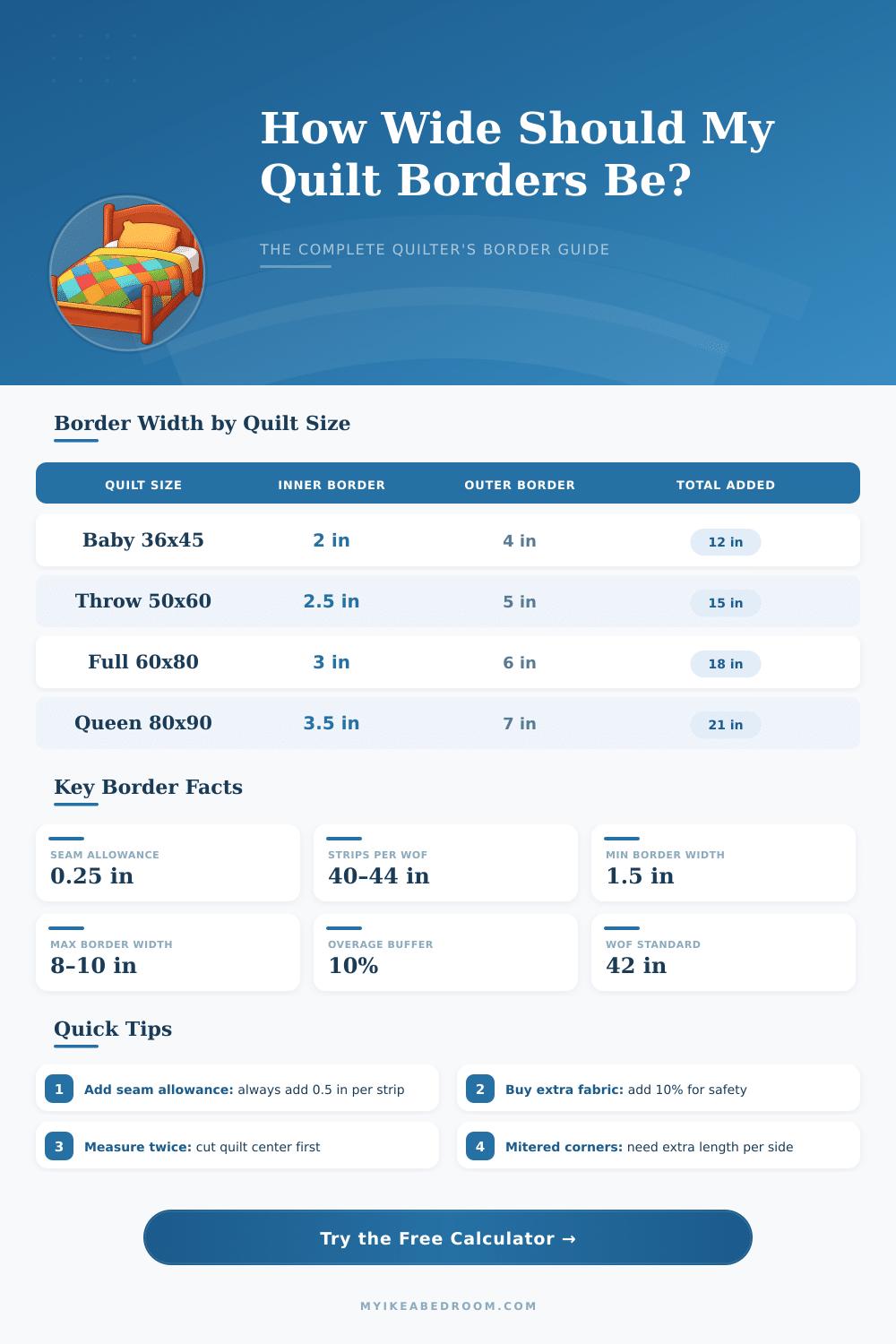
| Quilt Name | Center Size | Inner Border | Outer Border | Finished Size |
|---|---|---|---|---|
| Baby Quilt | 36 x 45 in | 2 in | 4 in | 48 x 57 in |
| Throw Quilt | 50 x 60 in | 2.5 in | 5 in | 65 x 75 in |
| Lap Quilt | 54 x 72 in | 2 in | 4 in | 66 x 84 in |
| Twin Quilt | 66 x 86 in | 3 in | 6 in | 84 x 104 in |
| Full / Double | 80 x 90 in | 3 in | 7 in | 100 x 110 in |
| Queen Quilt | 90 x 108 in | 3.5 in | 7 in | 111 x 129 in |
| King Quilt | 108 x 108 in | 4 in | 8 in | 132 x 132 in |
| Quilt Width | Border Width | Strips Needed (44 in WOF) | Cut Length per Strip | Total Yardage |
|---|---|---|---|---|
| 36 in | 2 in | 2 strips | 36 in (+ seam) | 0.125 yd |
| 50 in | 2.5 in | 2 strips | 50 in (+ seam) | 0.17 yd |
| 60 in | 3 in | 2 strips | 60 in (+ seam) | 0.22 yd |
| 80 in | 4 in | 3 strips | 44 in + pieced | 0.44 yd |
| 90 in | 4 in | 3 strips | 44 in + pieced | 0.44 yd |
| 108 in | 4 in | 3 strips | 44 in + pieced | 0.44 yd |
| 108 in | 8 in | 7 strips | 44 in + pieced | 1.56 yd |
| Border Width | Cut Width (w/ seam) | Strips per WOF Yard | Strips per 1/2 yd | Notes |
|---|---|---|---|---|
| 1.5 in | 2 in cut | 22 | 11 | Sashing / accent |
| 2 in | 2.5 in cut | 17 | 8 | Inner border |
| 2.5 in | 3 in cut | 14 | 7 | Inner / sashing |
| 3 in | 3.5 in cut | 12 | 6 | Standard inner |
| 4 in | 4.5 in cut | 9 | 4 | Mid border |
| 5 in | 5.5 in cut | 8 | 4 | Outer border |
| 6 in | 6.5 in cut | 6 | 3 | Wide outer |
| 8 in | 8.5 in cut | 5 | 2 | Statement border |
The border of a quilt form a frame around the outside of the face. It fits to change the look of a finished quilt. Also borders help to grow the quilt what is useful in case the central blocks do not reach the wanted size.
Add a border to one block of a quilt can turn it into an object like a cushion a bag or a big carry bag.
How to Add Borders to a Quilt
Correctly measuring the sizes is very important. For side borders measure up and down to the left, in the centre and to the right then average those numbers. That helps the border stay square and smooth.
The best way is to lay the top of the quilt on a big surface or the floor and measure through the centre in three spots. Add those three values and divide by three to reach the average. That average is used for the length of cut border strips.
When you sew the border, match the end of the fabric strip with the end of the quilt and pin it. Many pins along the whole length is a good idea. It is fine if there is a bit of extra fabric on one side.
Set pining from the centre out. After sewing of every side border, press the seam to the border to reach a more flat seam.
Borders do not have to be plain every time. For example, one method is to make a narrow solid border, then a border with nice squares, then another narrow solid border around it. Some quilts have several borders with different widths and shades.
Another idea is to use several borders that copy the pattern of blocks, for example switching one-color strips and two-color white strips then joining them. A dark neutral tone like black or charcoal can push the colours of the actual project.
The width of a border stays a personal choice. For a quilt with twelve-inch blocks it can be three, four, six or nine inches. It depends on the kind and beauty of the printed fabric that one uses.
Before adding borders square up the blocks so that all of them are the same size, what makes things easier. During calculation of the width add a quarter inch to every side for seam allowance.
Borders are useful too. If one uses a long-arm machine to quilt, the borders hold all seams along the edges. Whatever pattern one chooses, the quilt needs count for the border too.
For example, if the pattern means quilting every four inches, that must happen also on the border. Fun ideas for a quilt border include feathers, herringbone patterns, piano keys and linked squares, all done only with a walking foot.
In traditional quilts the design covers the area of the mattress, while everything hanging off the sides forms only a simple border. Thatspares time by cutting down the amount of piecing that one needs.