🪴 Planter Box Soil Calculator
Calculate exactly how much soil you need for any planter box or raised bed
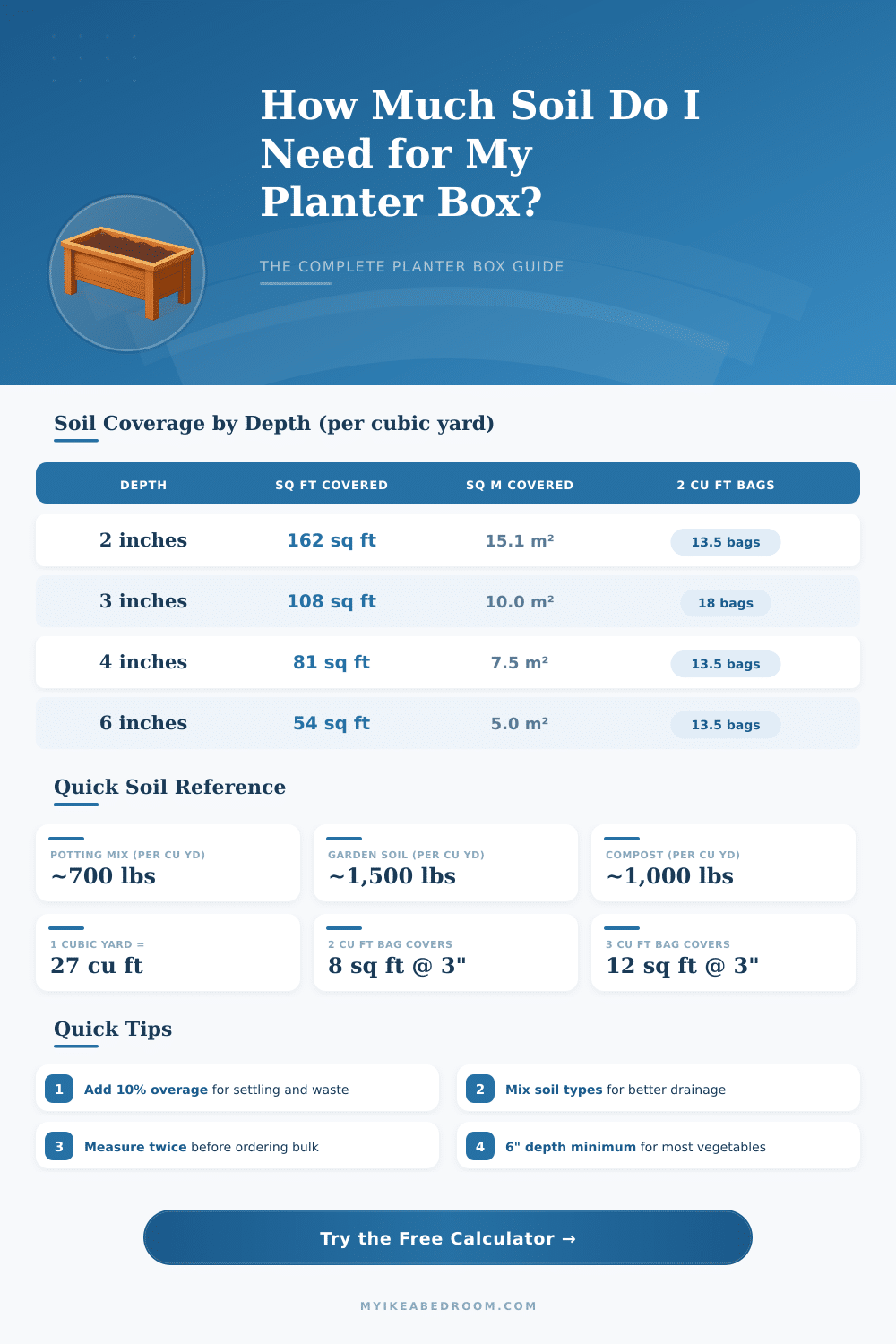
| Depth | Sq Ft Covered | Sq Meters | 2 cu ft Bags | 3 cu ft Bags |
|---|---|---|---|---|
| 1 inch (2.5 cm) | 324 sq ft | 30.1 m² | 13.5 | 9 |
| 2 inches (5 cm) | 162 sq ft | 15.1 m² | 13.5 | 9 |
| 3 inches (7.6 cm) | 108 sq ft | 10.0 m² | 13.5 | 9 |
| 4 inches (10 cm) | 81 sq ft | 7.5 m² | 13.5 | 9 |
| 6 inches (15 cm) | 54 sq ft | 5.0 m² | 13.5 | 9 |
| 8 inches (20 cm) | 40.5 sq ft | 3.8 m² | 13.5 | 9 |
| 12 inches (30 cm) | 27 sq ft | 2.5 m² | 13.5 | 9 |
| 18 inches (46 cm) | 18 sq ft | 1.7 m² | 13.5 | 9 |
| 24 inches (61 cm) | 13.5 sq ft | 1.25 m² | 13.5 | 9 |
| Bag Size | Cu Ft per Bag | Bags per Cu Yd | Coverage @ 3 in | Coverage @ 6 in |
|---|---|---|---|---|
| Small (1 cu ft) | 1 cu ft | 27 bags | 4 sq ft | 2 sq ft |
| Standard (2 cu ft) | 2 cu ft | 13.5 bags | 8 sq ft | 4 sq ft |
| Large (3 cu ft) | 3 cu ft | 9 bags | 12 sq ft | 6 sq ft |
| Jumbo (4 cu ft) | 4 cu ft | 6.75 bags | 16 sq ft | 8 sq ft |
| Bulk Yard Bag | 27 cu ft | 1 yard | 108 sq ft | 54 sq ft |
| Project | Dimensions | Area | Cu Yds @ 12 in | 2 cu ft Bags |
|---|---|---|---|---|
| Window Box | 4 ft x 1 ft | 4 sq ft | 0.15 cu yd | 2 bags |
| Small Raised Bed | 4 ft x 4 ft | 16 sq ft | 0.59 cu yd | 8 bags |
| Standard Raised Bed | 8 ft x 4 ft | 32 sq ft | 1.19 cu yd | 16 bags |
| Herb Garden Planter | 6 ft x 2 ft | 12 sq ft | 0.44 cu yd | 6 bags |
| Large Veggie Bed | 12 ft x 4 ft | 48 sq ft | 1.78 cu yd | 24 bags |
| Round Pot (3 ft) | 3 ft diam. | 7.07 sq ft | 0.26 cu yd | 4 bags |
| Balcony Planter | 3 ft x 1 ft | 3 sq ft | 0.11 cu yd | 2 bags |
| XL Community Bed | 16 ft x 4 ft | 64 sq ft | 2.37 cu yd | 32 bags |
Loose soil and potting mixes can settle 10–20% after watering. Always order at least 10% more than your calculated volume to account for this settling, especially in deep raised beds.
Buying in bulk (by the cubic yard) is more economical for projects over 3 cubic yards. For smaller planters, bagged soil is more practical. Mix potting mix with compost at a 70/30 ratio for optimal drainage and nutrition.
Planter box is a good way to grow various plants without having to dig in the yard. They stand high above the soil and often have a bottom made from cedar. Such boxes fit to store a lot of ground to feed vegetables, grasses, flowering vines, trees and even more.
High standing planter box help to escape bending during the work, what makes gardening simpler and practical.
How to Choose and Use a Planter Box
One finds many options to choose. Some form long rectangles from PVC and come in sloping, high, narrow or open forms. Others are made from wood and meant to look nice on a patio or balcony.
Planter box from wood commonly are built from top quality trees as Shorea, red cedar, white cedar or pine, together with strong frames. Those models give a clean, finished look to any outdoor space.
Picking the right tree is very important. Cedar stays a famous first option. The heartwood of cedar, juniper, cypress or other strong pines will last during several years before it will split.
Redwood and white oak also work well. Sealing of the inside with oil or finish costs little and easily helps the wood last more long.
When one uses plywood, it needs a waterproof liner, otherwise the wood will start to split. Plywood of sea grade with thick plastic liner, such as in pools, can serve at least ten years, if one cares about the outer surface. Covering of the inside with heavy black plastic is another usual method.
Thin wood strips can cover the upper edge of the plastic, so that it stays hidden.
Drainage deserves attention. Design that ensures good drainage probably should match well with the picked wood type. Food can dissolve or flow out from the box bottom over time, what affects the growth of plants in boxes compared to those in jars.
soil forms the most important part for a healthy garden. The height of many boxes measures only around nine inches and ground does not go this deeply, as many believe. One must not fill the whole thing with soil.
Making a false bottom eight inches below the top and filling only that part works well. Treated wood works for the build, but cedar beats it, even though it costs more.
Some planter box even include a frame built in, what is useful for climbing plants. Certain types have wheels below for easy movement, what helps, because after adding soil a planter box is almost impossible to move. Adding wheels could be useful, but they must bee big ones.
Strawberries, raspberries, tomato plants and grasses all benefit in planter box set up onporch or balcony.