🎨 Paint Calculator for Room
Enter your room dimensions to calculate exactly how much paint you need — walls, ceiling & trim.
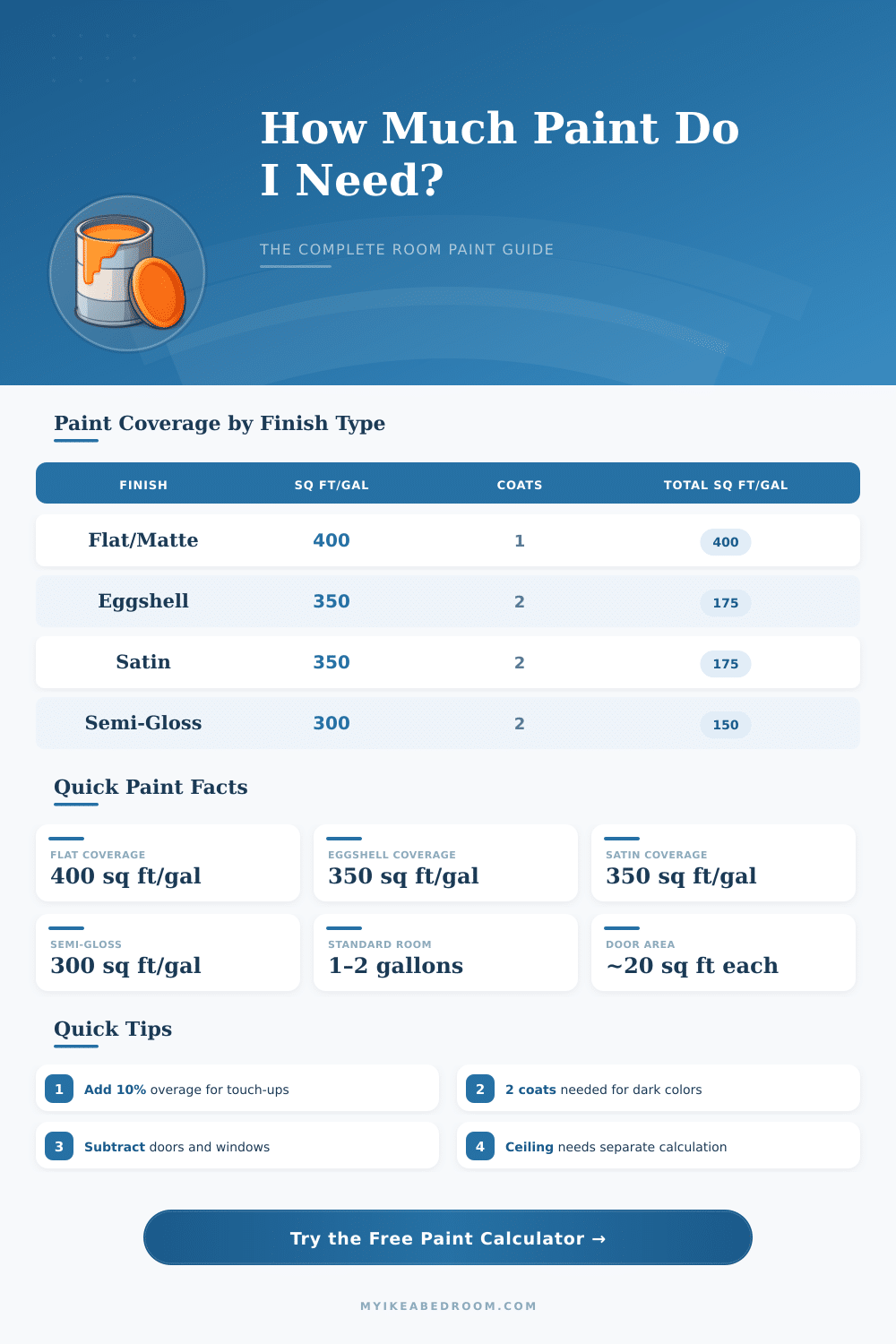
| Coats | Effective sq ft/gal | Gals for 200 sq ft | Gals for 400 sq ft | Gals for 600 sq ft | Gals for 800 sq ft |
|---|---|---|---|---|---|
| 1 coat | 350 | 0.57 | 1.14 | 1.71 | 2.29 |
| 2 coats | 175 | 1.14 | 2.29 | 3.43 | 4.57 |
| 3 coats | 117 | 1.71 | 3.43 | 5.14 | 6.86 |
| Room | Dimensions | Wall Area (sq ft) | Gallons (walls only) | Gallons (walls + ceiling) |
|---|---|---|---|---|
| Small Bathroom | 5 x 8 ft | 192 | 1.1 | 1.3 |
| Bathroom | 6 x 8 ft | 217 | 1.2 | 1.6 |
| Home Office | 10 x 10 ft | 320 | 1.8 | 2.4 |
| Bedroom | 12 x 14 ft | 416 | 2.4 | 3.2 |
| Master Bedroom | 14 x 18 ft | 512 | 2.9 | 4.2 |
| Living Room | 15 x 20 ft | 560 | 3.2 | 4.9 |
| Large Living Room | 18 x 24 ft | 672 | 3.8 | 6.1 |
| Open Floor Plan | 20 x 30 ft | 800 | 4.6 | 7.0 |
| Opening Type | Typical Size | Area (sq ft) | Area (m²) | Paint Saved (eggshell 2 coats) |
|---|---|---|---|---|
| Standard Door | 3 x 6.8 ft | 20.4 | 1.9 | 0.23 gal |
| Double Door | 6 x 6.8 ft | 40.8 | 3.8 | 0.47 gal |
| Small Window | 2 x 3 ft | 6 | 0.6 | 0.07 gal |
| Standard Window | 3 x 4 ft | 12 | 1.1 | 0.14 gal |
| Large Window | 4 x 5 ft | 20 | 1.9 | 0.23 gal |
| Sliding Glass Door | 6 x 7 ft | 42 | 3.9 | 0.48 gal |
| Container Size | Volume | Coverage (1 coat) | Coverage (2 coats) | Best Used For |
|---|---|---|---|---|
| Sample / Tester | 8 fl oz (0.06 gal) | ~25 sq ft | ~12 sq ft | Testing colors |
| Quart | 32 fl oz (0.25 gal) | ~90 sq ft | ~45 sq ft | Small areas / trim |
| Half Gallon | 64 fl oz (0.5 gal) | ~175 sq ft | ~88 sq ft | Single small room |
| Gallon | 128 fl oz (1 gal) | ~350 sq ft | ~175 sq ft | Standard rooms |
| 5-Gallon Bucket | 5 gal | ~1750 sq ft | ~875 sq ft | Large projects |
Paint is made up of material that when one applies it on a solid surface and leaves to dry, creates a thin layer like a film. In art, one uses it to produce images that one knows as paintings. One can describe paint also as a mix of parts that includes binding agents, color, VOCs and extras.
After use in a thin layer, it creates a firm and dry film by means of steps like drying or evaporation.
What Paint Is and How to Paint
For newcomers in art, acrylic paints or watercolors commonly are more forgiving, because they dry more quickly and clean more easily. Acrylics especially can copy the look of oil paints, while they are simpler to work with. Winsor and Newton water-based oil paints form another good option for programs at university level, although they do not belong to the most brilliant market products.
In painting, the main goal is to reach a range of textures, surfaces and colors. The first works must not become lasting pieces. They serve more as warm-up.
Good advice is simply to produce fifty paintings. Like this the amount helps to build actual sklil over time.
In painting, the mainstream spot is reach diversity of textures, surfaces and colours. Painting helps also relaxation in a calm mode. When one ends an image, one feels real fulfillment, knowing that it is done by hand instead of bought in a store.
In the area of home renewal, paint has many kinds. Between them are paints for interiors, for outsides, spray paints, paints for chalk, primer, metallic spray paints, paint for floor, paint for ceiling and stains four wood. Colors truly affect the feeling of room.
If one paints ceiling and walls by means of same color, room can seem more small. Use bright color for an accent wall to alter the look of the space.
Latex-based home paint usually is preferred for the top covering, and no problem exists during applying latex paint above dry oil primer. For bathrooms, Benjamin Moore Kitchen and Bath paint answers well for both walls and ceilings. It owns a bit of gloss, between eggshell and pearl finish.
The whole Benjamin Moore paint line is seen as good, and Sherwin Williams offers great internalpaint also.
Painting of IKEA furniture forms a whole theme. The most known IKEA lines, as Billy, Absence, Kallax and Malm, are made up of partial boards covered by means of veneer, not from solid wood. Veneer is smooth and non-porous, so it does not take paint as well as natural wood.
The IKEA KURA bed can receive painting after light sanding first, wiping of dust by means of a damp cloth and later use of wood primer. Rolled cabinet paint lightly with two coats works best. Light sanding between coats gives a factory-like finish.
Primer based on shellac, as Zinsser BIN, works well, even for beaten furniture. Even so, bits covered by means of fabric should not be painted.