🪵 Lumber Weight Calculator
Calculate the total weight of any lumber order by species, dimensions & moisture content
| Nominal Size | Actual Size (in) | Actual Size (mm) | Cross-Section Area (sq in) |
|---|---|---|---|
| 1x2 | 0.75 x 1.5 | 19 x 38 | 1.125 |
| 1x4 | 0.75 x 3.5 | 19 x 89 | 2.625 |
| 1x6 | 0.75 x 5.5 | 19 x 140 | 4.125 |
| 1x8 | 0.75 x 7.25 | 19 x 184 | 5.438 |
| 2x4 | 1.5 x 3.5 | 38 x 89 | 5.25 |
| 2x6 | 1.5 x 5.5 | 38 x 140 | 8.25 |
| 2x8 | 1.5 x 7.25 | 38 x 184 | 10.875 |
| 2x10 | 1.5 x 9.25 | 38 x 235 | 13.875 |
| 2x12 | 1.5 x 11.25 | 38 x 286 | 16.875 |
| 4x4 | 3.5 x 3.5 | 89 x 89 | 12.25 |
| 4x6 | 3.5 x 5.5 | 89 x 140 | 19.25 |
| 6x6 | 5.5 x 5.5 | 140 x 140 | 30.25 |
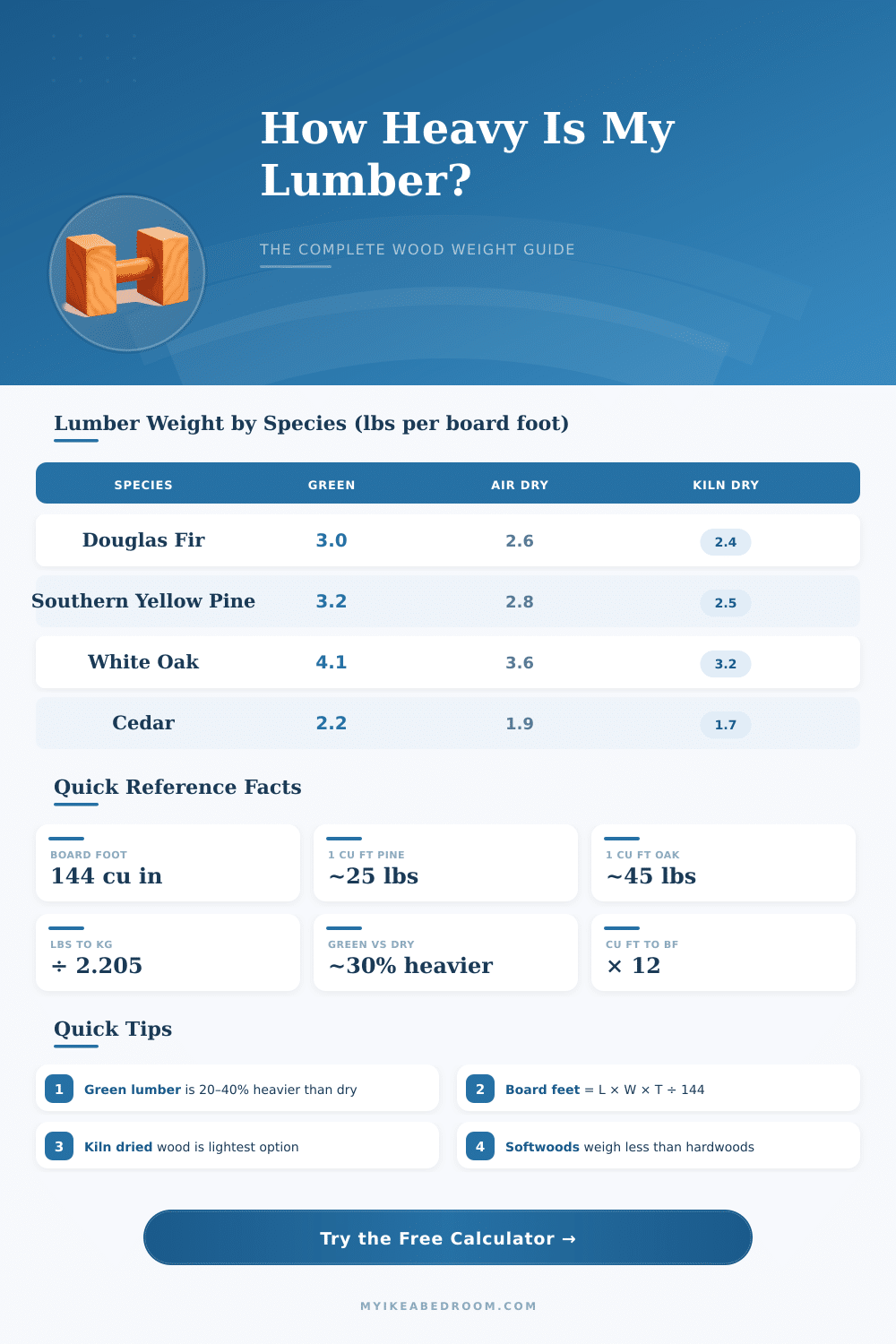
| Species | Green (freshly cut) | Air Dried (~15%) | Kiln Dried (~8%) |
|---|---|---|---|
| Douglas Fir | 38 | 34 | 32 |
| Eastern White Pine | 32 | 28 | 25 |
| Southern Yellow Pine | 43 | 39 | 36 |
| White Oak | 63 | 53 | 47 |
| Red Oak | 64 | 50 | 44 |
| Hard Maple | 57 | 50 | 44 |
| Western Red Cedar | 27 | 25 | 23 |
| Redwood | 50 | 28 | 26 |
| Black Walnut | 58 | 43 | 38 |
| Spruce | 34 | 30 | 27 |
| Hemlock | 50 | 32 | 29 |
| Poplar | 47 | 32 | 28 |
| Species | Lbs per Board Foot | Kg per Board Foot | Category |
|---|---|---|---|
| Western Red Cedar | 1.91 | 0.87 | Softwood |
| Eastern White Pine | 2.08 | 0.94 | Softwood |
| Redwood | 2.17 | 0.98 | Softwood |
| Spruce | 2.25 | 1.02 | Softwood |
| Poplar | 2.33 | 1.06 | Hardwood |
| Hemlock | 2.42 | 1.10 | Softwood |
| Douglas Fir | 2.67 | 1.21 | Softwood |
| Southern Yellow Pine | 3.00 | 1.36 | Softwood |
| Black Walnut | 3.17 | 1.44 | Hardwood |
| Red Oak | 3.67 | 1.66 | Hardwood |
| Hard Maple | 3.67 | 1.66 | Hardwood |
| White Oak | 3.92 | 1.78 | Hardwood |
Lumber and Weight are things you think about when you plan to build something, organize transfer or estimate what really lasts on the load of your truck. A calculator for Weight of Lumber converts boring math into an easy task; simply enter the measures and type of the wood, and you receive a reliable guess about Weight and amount. Recently I tested one of them with specific details and it pointed around 182 pounds for a specific species of wood.
Here the main point: the content of moisture probably is the biggest factor, that decides, whether a board seems lightweight or very heavy. Green wood, recently from the mill; fills up fully with water, what pushes it much more heavy than any, that already dried. Wood dried in dryers goes through like a bake in a kiln, what removes the humidity and drops the Weight a lot compared to the green brother.
What Makes Lumber Heavy or Light
Like this, dried 2x4x8-board from sugar pine and green 2x4x8 from white oak are not even close one to the other according to Weight. That pine board? You could carry it one-handed from the store.
Dry wood needs time and attention. Shorter and less big bits lose their humidity more quickly than long and large ones. Those big parts can sit during months, sometimes even more than a year, before they fully dry, according to the temperature, the air-moisture and the airflow in your region.
Even so tinier and shorter bits? They ready themselves in only some weeks, if one gives to them space.
The length clearly affects the Weight of a board, and although it sounds easy, there is nuance. When wood is heavier in one end than in the other, find the Weight of the whole, later use that for estimate the distribution of Weight regarding the support point. It is not hard, only an extra step.
For transport needs, wood dried in dryers usually one estimates at around 7 percent of moisture after one considers the shrinking. The upper weights follow the standards of the association for Lumber according to thicknesses. Here one finds tables, that detail weights each square foot for common wood and for products like plywood, MDF, particle board and melamine.
The board foot stays the usual unit in United States, so wood with certain thickness and species, cut and weighed according to that.
Treated wood adds its own extra to the Weight. Average treated wood gains around 0.06 pounds each cubic foot because of the chemical additions, during wood treated four ground contact reaches until around 0.15 pounds each cubic foot. The Weight of plywood ranges according to thickness also.
5/8-inch sheet weighs about 48 pounds, while 3/4-inch plywoodwill reach more to 60.8 pounds.
There is a clear tie between the strength of wood and its Weight, although not as simple, as one could believe. Sometimes more lightweight wood works even more well… Take for instance a paddle for a canoe.
Young wood commonly is soft and cracks under pressure, hence the density matters more than one would assume. That average Weight for cubic foot, that one sees in a list? Multiply it by your amount, and you have a precise calculation for the Weight.