🔥 Hydronic Baseboard Heater Calculator
Calculate the exact BTU output and baseboard length needed to heat any room efficiently
BTU/hr per ft
BTU/hr per ft
BTU/hr per ft
BTU/hr per ft
Recommended
Condensing System
Baseboard Run
Efficiency
| Room Size (sq ft) | BTU/hr (Moderate Climate) | BTU/hr (Cold Climate) | Baseboard Length Needed |
|---|---|---|---|
| 80 sq ft (8x10) | 1,600 – 2,000 | 2,400 – 3,200 | 3 – 4 ft |
| 100 sq ft (10x10) | 2,000 – 2,500 | 3,000 – 4,000 | 4 – 5 ft |
| 120 sq ft (10x12) | 2,400 – 3,000 | 3,600 – 4,800 | 4 – 6 ft |
| 150 sq ft (10x15) | 3,000 – 3,750 | 4,500 – 6,000 | 5 – 8 ft |
| 200 sq ft (10x20) | 4,000 – 5,000 | 6,000 – 8,000 | 7 – 11 ft |
| 250 sq ft (12x21) | 5,000 – 6,250 | 7,500 – 10,000 | 9 – 14 ft |
| 300 sq ft (15x20) | 6,000 – 7,500 | 9,000 – 12,000 | 11 – 17 ft |
| 400 sq ft (20x20) | 8,000 – 10,000 | 12,000 – 16,000 | 14 – 22 ft |
| Insulation Level | Mild Climate | Moderate Climate | Cold Climate | Very Cold |
|---|---|---|---|---|
| Excellent | 10 BTU/sq ft | 15 BTU/sq ft | 20 BTU/sq ft | 25 BTU/sq ft |
| Good | 15 BTU/sq ft | 20 BTU/sq ft | 25 BTU/sq ft | 30 BTU/sq ft |
| Average | 20 BTU/sq ft | 25 BTU/sq ft | 30 BTU/sq ft | 40 BTU/sq ft |
| Poor | 25 BTU/sq ft | 30 BTU/sq ft | 40 BTU/sq ft | 50 BTU/sq ft |
| Very Poor | 30 BTU/sq ft | 40 BTU/sq ft | 50 BTU/sq ft | 60 BTU/sq ft |
| Room Type | Typical Size | BTU/hr Needed | Baseboard Length | Notes |
|---|---|---|---|---|
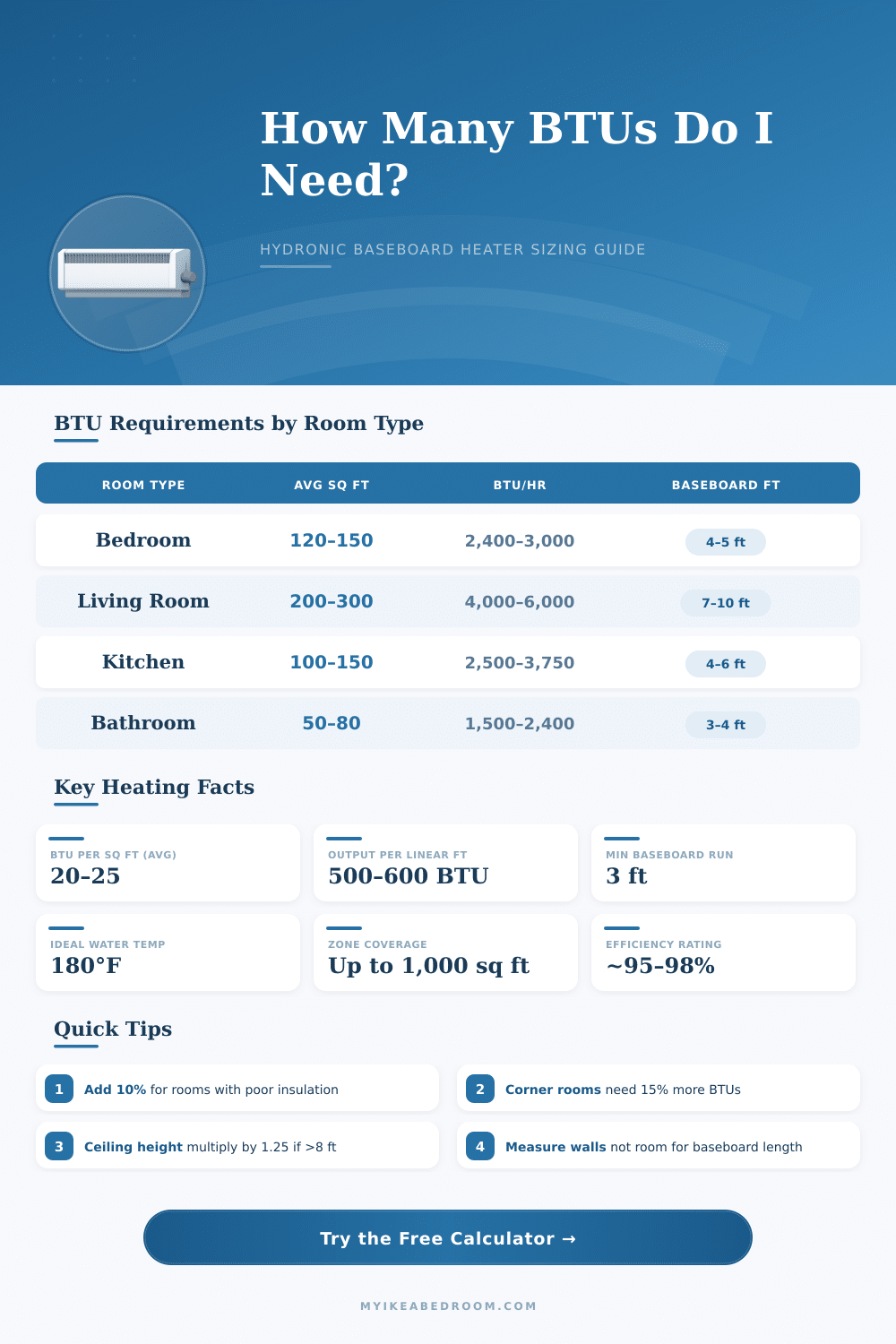
| Bathroom | 50 – 80 sq ft | 1,500 – 2,400 | 3 – 4 ft | Humidity factor |
| Bedroom | 120 – 180 sq ft | 2,400 – 4,500 | 4 – 8 ft | Lower setpoint OK |
| Home Office | 100 – 150 sq ft | 2,000 – 3,750 | 4 – 7 ft | Equipment adds heat |
| Living Room | 200 – 400 sq ft | 4,000 – 10,000 | 7 – 18 ft | Open plan needs more |
| Kitchen | 100 – 200 sq ft | 2,000 – 5,000 | 3 – 9 ft | Appliances reduce load |
| Basement | 400 – 800 sq ft | 6,000 – 16,000 | 10 – 30 ft | Ground insulation critical |
| Sunroom | 100 – 250 sq ft | 3,000 – 12,500 | 5 – 22 ft | High glass area |
| Garage | 400 – 600 sq ft | 10,000 – 18,000 | 17 – 33 ft | Uninsulated doors |
Warm water flowing through fins; here is the mainstream idea of Hydronic Baseboard Heater units. The water travels inward through those fins and later sends out its heat in the room air. When the warm air climbs along the wall, it naturally pulls colder air from the floor upward.
That is a simple convection device that helps to spread the heat through the whole space.
How Water-Filled Baseboard Heaters Work
What sets those heaters apart is the gentle and steady heat that they give. Whether filled with oil or with water, they keep the room temperature even after turning off. The internal liquid keeps the heat for a bit of time so the system does not need constant energy to simply keep the state.
When the thermostat signals to restart, there is yet a bit of heat, what makes the cycle smooth and efficient.
Baseboard Heater units come in many kinds. There are direct electrical models, Hydronic electrical and convection variants. In Hydronic systems, the water or oil first warms up, before handing the heat to the air, a totally different method than electrical elements, that blow heat directly.
Electrical Hydronic units measure in watts, while systems with warm water from boilers use BTUs.
For heating of a whole house, Hydronic baseboard units commonly are the best choice, especially if connected to a central boiler. The water warms in the boiler, then a pump pushes it through all tubes. Valves control the flow, and the thermostat decides when everything turns on or off.
Want you to set the temperature? Simply change the setting of the thermostat. One big advantage…
Rather than systems with blown air, you never must care about filters that need replacing.
The mainstream disadvantage is the starting cost. Swapping heaters for convection baseboard units can cost around 250 dollars, but full Hydronic setup reaches 800 dollars or more. About energy savings, Hydronic electrical baseboard units do not truly beat convection electrical ones, watt against watt.
Even so, the more even and comfortable warming could urge you too lower the thermostat a few degrees, what saves money over time.
About safety, Hydronic baseboard units stay quite cool to touch without danger. They do not reach temperatures that could light wood or other materials beside them. Common electrical Baseboard Heater units do get warmer, so the lower surface temperature of Hydronic units is a big plus if you have little children running around.
The Runtal company makes baseboard radiators here in Quarterly Hill, Massachusetts, and offers a five-year limited guarantee for their products. Their units even can work with water temperatures around 140 degrees, what is ideal for systems with radiant floorwarming.
Older Hydronic systems sometimes have problems with rust at the joints and can over time have bent fins. Cleaning and straightening those fins helps, though sometimes replacing the whole unit is wiser.