🪵 Hardwood Flooring Calculator
Calculate exact square footage, board count, and waste factor for any room shape or wood species
| Board Width | Board Length | Sq Ft / Board | Boards / 20 sq ft Box | Linear Ft / 100 sq ft |
|---|---|---|---|---|
| 2-1/4 in | Mixed (avg 36 in) | 0.56 | ~36 boards | 533 lin ft |
| 3-1/4 in | Mixed (avg 48 in) | 1.08 | ~18 boards | 369 lin ft |
| 5 in | Mixed (avg 48 in) | 1.67 | ~12 boards | 240 lin ft |
| 7 in | Mixed (avg 60 in) | 2.92 | ~7 boards | 171 lin ft |
| 5 in | 84 in (7 ft) | 2.92 | ~7 boards | 171 lin ft |
| Installation Type | Recommended Waste | Reason | Extra Boxes (per 200 sq ft) |
|---|---|---|---|
| Straight, rectangle room | 5–7% | Minimal cuts needed | ~1 box |
| Straight, irregular room | 10% | Doorways & notches | ~1-2 boxes |
| Diagonal (45°) | 12–15% | Corner triangle cuts | ~2 boxes |
| Herringbone / Chevron | 15–20% | Angle cuts on every board | ~3 boxes |
| Mixed / Random widths | 10–15% | Pattern matching waste | ~2 boxes |
| Stairs (per tread) | 25% | Nosing & riser cuts | Sold separately |
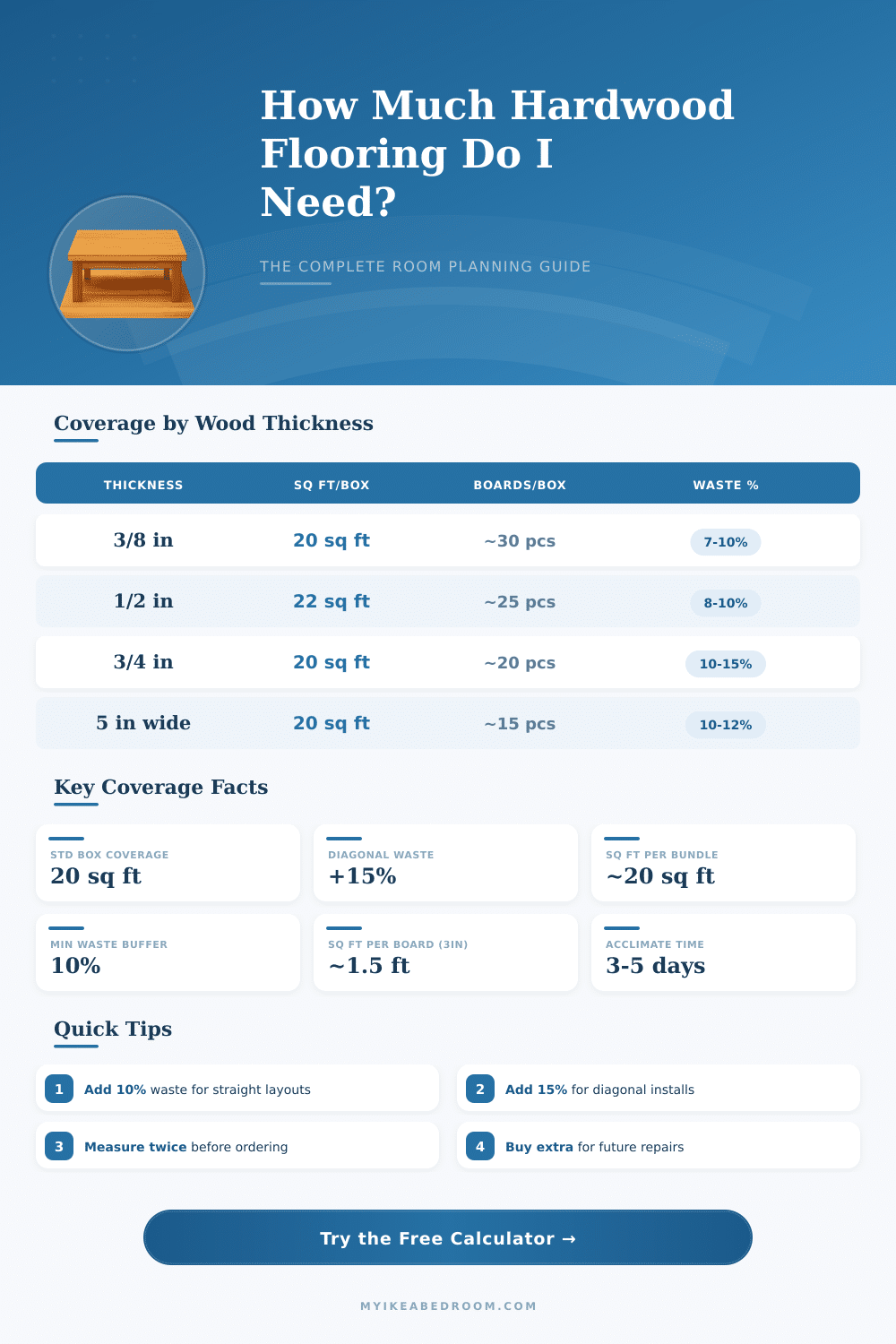
| Room Type | Typical Size | Net Sq Ft | With 10% Waste | Boxes Needed (20 sq ft) |
|---|---|---|---|---|
| Small Bedroom | 10 x 10 ft | 100 sq ft | 110 sq ft | 6 boxes |
| Standard Bedroom | 12 x 14 ft | 168 sq ft | 185 sq ft | 10 boxes |
| Master Bedroom | 14 x 16 ft | 224 sq ft | 246 sq ft | 13 boxes |
| Living Room | 15 x 20 ft | 300 sq ft | 330 sq ft | 17 boxes |
| Open Plan | 20 x 25 ft | 500 sq ft | 550 sq ft | 28 boxes |
| Dining Room | 12 x 14 ft | 168 sq ft | 185 sq ft | 10 boxes |
| Hallway | 4 x 18 ft | 72 sq ft | 79 sq ft | 4 boxes |
| Home Office | 10 x 12 ft | 120 sq ft | 132 sq ft | 7 boxes |
Hardwood flooring gives a home a classic and fancy look. Between the liked wood types is oak, hickory, maple and nut. Oak is the most chosen.
It has a pretty strong structure, it is tough and stable. Oak owns a clear shade, that producers rate. White oak works well for many tasks in almost every space.
Hardwood Floors: Types and Care
It bears a nice natural grain that adds charm and personality.
Solid hardwood flooring is made of one single piece of wood. It is the purest form of hardwood flooring, and the natural charm can not be denied easily. A big plus is that one can sand and refinish it many times during its whole life.
Squeaky floors commonly happen because of problems under the flooring, not because of the hardwood itself. Well taken care, hardwood floors in some houses last more than fifyt years.
Engineered hardwood is a bit different. It is made of layers. The upper layer forms the visible wood, while the bottom layers ensure firmness.
Engineered types include oak, hickory, maple and nut. Some of them are tough against scratches and friendly to pets. Pure solid oak delivers the typical wooden charm and feel, while engineered wood lays an artificial core under real wooden skin too lower the cost.
One can buy hardwood flooring either finished or unfinished. Unfinished wood one sands and finishes freely on the place itself to get a truly own style. If one sands and finishes it correctly, the flooring gets smooth and steady cover from wall to wall.
Finished flooring has tongue-and-groove joints, so that gaps can appear between the planks. Over time, those joints can become black, and the floors can split or crack.
Hardwood floors stay very liked and can bring good profit for investment, especially if one plans to sell in the coming few years. The range of wood types and finishes means free design choices. Hardwood bears real natural charm, with as much variety as the wooden species and ways to handle it.
Some folks themselves laid hardwood floors. It is a rewarding project, but hiring expert help can go more quickly and not much more in price. Before the installation, it is useful to let the wood content inside and leave it out, so that it adapts to the home setting.
Renting a sander costs much less than replacing the whole flooring. Shiny flooring reflects light more well and looks more bright. Also, dusty materials bring strong risks, so stayingsomewhere else during the work is a wise idea.
Old hardwood of decades past commonly came from slices of big, aged trees. Such trees are rare today. Modern flooring in United States comes from cared for fast growing trees.
The finished product has more sapwood and tends to be softer than the old hardwood in older homes.