🪣 Grout Coverage Calculator
Calculate exactly how much grout you need for any tile project — fast, accurate, and waste-free.
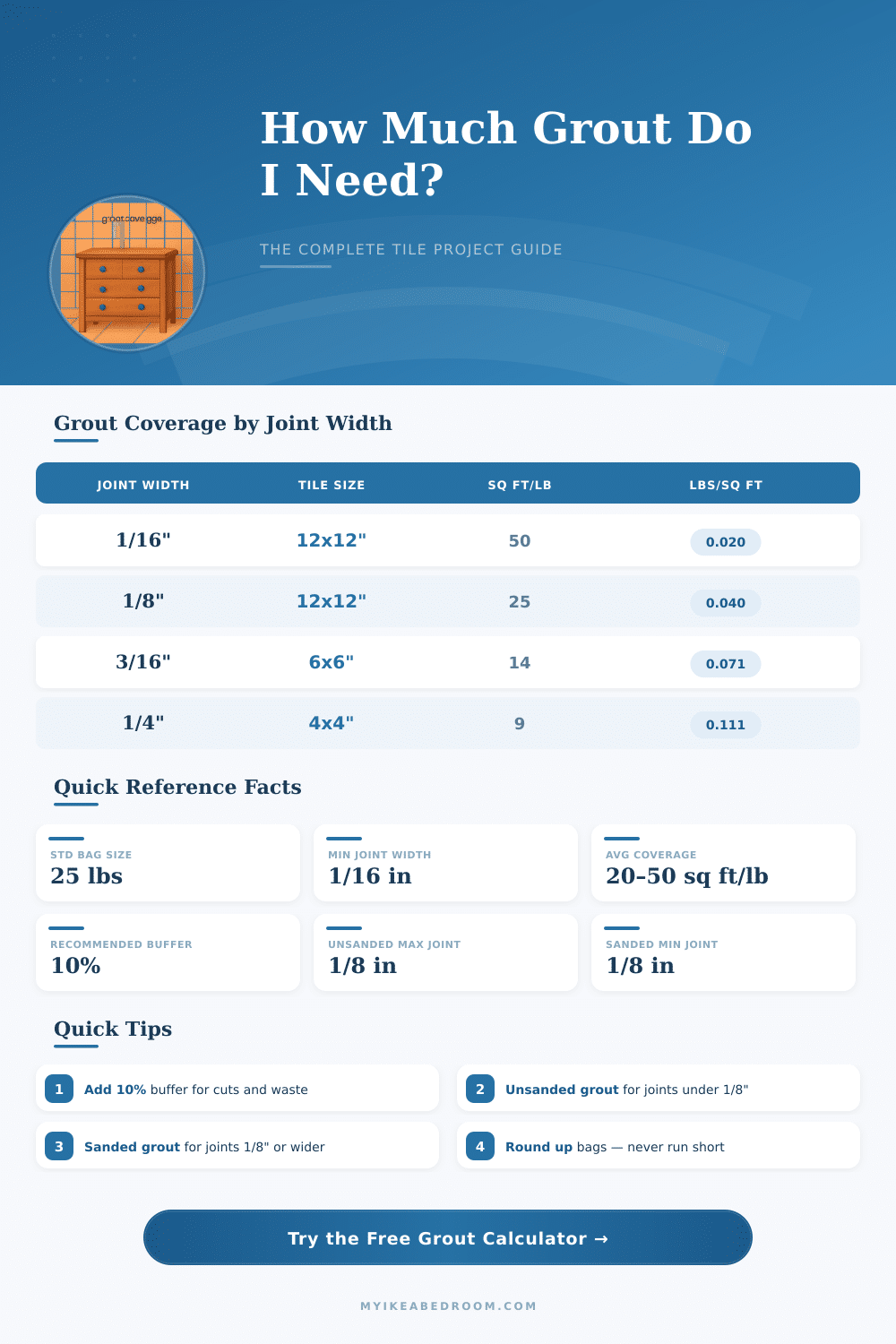
| Joint Width | Tile Size | Approx Sq Ft per Lb | Lbs per Sq Ft |
|---|---|---|---|
| 1/16 in (1.6 mm) | 12 x 12 in | 50 | 0.020 |
| 1/8 in (3.2 mm) | 12 x 12 in | 25 | 0.040 |
| 1/8 in (3.2 mm) | 6 x 6 in | 18 | 0.056 |
| 3/16 in (4.8 mm) | 6 x 6 in | 14 | 0.071 |
| 3/16 in (4.8 mm) | 4 x 4 in | 10 | 0.100 |
| 1/4 in (6.4 mm) | 4 x 4 in | 9 | 0.111 |
| 1/4 in (6.4 mm) | 12 x 12 in | 20 | 0.050 |
| 3/8 in (9.5 mm) | 12 x 12 in | 14 | 0.071 |
| 1/2 in (12.7 mm) | 12 x 12 in | 10 | 0.100 |
| 1/16 in (1.6 mm) | 2 x 2 in (mosaic) | 8 | 0.125 |
| Grout Type | Bag / Kit Size | Typical Coverage | Joint Width Range |
|---|---|---|---|
| Sanded Grout | 50 lb bag | 60–70 sq ft (1/8 in joint) | 1/8 in – 1/2 in |
| Sanded Grout | 25 lb bag | 30–35 sq ft (1/8 in joint) | 1/8 in – 1/2 in |
| Unsanded Grout | 25 lb bag | 40–80 sq ft (1/16 in joint) | 1/16 in – 1/8 in |
| Epoxy Grout | 9 kg kit | 45–55 sq ft (1/8 in joint) | 1/16 in – 1/2 in |
| Rapid-Set | 25 lb bag | 30–40 sq ft (1/8 in joint) | 1/16 in – 3/8 in |
| Pre-Mixed | 1 gal | 20–30 sq ft (1/8 in joint) | 1/16 in – 1/8 in |
| Polymer-Modified | 25 lb bag | 35–50 sq ft (1/8 in joint) | 1/16 in – 1/4 in |
| Glass Tile Grout | 10 lb bag | 25–35 sq ft (1/16 in joint) | 1/16 in – 1/8 in |
| Project | Area | Lbs Needed (1/8 in) | 25 lb Bags |
|---|---|---|---|
| Small Bathroom | 50 sq ft | 2.0 lbs | 1 bag |
| Standard Bathroom | 80 sq ft | 3.2 lbs | 1 bag |
| Kitchen Floor | 150 sq ft | 6.0 lbs | 1 bag |
| Living Room | 300 sq ft | 12.0 lbs | 1 bag |
| Full Home (1,500 sq ft) | 1,500 sq ft | 60 lbs | 3 bags (25 lb) |
| Backsplash (4x8 ft) | 32 sq ft | 1.3 lbs | 1 bag |
| Shower Surround | 90 sq ft | 5.0 lbs | 1 bag |
| Large Patio | 600 sq ft | 30 lbs | 2 bags (25 lb) |
Figuring out the needs of grout for a project can be hard. Well, there are grout calculators, that makes it much easier. Such tools work for various kinds of grout, for instance that with sand, that without sand and epoxy grout.
To use one of them simply enter the sizes of the tiles, the thickness of tile and the width of grout lines. Some calculators also ask about the depth of the grout lines in decimal inches and about the whole square area, that will be covered by tiles.
How Much Grout Do You Need
Some calculators allow you to choose your product, enter details about the whole surface, size of holes and size of tiles, then give the estimate with one tap. Other tools even help to choose a particular brand of grout first, and then they count the needed amount. The whole process is really simple and quick.
Important to recall, that the intended amount is only an estimate. It is based on standard sizes of tiles and meant only for estmiates. The real amount will change according to conditions in the work place, the actual sizes of tiles and the real sizes of installed grout lines.
It is good to add five to ten percent of extra material, to ensure, that the whole project is covered. Also, using enough thin glue can reduce the needed amount of grout. For ceramic tiles and glass tiles, lower the estimate by ten to fifteen percent to make up for waste, dripping and cleaning.
Charts about amounts of grout are also useful. For instance, one of them shows, that one 11-pound bag of Starlike grout covers various square areas according too size of tiles and width of gaps. Another chart describes 12×24 tiles with 3/8-inch thickness and 3/16-inch gap, that covers 123.5 square feet.
Some calculators can be a bit unclear, so doubling the result of the tool is usually safer for certain products.
grout is porous. It does not resist water, and sealer for grout does not make the shower waterproof. For wet places, epoxy grout is usually preferred.
Salt and dirt does not change it, and it only needs a rub one or two times yearly to stay nice. Darker colour of grout does not show dirt that strongly.
If the grout lines end too high, almost level with the surface of tiles, they do not stay still everywhere. Full coverage of grout is needed to ensure, that everything stays flat. For wide gaps, like half an inch, use grout made for such spaces.
Read the bag to check the amount for those tiles andgaps (it helps to mix the right amount).