🛋 Furniture Weight Calculator
Estimate the weight of any furniture piece by material, shape, and dimensions. Perfect for moving planning and floor load checks.
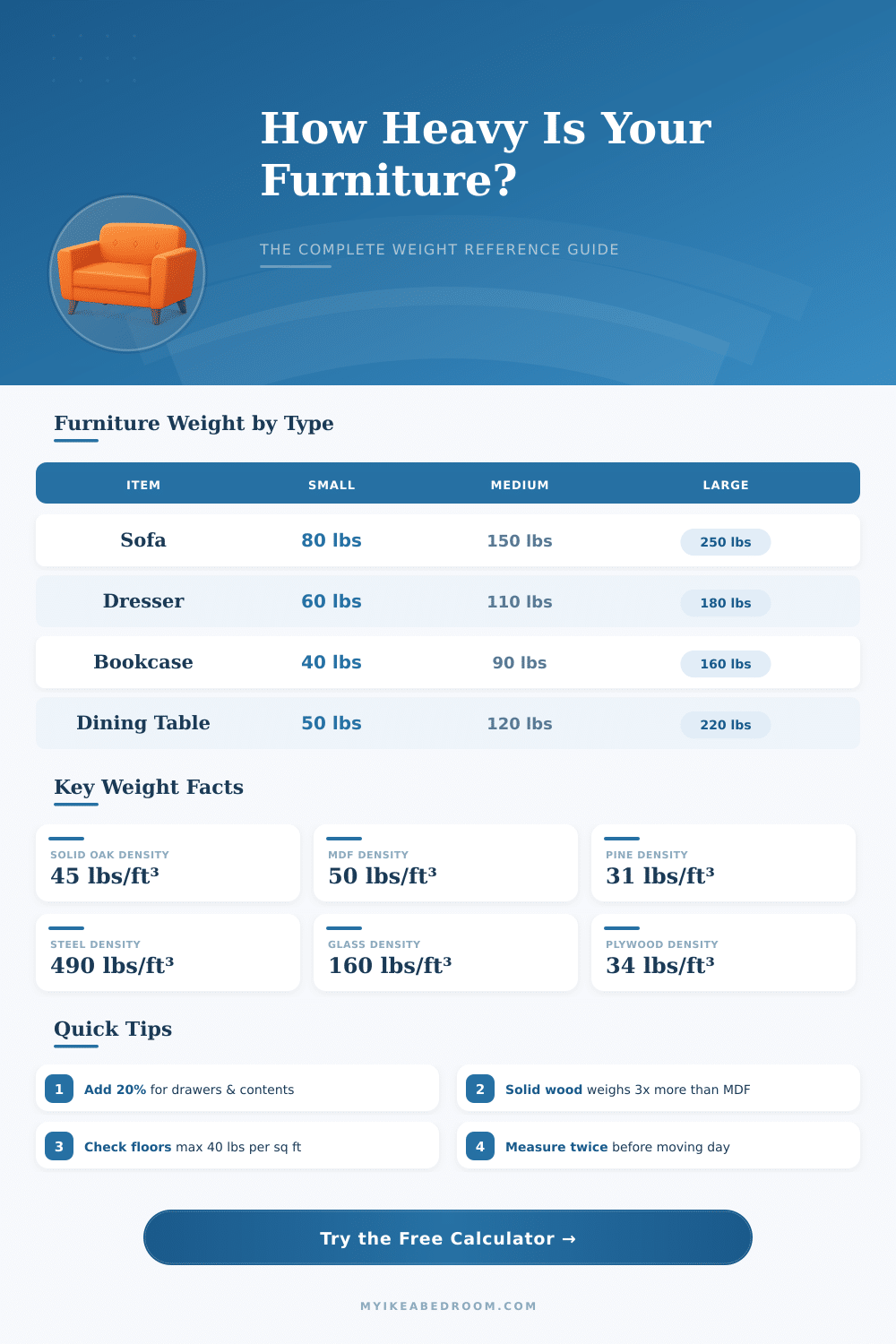
| Furniture Item | Small / Light | Medium / Average | Large / Heavy |
|---|---|---|---|
| Sofa (3-seat) | 80 lbs (36 kg) | 150 lbs (68 kg) | 250 lbs (113 kg) |
| Armchair / Accent Chair | 25 lbs (11 kg) | 55 lbs (25 kg) | 90 lbs (41 kg) |
| Dining Table | 40 lbs (18 kg) | 120 lbs (54 kg) | 220 lbs (100 kg) |
| Dining Chair (each) | 8 lbs (4 kg) | 18 lbs (8 kg) | 35 lbs (16 kg) |
| Dresser / Chest | 60 lbs (27 kg) | 110 lbs (50 kg) | 180 lbs (82 kg) |
| Bookcase / Shelving | 30 lbs (14 kg) | 75 lbs (34 kg) | 160 lbs (73 kg) |
| Desk (writing) | 35 lbs (16 kg) | 80 lbs (36 kg) | 160 lbs (73 kg) |
| Bed Frame (queen) | 60 lbs (27 kg) | 130 lbs (59 kg) | 250 lbs (113 kg) |
| Wardrobe / Armoire | 90 lbs (41 kg) | 180 lbs (82 kg) | 300 lbs (136 kg) |
| TV Stand / Media Unit | 25 lbs (11 kg) | 65 lbs (29 kg) | 130 lbs (59 kg) |
| Coffee Table | 15 lbs (7 kg) | 45 lbs (20 kg) | 100 lbs (45 kg) |
| Mattress (queen) | 50 lbs (23 kg) | 80 lbs (36 kg) | 130 lbs (59 kg) |
| Material | Density (lbs/ft³) | Density (kg/m³) | 1 ft³ weighs |
|---|---|---|---|
| Solid Hardwood (Oak) | 45 lbs/ft³ | 720 kg/m³ | 45 lbs / 20.4 kg |
| Solid Pine / Softwood | 31 lbs/ft³ | 496 kg/m³ | 31 lbs / 14.1 kg |
| MDF / Particle Board | 50 lbs/ft³ | 800 kg/m³ | 50 lbs / 22.7 kg |
| Plywood | 34 lbs/ft³ | 544 kg/m³ | 34 lbs / 15.4 kg |
| Glass & Steel Frame | 160 lbs/ft³ | 2,560 kg/m³ | 160 lbs / 72.6 kg |
| Upholstered (foam/fabric) | 5 lbs/ft³ | 80 kg/m³ | 5 lbs / 2.3 kg |
| Bamboo | 25 lbs/ft³ | 400 kg/m³ | 25 lbs / 11.3 kg |
| Rattan / Wicker | 12 lbs/ft³ | 192 kg/m³ | 12 lbs / 5.4 kg |
| Scenario | Typical Load | Floor Rating Needed | Notes |
|---|---|---|---|
| Standard residential floor | — | 40 lbs/ft³ capacity | IRC minimum requirement |
| Bookcase fully loaded (6ft) | 200–350 lbs | ~3–4 ft³ footprint | Distribute with pads |
| Grand piano | 600–1,200 lbs | Consult structural engineer | Concentrated load risk |
| Wardrobe + clothes | 300–500 lbs | ~6 ft³ footprint | Usually within spec |
| Aquarium (per gallon) | ~10 lbs/gal | Add tank + stand weight | High point load risk |
| Safe / gun safe | 200–800 lbs | May need floor reinforcement | Place near load-bearing walls |
The weight of furniture matters much more than many folks believe. It affects everything, from the costs for moving to the safety of the floor, that must bear the whole room. Little chairs commonly weigh less than 15 pounds, but big pianos easily pass 500 pounds.
Tables shelves and sofas normally sit between 50 and 150 pounds, when they are empty. Weight of chairs ranges mostly between 30 and 50 pounds, based on size and style.
Why Furniture Weight Is Important
Planning moving, you basically need a good guess about weights. Moving companies apply basic calculators to guess how much the items of a family weigh. One way works by going room to room.
Some tools allow you to add certain furniture bits one by one. One chooses the room, then notes how many of every kind of object there are. For instance, choose the bedroom and add a crib.
Or one walks through the home and does a rough guess for every box and furniture part, to reach a nearby numbre.
Skill for weight is a fully different topic, that one must consider. Some two-seat chairs point maximum weight of 250 pounds, what seems weird, because two sitters imply, that every person only weighs around 112 pounds. Other two-seat chairs mark the maximum at 500 pounds, where some note 225 pounds for one chair.
Choices for seating are tested to meet standards of ASTM. If a product claims, that it lasts 206 pounds, then it truly lasts that amount, if one follows the assembly instructions correctly. Certain chairs, storage units, beds and child products have there own weight limits, that one finds directly on the page of the product.
Also shelves have limits. Shelving long around 3 feet can bear between 60 and 120 pounds. The real skill depends strongly on the used materials, so checking with the maker is always wise.
Little cube shelves bear around 15 pounds each shelf, while others last 28 pounds each shelf.
weight on floor is another issue, that folks must know. In North America, buildings usually are built to last a live load of 40 pounds each square foot. Average everyday furniture should not create a problem for most homes.
A table of 300 pounds spreads its weight through its contact area with the floor. Move furniture slightly every six months or so can help stop damage to floors.
Tipping is a real problem also. Furniture tips forward, when some stands on the front and the back part falls down hard. Counterweights from heavy materials can help steady tipped objects like shelves, lamps and file cabinets.
Bags full of sand are another cheap option. Heavy weights and sandbags work well for outside furniture and tents, so thatthey do not blow away.
A sofa does not have the same heavy support though. Sitting lays more weight on the two back feet, so the weight does not spread equally. However the center of weight sits quite a lot below, so that it does not make the sofa unstable.