🪑 Desk Chair Height Calculator
Find your ideal ergonomic seat height based on your body measurements
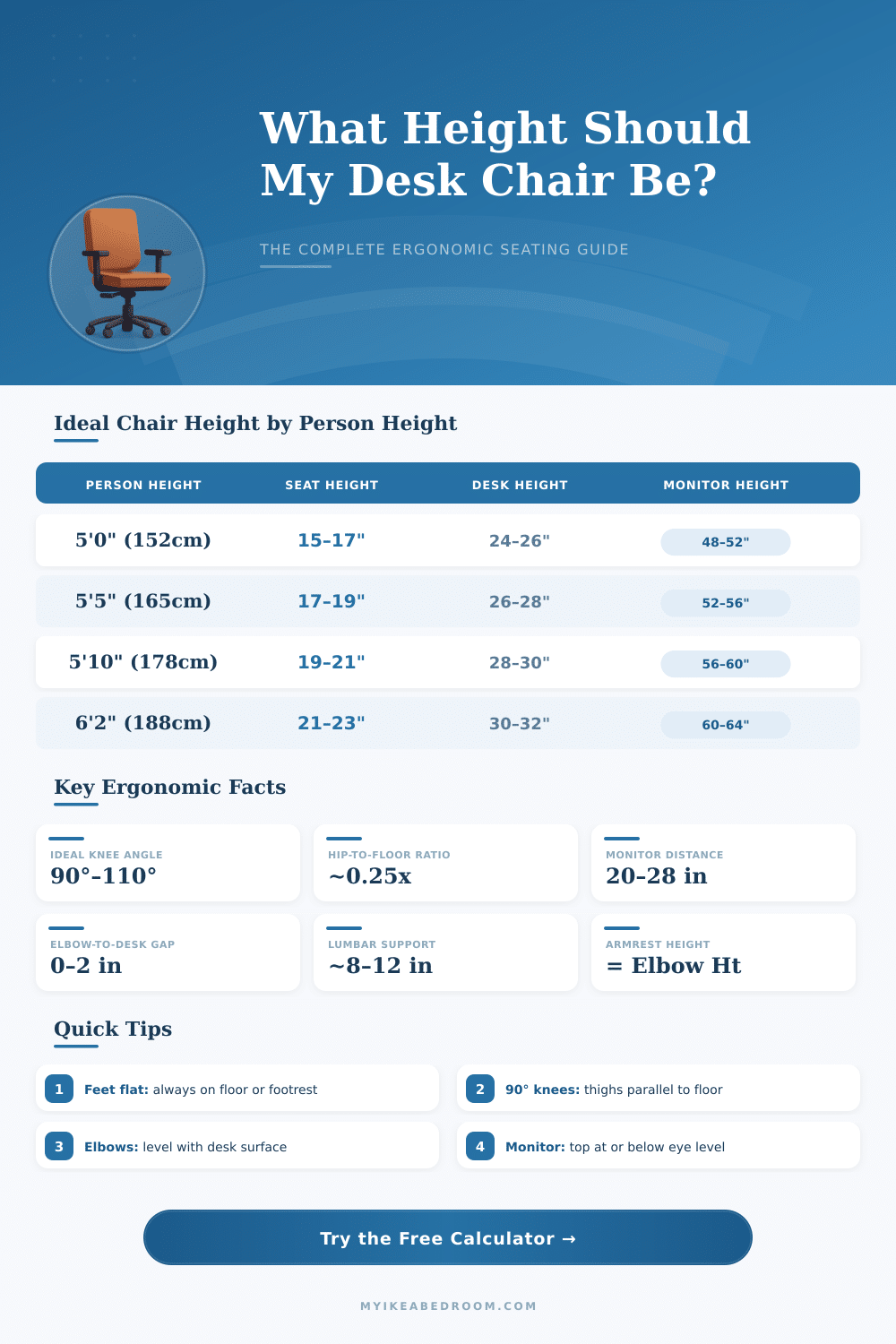
| Person Height | Ideal Seat Height | Desk Height | Monitor Eye Level | Armrest Height |
|---|---|---|---|---|
| 4'10" (147 cm) | 14–16" (36–41 cm) | 23–25" (58–64 cm) | 44–48" (112–122 cm) | 8–10" (20–25 cm) |
| 5'0" (152 cm) | 15–17" (38–43 cm) | 24–26" (61–66 cm) | 46–50" (117–127 cm) | 9–11" (23–28 cm) |
| 5'2" (157 cm) | 16–18" (41–46 cm) | 25–27" (64–69 cm) | 48–52" (122–132 cm) | 9–11" (23–28 cm) |
| 5'4" (163 cm) | 17–19" (43–48 cm) | 26–28" (66–71 cm) | 50–54" (127–137 cm) | 10–12" (25–30 cm) |
| 5'6" (168 cm) | 17.5–19.5" (44–50 cm) | 27–29" (69–74 cm) | 52–56" (132–142 cm) | 10–12" (25–30 cm) |
| 5'8" (173 cm) | 18–20" (46–51 cm) | 27.5–29.5" (70–75 cm) | 54–58" (137–147 cm) | 11–13" (28–33 cm) |
| 5'10" (178 cm) | 19–21" (48–53 cm) | 28–30" (71–76 cm) | 56–60" (142–152 cm) | 11–13" (28–33 cm) |
| 6'0" (183 cm) | 20–22" (51–56 cm) | 29–31" (74–79 cm) | 58–62" (147–157 cm) | 12–14" (30–36 cm) |
| 6'2" (188 cm) | 21–23" (53–58 cm) | 30–32" (76–81 cm) | 60–64" (152–163 cm) | 13–15" (33–38 cm) |
| 6'4" (193 cm) | 22–24" (56–61 cm) | 31–33" (79–84 cm) | 62–66" (157–168 cm) | 14–16" (36–41 cm) |
| Body Joint | Ideal Angle | Acceptable Range | Notes |
|---|---|---|---|
| Knee angle | 90° | 85°–110° | Thighs parallel to floor |
| Hip angle | 90°–100° | 85°–110° | Avoid compression of thighs |
| Elbow angle | 90° | 85°–110° | Arms relaxed at desk level |
| Monitor tilt | 0°–15° back | 0°–20° | Top of screen at/below eye level |
| Back recline | 95°–105° | 90°–120° | Slight recline reduces lumbar load |
| Lumbar support | 8–12" from seat | 6–14" | Supports natural spine curve |
| Chair Type | Typical Height Range | Best Desk Height | Best For |
|---|---|---|---|
| Office Task Chair | 16–21" (41–53 cm) | 28–30" (71–76 cm) | General office work, 5'0"–6'2" |
| Gaming Chair | 16–21" (41–53 cm) | 28–32" (71–81 cm) | Long gaming/computing sessions |
| Saddle Chair | 18–27" (46–69 cm) | 30–36" (76–91 cm) | Active sitting, reduced back strain |
| Kneeling Chair | 20–25" (51–64 cm) | 27–30" (69–76 cm) | Forward-lean posture, core engagement |
| Drafting Chair | 22–33" (56–84 cm) | 36–42" (91–107 cm) | Drafting tables, standing desk height |
| Counter Stool | 24–27" (61–69 cm) | 34–36" (86–91 cm) | Counter-height surfaces |
| Bar Stool | 28–33" (71–84 cm) | 40–42" (102–107 cm) | Bar-height surfaces |
Election of the right Height for the Desk Chair is more important than most many folks believe. Pains in the back or in the neck after long working at the table commonly shows that one needs to improve the setup. The Height of the chair seriously affects the sitting comfort, so it matters to do it correctly.
Here the hard cause: there does not exist one standard for the Height of Desk Chairs. Chairs that are not adjustable differ by the makers, so that bad choice can create real troubles. The most adjustable office chairs have range of around 17 to 21 inches from the floor, what works for many folks.
How to Choose the Right Desk Chair Height
Some sources point the comfortable range of 16 to 21 inches. Height between 19 and 21 inches usually works well for the majority, although adjustable options allow to adapt to individual needs.
In North America the standard Height of desks are around 29 inches. Typical desks in workplaces have about 29 to 30 inches. Fixed tables for tall folks commonly are 28 to 29 inches high.
Even so that 28-30-inch range may force many people too raise their Desk Chair to wrong position only to reach the table. A study from 2023 shows that almost the half of folks choose their desk and Desk Chair with entirely wrong measures. Some setups are too high, but most setups are too low.
That leads to pains and lower output.
The traditional thinking stresses the comfort. While sitting, there should not happen tension, bend or twisting in unusual ways to reach objects. The feet should rest flat on the floor or footrest.
The arms should be at 90 degrees above the table. When the elbows bend at a corner much more then 90 degrees, the desk is too low. The thighs should rest almost parallel to the floor, when the feet are flat.
The Desk Chair should support at least three-quarter part of the thigh length. Also the depth of the Desk Chair matters for good support.
The Height of the keyboard and the mouse should be low, almost in the lap, so that the wrists stay level and straight. That helps to escape strain. Some well designed desks even come in various sizes, as small, medium and big, so it matters to choose the right size.
For standing desks the Heights usually range between 38 and 42 inches. Some adjustable models reach around 23 to 48.5 inches. If you have too high a desk and can not swap the furniture, you can use adjustable chairs that go up to almost 36 inches.
Adding a tall cylinder or thick cushion on the Desk Chair also can help. Features as Height-adjustable chairs, tilting parts andbuilt-in back support all help so that the body stays comfortable and close whole day.