🚧 Deck Lumber Calculator
Calculate board count, linear feet, and total lumber needed for your deck project
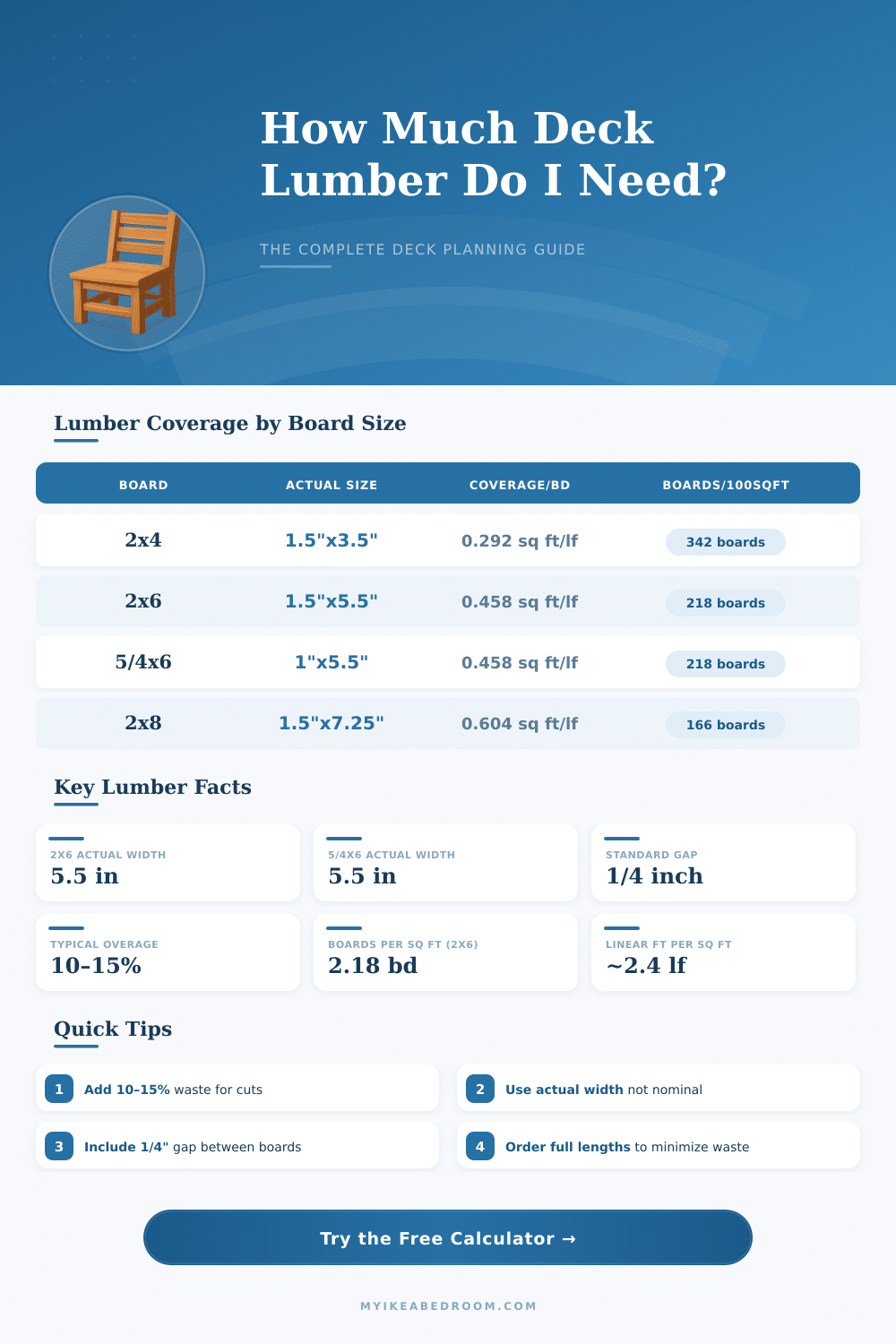
| Nominal Size | Actual Width | Coverage/Linear ft | Linear ft per 100 sq ft | Boards per 100 sq ft (16ft) |
|---|---|---|---|---|
| 2x4 | 3.5 in (8.9 cm) | 0.292 sq ft | 342 linear ft | ~22 boards |
| 2x6 | 5.5 in (14 cm) | 0.458 sq ft | 218 linear ft | ~14 boards |
| 5/4x6 | 5.5 in (14 cm) | 0.458 sq ft | 218 linear ft | ~14 boards |
| 2x8 | 7.25 in (18.4 cm) | 0.604 sq ft | 166 linear ft | ~11 boards |
| 2x10 | 9.25 in (23.5 cm) | 0.771 sq ft | 130 linear ft | ~9 boards |
| 1x6 | 5.5 in (14 cm) | 0.458 sq ft | 218 linear ft | ~14 boards |
| Deck Size | Area (sq ft) | Area (m²) | 2x6 @ 16ft (boards) | 5/4x6 @ 16ft (boards) | Linear ft Needed |
|---|---|---|---|---|---|
| 8 x 10 | 80 sq ft | 7.4 m² | 12 | 12 | 180 lf |
| 10 x 12 | 120 sq ft | 11.1 m² | 17 | 17 | 272 lf |
| 12 x 16 | 192 sq ft | 17.8 m² | 28 | 28 | 434 lf |
| 16 x 20 | 320 sq ft | 29.7 m² | 46 | 46 | 723 lf |
| 20 x 24 | 480 sq ft | 44.6 m² | 69 | 69 | 1085 lf |
| 24 x 30 | 720 sq ft | 66.9 m² | 103 | 103 | 1628 lf |
| Joist Spacing | Best Board | Max Span | Joists per 16ft |
|---|---|---|---|
| 12" o.c. | 5/4x6, 2x4 | Strong support | 17 joists |
| 16" o.c. | 2x6, 5/4x6 | Standard deck | 13 joists |
| 24" o.c. | 2x8, 2x10 | Wide span | 9 joists |
Build a Deck is nice, however the expense for Lumber commonly shocks folks. A typical professionally done wooden Deck costs between 30 and 60 dollars per square foot. The basic Lumber involves 35% to 45% of the whole budget like this it forms the biggest part of the total costs.
Wooden Deck boards usually cost between 3 and 20 dollars per square foot, if one considers only the materials without the work. The pressure-treated Lumber is the most liked and budget-friendly option. For materials of pressure-treated wooden Deck one pays around 15 to 25 dollars per square foot, or 25 to 50 dollars when one adds professional building.
How Much Does It Cost to Build a Deck?
The final amount ranges according to the size of the Deck, the trouble of the design, the preparation of the place and the local wages for work.
Redwood presents a more expensive option. Deck from redwood can spend 30 to 75 dollars or even more per square foot. For a Deck of 16 to 20 feet it results in 9,600 to 24,000 dollars, depending on the quality of the Lumber.
Cedar forms another natural choice, that tneds to be costly. Posts from cedar in various regions cost 140 to 160 dollars at big stores, and even more at special Lumber stores.
Exotic hard timbers, as Ipe, range between 10 and 20 dollars per square foot only for the material. Composite Deck boards, for instance Trex, cost between 5 and 14 dollars per square foot. Those fake boards require less work then the most natural timbers, although they are more expensive at first.
The most cheap composite Deck averages around 15 dollars per square foot. More quality materials raise the price of a Deck to 50 dollars per square foot or more.
The national middle price for a Deck is 8,157 dollars, with a range of 4,348 to 12,479 dollars. The expenses add up very quickly. In one plan for a 16-by-20-foot Deck the frame wood cost 4,000 dollars, the Deck boards 9,000 dollars, the steels 950 dollars, the seals 1,400 dollars and the gates 7,700 dollars.
A quote for a 16-by-20-foot Deck with composite reached around 17,000 dollars.
Also the buying place matters. Prices for pressure-treated 2×6-beam can almost double at a Lumber supply store compared to big stores as Home Depot. Shopping around in various stores can truly save money.
About upkeep one must also think, because it adds extra costs. Wooden Deck boards need washing and renewal of the finish all two to three years. Composite Deck needs only regular cleaning, so less work.
So much starting cost commonly pays for itself through long-term savings on care and repair. Pressure-treated frame wood stays the most budget-friendly choice for the structure of the Deck, although some new pressure-treated Lumber can have flaws. Natural wood as redwood, cedar and cypress has built-in protection without environmental problems, but it is more expensive.
Using treated woodcontinuously is the cheapest way for most Deck projects.