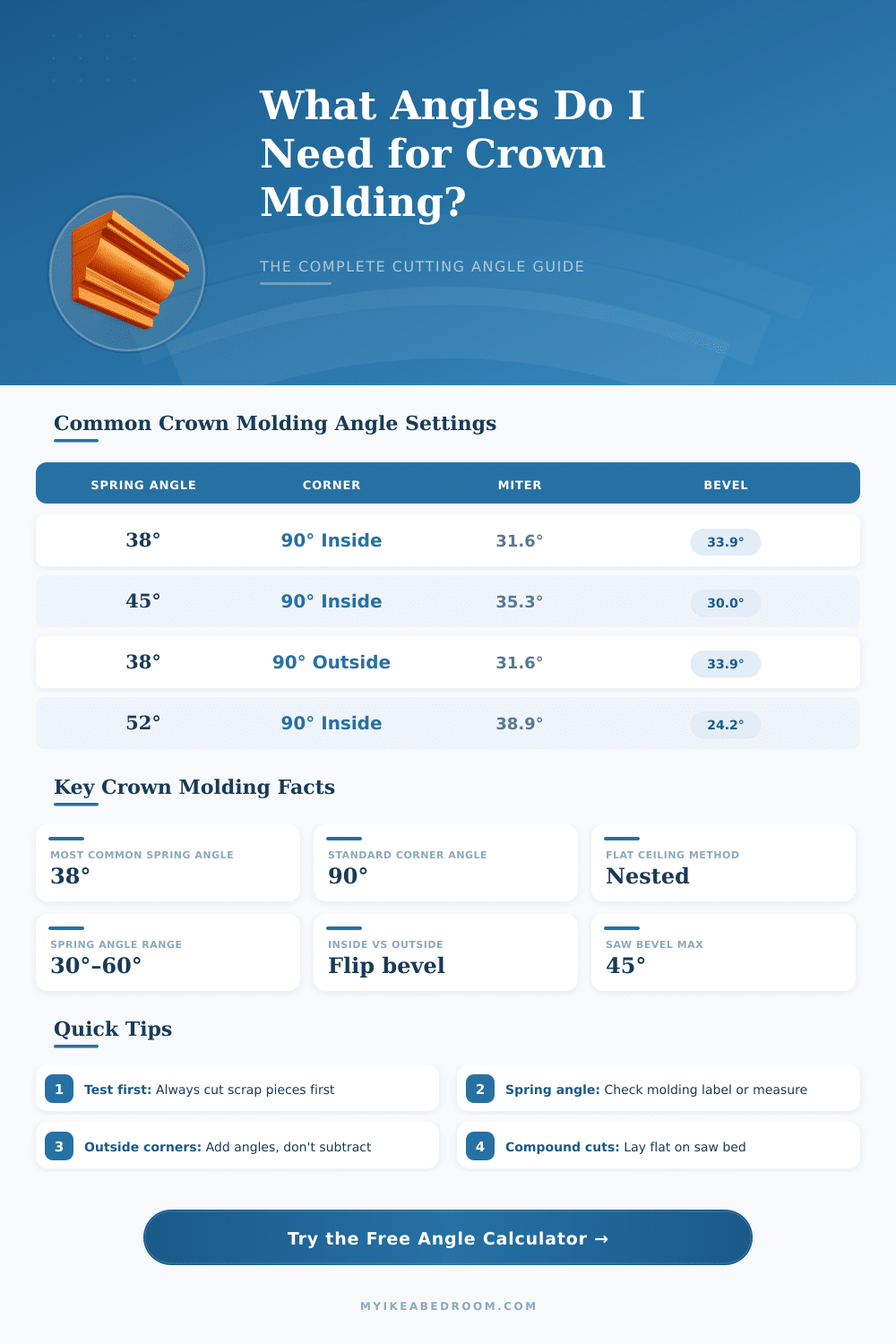
📐 Crown Molding Angle Calculator
Get exact miter and bevel saw settings for any spring angle and corner configuration
| Spring Angle | Corner Type | Miter Angle | Bevel Angle | Notes |
|---|---|---|---|---|
| 30° | Inside | 25.7° | 40.9° | Low-profile molding |
| 38° | Inside | 31.6° | 33.9° | Most common – default |
| 45° | Inside | 35.3° | 30.0° | Standard flat-back |
| 52° | Inside | 38.9° | 24.2° | High-profile molding |
| 60° | Inside | 43.3° | 17.1° | Steep angle |
| 38° | Outside | 31.6° | 33.9° | Flip left/right direction |
| 45° | Outside | 35.3° | 30.0° | Flip left/right direction |
| 52° | Outside | 38.9° | 24.2° | Flip left/right direction |
| Spring Angle | Corner Type | Miter Only | Bevel | Saw Position |
|---|---|---|---|---|
| 38° | Inside Left | 31.6° Left | 0° | Wall side down |
| 38° | Inside Right | 31.6° Right | 0° | Wall side down |
| 45° | Inside Left | 45° Left | 0° | Wall side down |
| 45° | Inside Right | 45° Right | 0° | Wall side down |
| 38° | Outside Left | 31.6° Right | 0° | Ceiling side down |
| 38° | Outside Right | 31.6° Left | 0° | Ceiling side down |
| Corner Angle | Half Angle | Typical Use | Notes |
|---|---|---|---|
| 45° | 22.5° | Acute corners | Use compound formula |
| 90° | 45° | Standard room | Most common scenario |
| 120° | 60° | Hexagonal room | Bay windows, angled walls |
| 135° | 67.5° | Bay windows | Octagonal rooms |
| 270° | 135° | Tray ceiling | Outside re-entrant corner |
crown molding for corners can seem really hard when one starts, and honestly it is between those tasks that always upsets folks. The most many crown molding have one from three typical angle corners: 38, 45 or 52 degrees. This angle corner simply shows how the molding leans against the wall.
It matters a lot, because it changes entirely the way one cuts it.
How to Cut Crown Molding Corners
For typical American crown molding with 52 or 38 degree corners, there are handy charts that point the precise miter and bevel positions that one requires. Those charts assume that the wall corners are at 90 degrees, what is the usual case. If one works with common crown molding in a 90 degree corner and 38 degree angle corner, I noticed that the saw works best if one lays the miter at around 31.62 degrees and the bevel at about 33.86 degrees.
The most many saws have only few marks beside thsoe values, what simplifies the task.
If your crown molding has a 45 degree angle corner and you work with standard 90 degree corners, you will want to set the miter angle at around 35.26 degrees and the bevel at 30 degrees. Funny thing is, many folks simply cut directly at 45 degrees and later get angry when the peaces do not match well. That mistake happens more commonly than one hopes.
The used corners are not almost like this simple as sharing 90 in two.
There is another method that skips all complex angle math. One can flip the molding upside-down and press it against the fence of the miter saw, and then a direct 45 degree slice does everything perfectly. Some prefer to lay it flat on the table of the saw instead.
Laying it flat commonly gives cleaner slices and seems safer.
When one meets a 120 degree outer corner, all slices need 15 degrees. Because of that, the crown molding should rest flat on the table of the saw. If you face a 135 degree inner corner with a 45 degree angle corner, you certainly will need a miter saw that can do bevel cuts.
A simple angle finder becomes your best helper when the walls are not fully square. Simply measure the angle of the wall, split it by two and mark that value on your saw. On the other hand, reading degrees on a cheap saw can fool you.
The zero point of your saw sometimes does not match with real 90 degrees in practice.
Getting perfect corners from a chart is one thing, truly applying them on a saw with little marks and a big blade is something entirely different. Do some test slices on cheap wood before touching the real material simply makes sense. For corners one always lays the left-hand side of the blade.
Crown molding also lookssurprisingly good on tall ceilings with heights between 8 and 14 feet, especially if one chooses bigger and more detailed profiles for sharper corners.