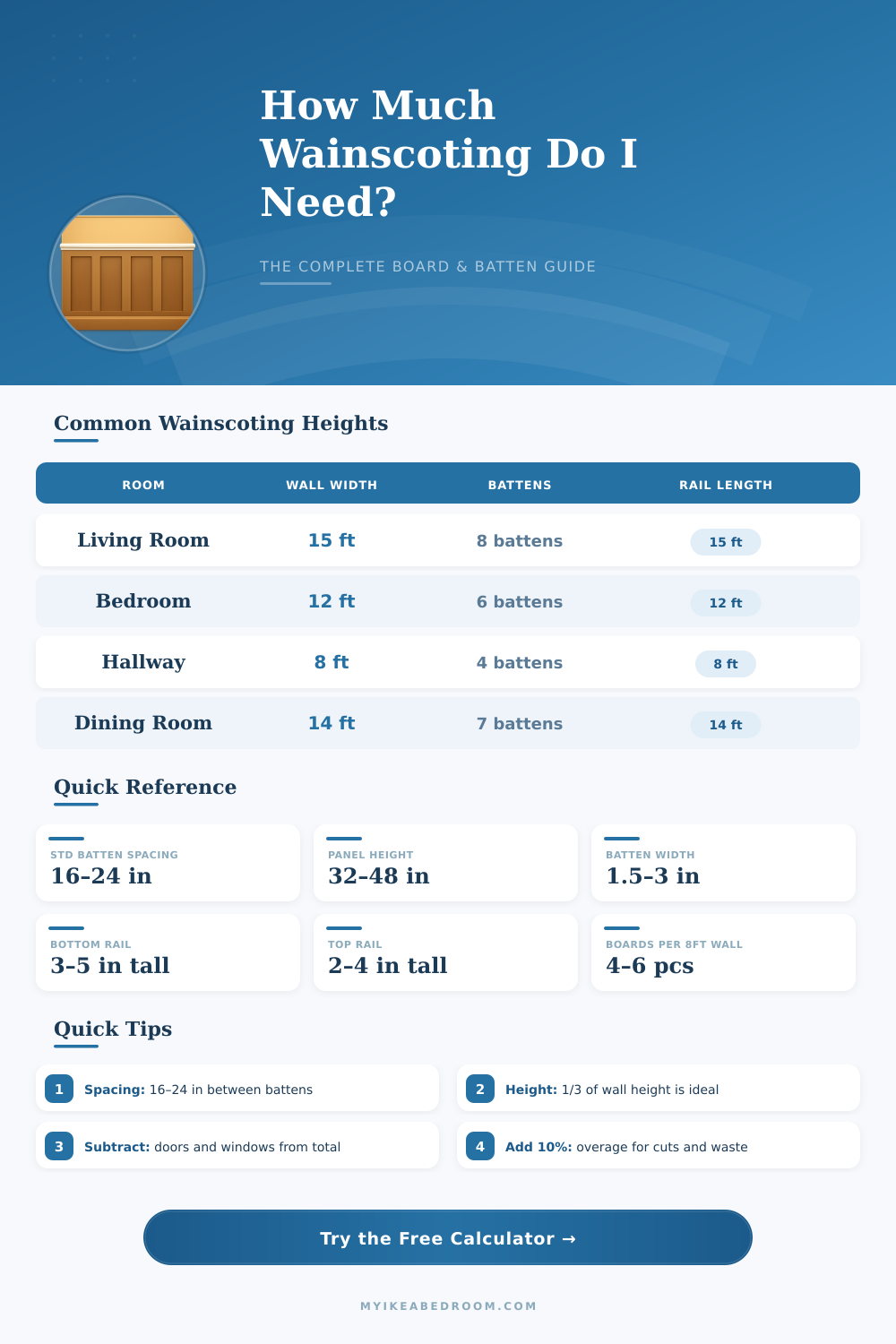
🪟 Board & Batten Wainscoting Calculator
Calculate exactly how many boards, battens, and rails you need for your wainscoting project.
| Spacing (in) | Spacing (cm) | Battens / 10 ft wall | Look & Feel |
|---|---|---|---|
| 8 in | 20.3 cm | ~15 | Very dense, formal |
| 12 in | 30.5 cm | ~10 | Traditional, classic |
| 16 in | 40.6 cm | ~8 | Standard, balanced |
| 20 in | 50.8 cm | ~6 | Airy, modern |
| 24 in | 61.0 cm | ~5 | Open, contemporary |
| 30 in | 76.2 cm | ~4 | Very open, minimal |
| Room | Ceiling Height | Panel Height (in) | Panel Height (cm) |
|---|---|---|---|
| Living Room | 8 ft | 32–36 in | 81–91 cm |
| Dining Room | 9 ft | 36–42 in | 91–107 cm |
| Bedroom | 8 ft | 30–36 in | 76–91 cm |
| Bathroom | 8 ft | 36–48 in | 91–122 cm |
| Hallway | 8–9 ft | 32–40 in | 81–102 cm |
| Staircase | Variable | 36–42 in | 91–107 cm |
| Home Office | 8 ft | 30–36 in | 76–91 cm |
| Kids Room | 8 ft | 24–30 in | 61–76 cm |
| Project | Wall Length | Battens Needed | Rail Length (ft) |
|---|---|---|---|
| Small Bedroom Accent Wall | 10 ft | 7–8 | 10 ft x2 |
| Living Room Feature Wall | 15 ft | 11–12 | 15 ft x2 |
| Dining Room Perimeter | 52 ft | 39–40 | 52 ft x2 |
| Hallway (one side) | 8 ft | 6–7 | 8 ft x2 |
| Bathroom Accent | 6 ft | 4–5 | 6 ft x2 |
| Staircase Wall | 20 ft | 15–16 | 20 ft x2 |
Board and Batten Wainscoting works by using flat parts that hold narrow strips, meaning thin shelves that cover the gaps between the boards. Here the key spot: the Wainscoting itself is not any one style really. What really matters is the kind of panel that you set on the wall.
One can choose beaded shelf, Board and Batten or even something entirely different. There are whole range of wall coverings. Wooden panels, shiplap, tongue-and-groove, Board and Batten.
How Board and Batten Wainscoting Works
And honestly the most of them have quite a lot of shared traits, so that the line between them gets a bit unclear.
Historically, the Board and Batten method existed as outer covering for walls, where broad vertical boards had their gaps covered by narrow Batten strips. Indoor use then was not really backed up. The original build was based on mortise-and-tenon frame with loose panels, so that the wood does not crack during drying and does not warp because of changes in humidity.
A more common indoor version that one used later, some call shaker-style Wainscoting, because real Board and Batten usually have vertical Battens of one to two inches broad, pinned above boards each twelve inches braod.
Jump quickly to today, and Board and Batten wall covering fits almost every home style that you want. It does change the room; lifts it, gives it a fresh and new feeling. Nice about it is that it forms that sense of improvement that really boosts both the value and the visible charm, without being too difficult.
One could do a Board and Batten accent wall during a weekend, if one wants. Combine it with wallpaper, and you have a really striking spot. Lay it in a hallway ore entry?
Right away character it adds. Even a tired, old bathroom gets new spirit thanks to that covering.
When folks lay it in a dining room, they commonly hesitate to decide where to end. One way that works is to start about one third up from the wall height. Colonial and Victorian houses usually favor more traditional heights.
High covering looks well in bathrooms, but can feel odd and separate, if one lays it that much high in livingrooms.
Pre-cut kit sets are out there, that store everything, American lasting wooden bits, easy guides, the whole package. They are designed for weekend work and skip all planning. Some even come primed and ready to hang.
If you watch your budget, take primed boards from any building store to do the task. Another good option is MDF, because it shows less visible gaps. Based on your plan, some folks lay fiber-card below as support behind the Battens.
One final spot deserves mention: black wood stains, blues and gray versions of that look became very trendy recently. There is debate whether those dark colors could seem dated after the 2020s, unless it is already a natural trait in your house. Even so, it does change a simple white room into something with real depth and style.