🚪 Bifold Door Size Calculator
Find the perfect bifold door dimensions for any opening — instantly in imperial or metric
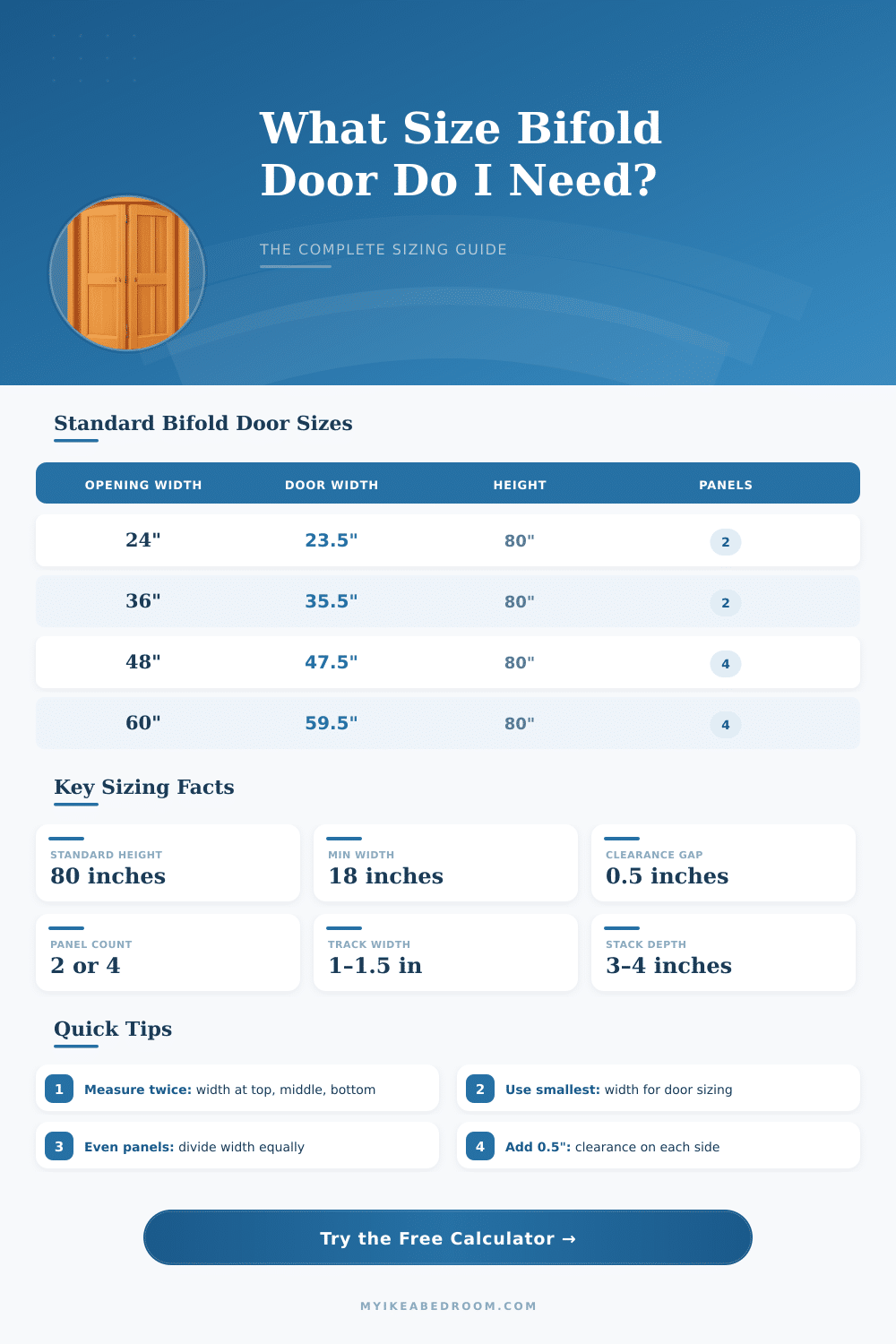
| Opening Width | Door Width (imperial) | Door Width (metric) | Panels | Panel Width Each |
|---|---|---|---|---|
| 18" | 17.5" | 44.5 cm | 2 | 8.75" |
| 24" | 23.5" | 59.7 cm | 2 | 11.75" |
| 30" | 29.5" | 74.9 cm | 2 | 14.75" |
| 32" | 31.5" | 80.0 cm | 2 | 15.75" |
| 36" | 35.5" | 90.2 cm | 2 or 4 | 17.75" or 8.875" |
| 48" | 47.5" | 120.7 cm | 4 | 11.875" |
| 60" | 59.5" | 151.1 cm | 4 | 14.875" |
| 72" | 71.5" | 181.6 cm | 4 or 6 | 17.875" or 11.9" |
| 80" | 79.5" | 201.9 cm | 4 | 19.875" |
| 96" | 95.5" | 242.6 cm | 6 | 15.9" |
| Material | Weight per Panel (approx) | Typical Use | Notes |
|---|---|---|---|
| Hollow Core Wood | 15–25 lbs | Interior closets | Lightweight, budget-friendly |
| Solid Wood | 30–60 lbs | Premium closets | Heavy, durable, paintable |
| MDF / Composite | 20–40 lbs | Painted finishes | Smooth, moisture-sensitive |
| PVC / Vinyl | 10–18 lbs | Laundry, humid areas | Moisture-resistant |
| Aluminum Frame | 12–22 lbs | Modern, minimalist | Rust-resistant |
| Mirror Panel | 25–50 lbs | Bedroom, dressing | Needs heavy-duty hardware |
| Rough Opening Width | Finished Opening Width | Door Size to Order | Frame Allowance |
|---|---|---|---|
| 25.5" | 24" | 23.5" | 1.5" total |
| 37.5" | 36" | 35.5" | 1.5" total |
| 49.5" | 48" | 47.5" | 1.5" total |
| 61.5" | 60" | 59.5" | 1.5" total |
| 73.5" | 72" | 71.5" | 1.5" total |
Bifold Door do not sell by their listed Size, they sell by nominal Size, which simply shows the basic dimension, not the real width of the door. So if you see a label with “24 inches“, it will not be exactly 24 inches after it is hung. For instance a Bifold Door of 36 by 80 inches could actually measure 35½ inches by 79 inches.
Makers differ a bit, so checking the exact set of sizes before purchase really deserves the effort.
How to Measure and Fit Bifold Doors
Bifold Door come in a series of usual sizes. The heights most commonly reach 80, 84, almost 92½, 96 and 108 inches. Widths cover various values, 36, 48, 56, 60, 64, 72 and 84 inches all are common.
The most used types seem to be 48 by 80, 60 by 80, 60 by 96 and 72 by 96. Also thikcer panels exist; a 32 by 80 door with one and three-eighth inches thickness, while standard thickness usually is one and three-quarters or one and three-sixteenth inches.
Here where things become serious: the rough opening needs to be bigger than the door itself. Those extra spaces allow you to adjust and fit the frame so that the doors move freely without sticking. From my experience, plan for around 2 inches more broadly and 2 inches more highly than the door, to have enough swing space.
For a 30-inch Bifold Door, you would want the rough opening to be around 31 to 31¼ inches broad. Regarding height, Bifold Door openings should reach the door height of 80¾ inches, measured from the finished floor.
Proper clearance matters more then one thinks. You would want to leave around half-inch swing space for the real fit. This means that the Size of door that you order must be the nominal Size less that clearance in both directions.
When your opening does not match a standard Size, then it becomes hard. Most stores keep the usual widths… 24 inches, 30 inches; so finding a pair of 26-inch doors for a 52-inch space becomes really tough.
For something like a 58-inch opening, you could use a 60-inch Bifold Door set with a bit of change, although it depends on your specific work. The good news is that Bifold Door can be cut with a simple table saw. Solid core types are easy to adjust.
Hollow cores also cut fine, just remove the edges, adjust the core and stick them back. If standard sizes absolutely do not work, custom doors are available, but they cost more and need more time to arrive.
Wider openings? Bifold Door can only go so far. A closet of 96 inches broad by 80 inches high needs two pairs of Bifold Door with a total of eight panels.
Exterior glass Bifold Door can cover openings up to 60 feet broad and 12 feet high, depending on the setup and specs of the maker. When you adjust a door, cut the slice between top and bottom instead of removing it from one side. Make sure that the hinge side edge stays square andthe rail is flat, otherwise you will end with a door that sticks every time you try to open it.