❄️ Bedroom BTU Calculator
Find the right air conditioner size for any bedroom or room — with adjustment factors for ceiling height, sun exposure & occupancy
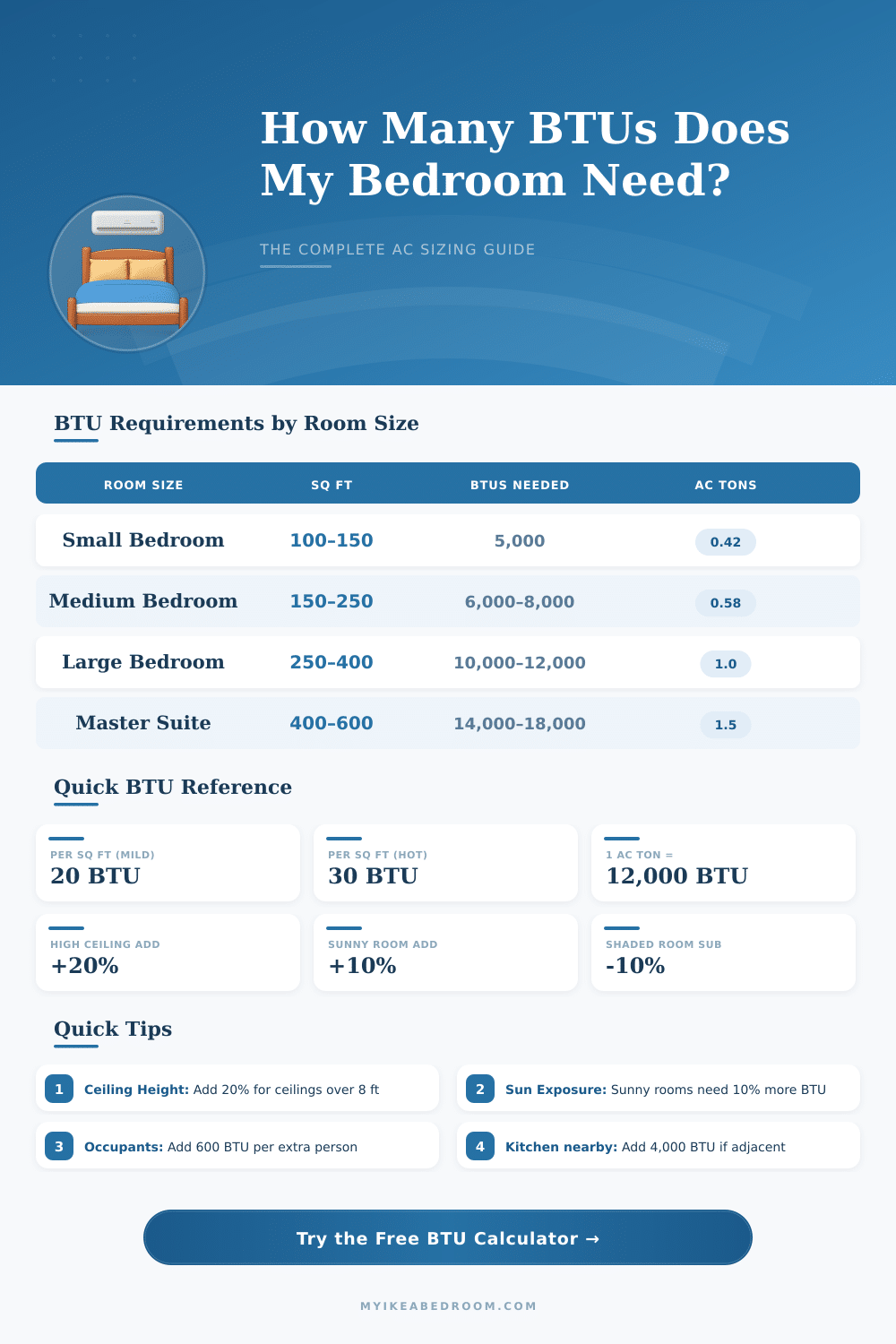
| Room Type | Area (sq ft) | Area (m²) | BTU Needed | AC Tons | kW Equiv. |
|---|---|---|---|---|---|
| Nursery / Small Bedroom | 80–120 | 7.4–11.1 | 5,000 | 0.42 | 1.46 |
| Small Bedroom | 120–170 | 11.1–15.8 | 6,000 | 0.50 | 1.76 |
| Medium Bedroom | 170–230 | 15.8–21.4 | 8,000 | 0.67 | 2.34 |
| Large Bedroom | 230–300 | 21.4–27.9 | 10,000 | 0.83 | 2.93 |
| Master Bedroom | 300–400 | 27.9–37.2 | 12,000 | 1.00 | 3.52 |
| Large Master Suite | 400–500 | 37.2–46.5 | 14,000 | 1.17 | 4.10 |
| Extra Large Suite | 500–650 | 46.5–60.4 | 18,000 | 1.50 | 5.27 |
| Very Large Suite | 650–900 | 60.4–83.6 | 24,000 | 2.00 | 7.03 |
| Factor | Condition | BTU Adjustment | % Change |
|---|---|---|---|
| Sun Exposure | Very Sunny / South-Facing | +1,000 BTU | +10% |
| Sun Exposure | Mostly Shaded | –1,000 BTU | –10% |
| Ceiling Height | Over 8 ft (per extra ft) | +Volume × 20 BTU | +5–20% |
| Occupants | Each extra person above 2 | +600 BTU each | +5–8% |
| Kitchen Adjacent | Room next to kitchen | +4,000 BTU | +15–30% |
| Floor Level | Top floor / attic room | +10–15% | +10% |
| Climate | Hot / poor insulation | +20–30% | +25% |
| Windows | Each extra window (3+) | +500 BTU each | +3–5% |
| AC Unit Size | BTU Rating | Tons | Typical Coverage | Best For |
|---|---|---|---|---|
| Window Unit – Small | 5,000 BTU | 0.42 | 100–150 sq ft | Nursery, small office |
| Window Unit – Med | 8,000 BTU | 0.67 | 200–300 sq ft | Bedroom, studio |
| Window Unit – Large | 12,000 BTU | 1.00 | 300–550 sq ft | Master bedroom |
| Mini-Split – Small | 9,000 BTU | 0.75 | 200–350 sq ft | Bedroom, office |
| Mini-Split – Standard | 12,000 BTU | 1.00 | 350–500 sq ft | Master bedroom |
| Mini-Split – Large | 18,000 BTU | 1.50 | 500–750 sq ft | Open plan / suite |
| Central AC – Small | 24,000 BTU | 2.00 | 700–1,000 sq ft | Whole floor zone |
| Central AC – Std | 36,000 BTU | 3.00 | 1,200–1,800 sq ft | Whole home zone |
Count the right amount of btu for a unit in a bedroom is commonly a confusing cause. On the net there are free tools that help to estimate how many btu are needed to cool or heat a room depending on its size, setup and other circumstances. Even so also without such tools, some basic tips are useful to know.
A practical thumb-rule suggests around 40 btu each square foot. Like this, a unit of 8 000 btu is enough for cooling spaces around 200 square feet, for instance a room of 20 by 10 feet. In cases with many windows or constant sunshine, best plan even 45 btu each square foot.
How to Choose the Right BTU for a Bedroom
For tiny bedrooms of about 150 square feet, a unit of 5 000 btu widely works well. One real attempt shows that 5 000 btu’s unit successfully handled almost 80-degree heat under strong sun, although 6 000 btu would be more reliable during the hottest days. Brands also advise 5 000 btu for spaces of 100 to 150 square feet, plus 10 percent for sunny rooms, what arrives at around 5 500 btu.
Such tiny devices for bedrooms cost almost 100 dollars, and replacing a central system with one of them can halve the summer costs for cooling.
A medium bedroom or tiny living room of around 180 square feet fits well with 6 000 btu, if the insulation and shade are good. For rooms of 250 to 400 square feet, you kneed between 7 000 and 8 500 btu. A unit of 8 000 btu works for bigger bedrooms and rooms between 300 and 350 square feet.
A unit of 9 000 btu fits to serve a typical bedroom of around 10 to 14 square metres, but for larger spaces it would overload itself.
Rooms with good insulation, little sunshine and only one or two people can get by with the bottom limit of any btu range. On the other hand, things like high ceilings raise the need. For instance, a bedroom with a cathedral ceiling of around 13 feet closely matches in volume to a standard space of 310 square feet with an 8-foot ceiling, what requires around 6 200 btu for a portable unit.
Picking too big a unit does not always help. When a unit owns more power than required, the room cools too soon. The thermostat turns the device off before it well removes the humidity.
On the other hand, a unit of 12 000 btu with a reverse compressor handles extra power more well, because the compressor changes its speed and handles excess of capacity. Devices with low noise and dehumidifying skill deserve attention. Between portable models, dual-tube versions of 10 000 to 12 000 btu with inverter form a reliable solution, because they start the compressor cleverly and adapt to the need.
Single-tube portable units however lose a bit of cooling, because they cast heated air outside, andthat downside does not appear in the btu calculations.