🌡️ Baseboard Heat Loss Calculator
Calculate BTU requirements and baseboard heater length for any room using real heat loss formulas
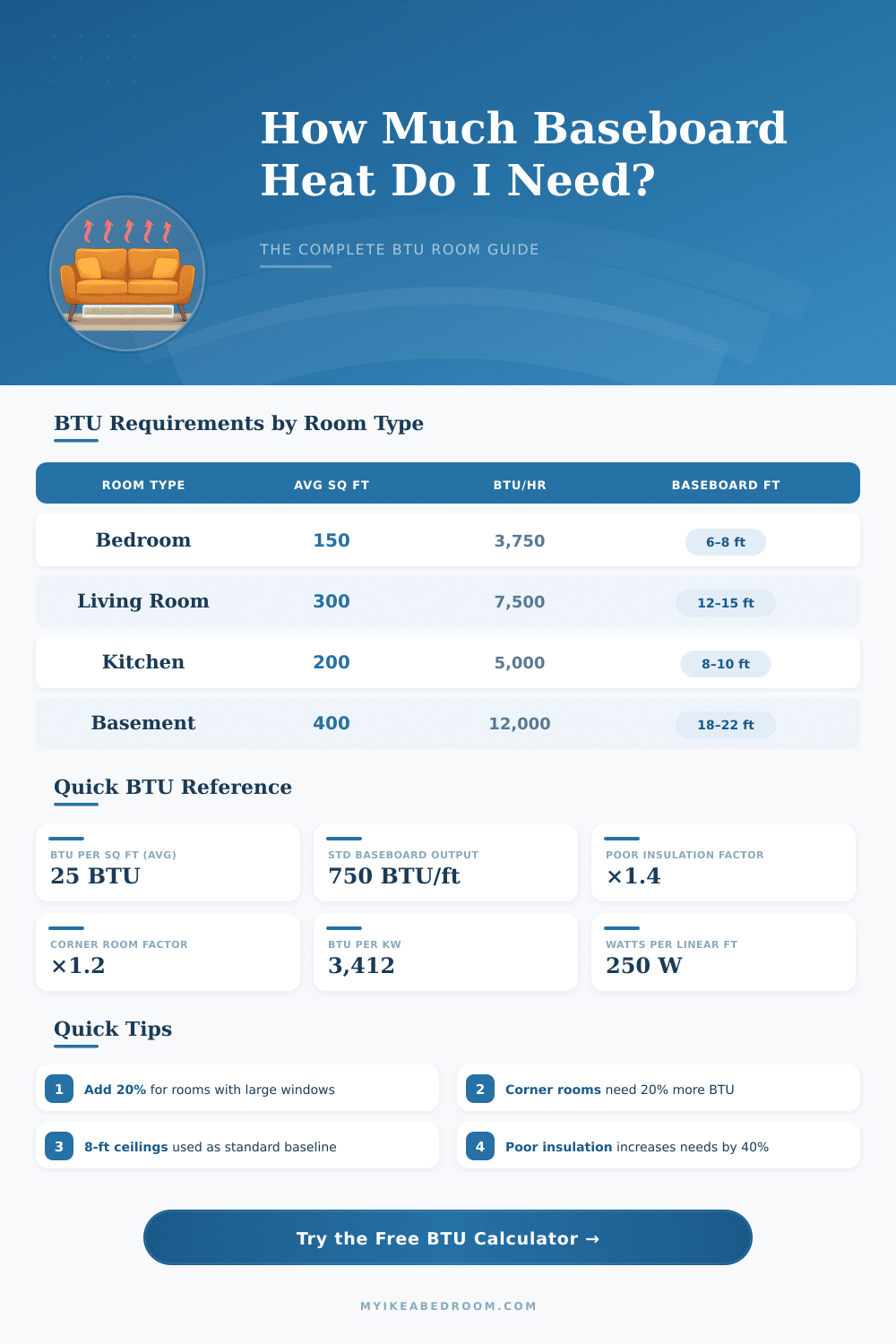
| Room Size | Poor Insulation | Average Insulation | Good Insulation | Excellent |
|---|---|---|---|---|
| 100 sq ft | 3,500 BTU | 2,500 BTU | 1,800 BTU | 1,200 BTU |
| 150 sq ft | 5,250 BTU | 3,750 BTU | 2,700 BTU | 1,800 BTU |
| 200 sq ft | 7,000 BTU | 5,000 BTU | 3,600 BTU | 2,400 BTU |
| 300 sq ft | 10,500 BTU | 7,500 BTU | 5,400 BTU | 3,600 BTU |
| 400 sq ft | 14,000 BTU | 10,000 BTU | 7,200 BTU | 4,800 BTU |
| 500 sq ft | 17,500 BTU | 12,500 BTU | 9,000 BTU | 6,000 BTU |
| 600 sq ft | 21,000 BTU | 15,000 BTU | 10,800 BTU | 7,200 BTU |
| Total BTU/hr | HW Std (600 BTU/ft) | HW High (800 BTU/ft) | Electric Std (853 BTU/ft) | Steam (1000 BTU/ft) |
|---|---|---|---|---|
| 2,000 BTU | 3.3 ft | 2.5 ft | 2.3 ft | 2.0 ft |
| 4,000 BTU | 6.7 ft | 5.0 ft | 4.7 ft | 4.0 ft |
| 6,000 BTU | 10.0 ft | 7.5 ft | 7.0 ft | 6.0 ft |
| 8,000 BTU | 13.3 ft | 10.0 ft | 9.4 ft | 8.0 ft |
| 10,000 BTU | 16.7 ft | 12.5 ft | 11.7 ft | 10.0 ft |
| 12,000 BTU | 20.0 ft | 15.0 ft | 14.1 ft | 12.0 ft |
| 15,000 BTU | 25.0 ft | 18.8 ft | 17.6 ft | 15.0 ft |
| Window Type | Small (15 sq ft) | Medium (24 sq ft) | Large (36 sq ft) | U-Value (est.) |
|---|---|---|---|---|
| Single Pane | 750 BTU | 1,200 BTU | 1,800 BTU | 1.1 |
| Double Pane | 375 BTU | 600 BTU | 900 BTU | 0.5 |
| Triple Pane | 225 BTU | 360 BTU | 540 BTU | 0.3 |
| Low-E Double | 300 BTU | 480 BTU | 720 BTU | 0.4 |
Baseboard heaters work by a basic principle: convection. The cold air sinks to the floor receives heat from the heater, and then rises upward in the room. That continuous circulation forms a gentle flow of convection, that spreads the heat through the whole space.
Here is the main point though. So that it truly works, the air must be able to freely flow under the heater itself. If something blocks that air flow, the device will not give much benefit, even though it still burns the water.
How Baseboard Heaters Work and How to Use Them
It requires pulling cold air from below and pushing the heated air upward.
One finds those heaters usually installed under windows and beside doors. It makes sense, because here rooms commonly lose the most heat. By warming the wall and the window surface, they indeed reduce that unpleasant feeling of drafts.
But here is the change, if you lay them on an exterior wall, the warmest part of that wall finds itself right against the cold exterior temperatures, which increases the heat loss through that wall. If you install a baseboard heater instead on an internal wall, you do not get truely efficient results.
Electrical baseboard heaters reach 100 percent efficiency, so in theory all that heat enters your spaces without any waste during the process. Sounds good, right? But compared to what modern heat pumps can do, that 100 percent rating is no longer the main selling point that it once was.
The real trouble with baseboard heaters does not deal about their efficiency. It is that you lay your heat source on the coldest wall of the whole room.
To estimate how much baseboard heating you truly need, one does a heat loss calculation. Those calculations consider the quality of your insulation, windows, doors, air outflow, ceiling height and the lowest exterior temperatures in your region. When comes the moment for choosing the real devices, a bit of oversizing widely helps.
There is no penalty for going a bit bigger then the strict minimal need.
Dust and dirt that stuffs the fins will limit the air flow and efficiency very soon. Keeping those fins clean, you make a big difference. Also, you will want to keep at least six inches of distance between furniture or curtains and electrical baseboard heaters, they get so hot that they create a real fire danger.
Children risk getting burns also.
Even lowering the thermostat by only one or two degrees, one noticeably reduces the energy use. The exact numbers show around seven percent more heating costs for every degree above 68°F. Programmable or smart thermostats help, because they let you set lower temperatures automatically by schedule. You can also use room dividers.
Hang thick curtains on a rod, to split big rooms into smaller areas, whichgreatly reduces the heat loss.
Improve the wall insulation, replace old drafty windows and block air leaks, everything that helps to reduce heat loss. After you strengthened the building cover, the exact place of your heat source matters less, as long as the total heating power matches your needs. Even so, floors that lack proper air sealing or insulation can lose huge amounts of heat around the level of baseboard heaters.