Firewood Rack Size Calculator
Size a rack from your cord fraction, real log length, stack height, bay count, airflow spacing, roof overhang, and capacity margin.
Choose a common firewood storage layout, then tune the fields for your logs and drying clearance.
Rack Size Results
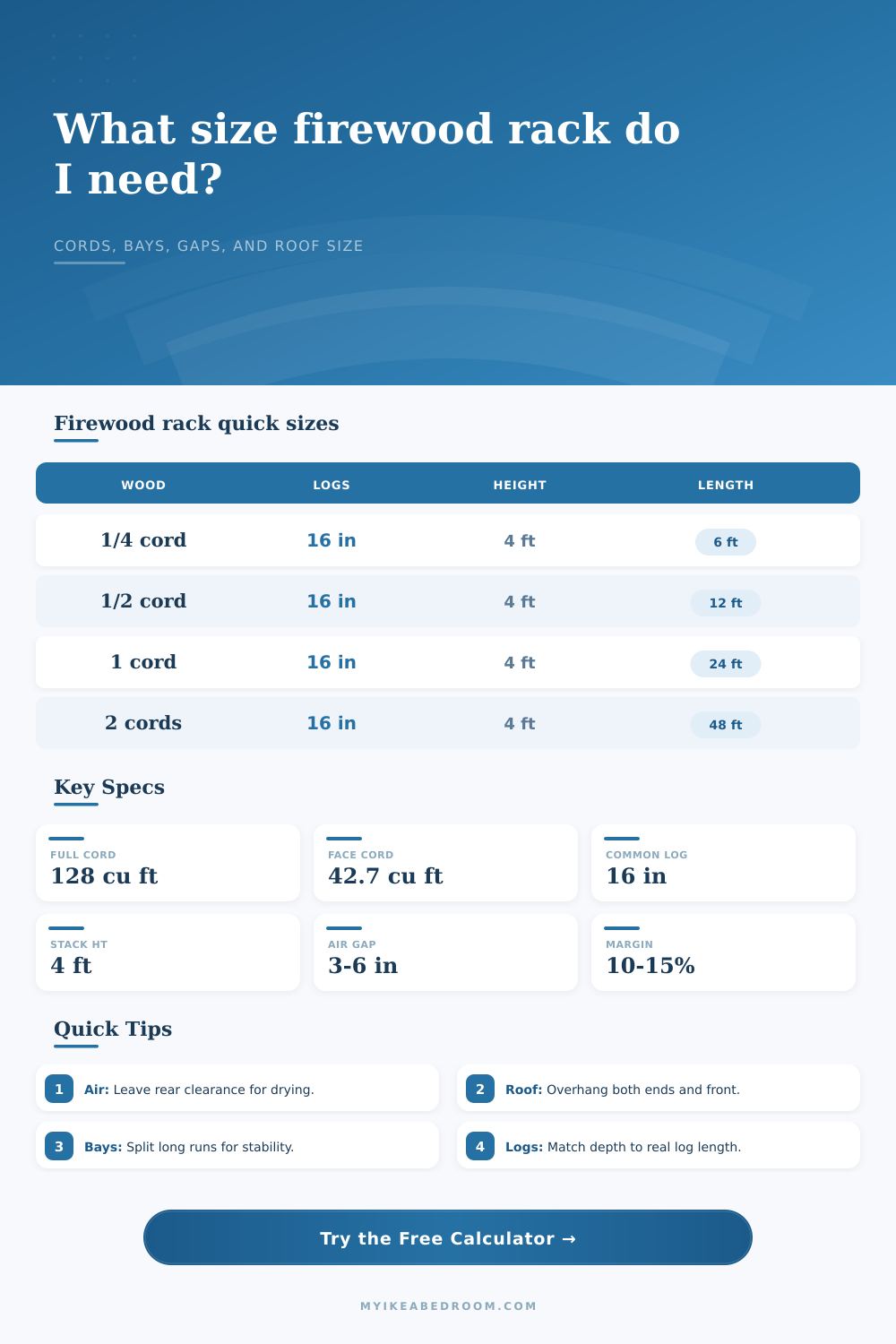
| Firewood amount | Stacked volume | 16 in log equivalent | Typical rack use |
|---|---|---|---|
| 1/8 cord | 16 cu ft | About 3 ft by 4 ft | Weekend fireplace bin |
| 1/4 cord | 32 cu ft | About 6 ft by 4 ft | Patio or porch rack |
| 1/3 cord | 42.7 cu ft | One face cord | Small stove season |
| 1/2 cord | 64 cu ft | About 12 ft by 4 ft | Frequent weekend use |
| 1 cord | 128 cu ft | Three face cords | Long heating season |
| Log length | Single-row depth | Face cord volume | Notes |
|---|---|---|---|
| 12 in | 12-14 in | 32 cu ft | Compact stove wood |
| 16 in | 16-18 in | 42.7 cu ft | Common firewood |
| 18 in | 18-20 in | 48 cu ft | Larger inserts |
| 20 in | 20-22 in | 53.3 cu ft | Deep fireplaces |
| Bay count | Best for | Span control | Rotation |
|---|---|---|---|
| 1 bay | 1/8-1/4 cord | Short and simple | Single batch |
| 2 bays | 1/3-1/2 cord | Stable mid-size rack | Dry and ready |
| 3 bays | 1-1.5 cords | Shorter long runs | Oldest first |
| 4 bays | 2+ cords | Modular wall rack | Species sorting |
| Detail | Low clearance | Normal clearance | Exposed location |
|---|---|---|---|
| Rear airflow | 2 in | 4 in | 6 in or more |
| End airflow | 1 in | 3 in | 4-6 in |
| Roof overhang | 3 in | 6 in | 8-12 in |
| Top seasoning gap | 2 in | 3-6 in | 6 in or more |
A firewood rack is an easy DIY job… Unless you go to stack your wood on it and find out it doesn’t fit. And you have all these logs so why didn’t it fit? You never thought about air flow, dividers, or how people realy stack their wood. A sizing tool would prevent you from building a firewood rack and then only having half the amount of wood you expected. Also rain could leak through your roof onto your wood.
The volume of firewood are not as it appears. One cord equals 128 cubic feet (a pile that’s 8 ft x 4ft x 4ft). But what about imperfect packing? Sixteen-inch logs is ideal for good packing, but this is rarely done. How many bays will you have? What’s the height of each stack? And how long should the logs be? Enter your rainfall and roof size into the calculator and it does all the math so you don’t have to guess at conversions.
How to Build the Right Firewood Rack
People don’t think about the area consumed by the rack. Airflow gaps, dividers and posts limits available space. If you build a rack for exactly one cord without any buffer you’ll likely struggle to fit that last bit of wood. At least not easy. Think of it as stuffing hard blocks in a suitcase.
Enter the capacity margin. This is an additional allowance you tack onto total volume to allow for logs being stacked loosely or having different lengths. Remember wood isn’t a fluid… it require more room. For most homeowners, ten to fifteen percent are enough. This prevents your rack from turning into a puzzle each time you need to stock-up.
Drying wood requires airflow To dry, wood needs to be able to breathe, particularly in humid climates. Clearing space around the wood. Leaving a few inches between the pile and a fence or other structure, over the top layer, and behind the stack… Facilitate faster seasoning. How clearances impact drying time is indicated on the reference table.
Little details matters, such as this one. Wet wood doesn’t burn well; a tight stack remains wet. Using a rack with several bays is more stable than a large single bay. The posts of a long bay will sag or even bow out. Break the rack up into two or three section; shorter spans are simpler to support. It also helps organize the wood. Keep the seasoned wood separated from new, green wood. By doing this you burn the driest wood first which lowers creosote in your chimney and increases how well it burns.
The idea behind building a firewood rack is to make something practical yet also able to hold as much wood as possible. So how do you balance out safety versus capacity? It all depends off your space, your airflow gaps, stack height, and log length. Designing a rack requires tweaking these variables. The end result is a ready-to-burn stash of wood, stacked high and dry, yet still easily accessible. When the dimensions are right, the fire warms while the rack remains practicaly invisible.