Aquarium Stand Load Capacity Calculator
Estimate filled aquarium weight, glass or acrylic shell load, substrate, decor, stand footprint pressure, leg contact load, floor load, and safety-factor margin.
1Aquarium presets
Choose a common setup, then adjust the stand rating, feet, contact pads, and floor limit to match the actual room.
2Tank, stand, and floor inputs
Aquarium load results
3Material and load constants
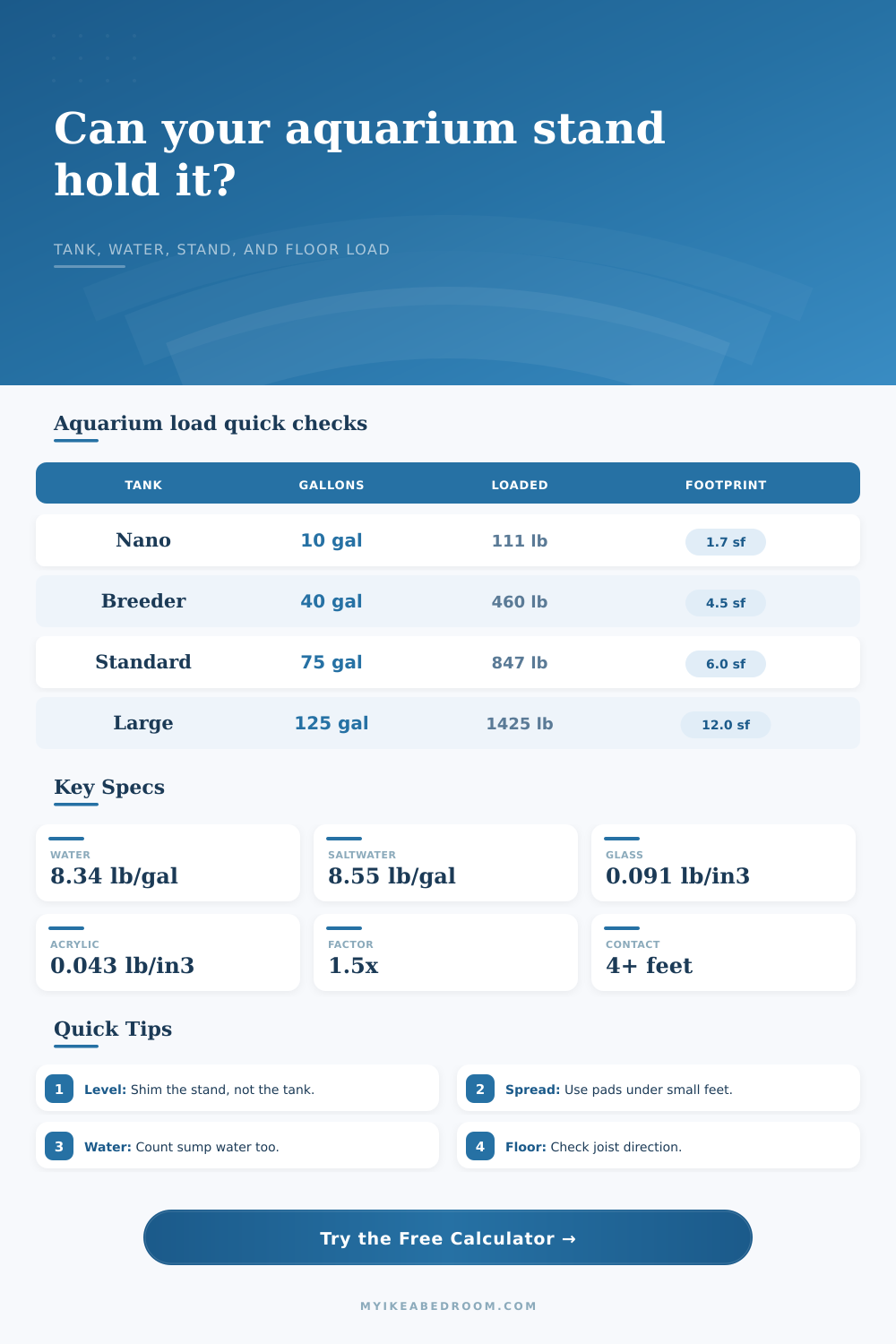
4Common aquarium load table
| Nominal tank | Typical outside size | Water only | Loaded planning range |
|---|---|---|---|
| 10 gallon standard | 20 x 10 x 12 in | 83 lb freshwater | 105 to 130 lb with glass and light substrate |
| 20 gallon high | 24 x 12 x 16 in | 167 lb freshwater | 225 to 280 lb with gravel, decor, and gear |
| 40 breeder | 36 x 18 x 16 in | 334 lb freshwater | 420 to 520 lb depending on substrate and rock |
| 75 gallon standard | 48 x 18 x 21 in | 626 lb freshwater | 780 to 950 lb with cabinet, rock, and equipment |
| 125 gallon standard | 72 x 18 x 22 in | 1043 lb freshwater | 1250 to 1550 lb with stand and hardscape |
5Stand contact reference
| Contact style | Calculator treatment | What to measure | Common caution |
|---|---|---|---|
| Full plinth base | Uses most of stand footprint as contact area | Outer base length and width where it touches floor | Check that the base sits flat without rocking |
| Two long rails | Uses rail contact area estimate | Rail length, rail width, and number of rails | Narrow rails can mark soft floors under high load |
| Four small feet | Uses foot area times leg count | Each pad length and width, not the decorative cap | Small feet create high local pressure |
| Six or eight legs | Divides total weight across contact points | Actual number of load-bearing feet touching floor | Uneven floors can unload one foot and overload another |
6Substrate and decor weight table
| Material | Planning density | Two inch bed in 48 x 18 in tank | Load note |
|---|---|---|---|
| Fine sand | About 90 lb/cu ft | 90 lb before slope or displacement | Dense and easy to underestimate in deep beds |
| Aquarium gravel | About 75 lb/cu ft | 75 lb before slope or displacement | Useful default for many freshwater tanks |
| Plant soil | About 55 lb/cu ft | 55 lb before cap layers | Layered planted tanks should add all layers |
| Live rock or dense stone | Enter measured weight | Often 40 to 150 lb in reef tanks | Rock can replace some water but still adds load |
7Floor load comparison table
| Planning check | Typical entry | Calculator output | How to interpret it |
|---|---|---|---|
| Stand rating | Rated capacity in pounds | Safety-adjusted capacity margin | Margin below 1.0x means the entered setup exceeds the safety-adjusted stand rating |
| Footprint pressure | Total weight divided by stand base area | Pounds per square foot | Compare against the room planning load and seek review for concentrated tanks |
| Leg load | Total weight divided by feet | Pounds per support point | Useful for checking small contact pads, leveling feet, and soft flooring |
| Contact pressure | Weight over actual touching area | Pounds per square inch | High values can dent flooring even when the floor structure is adequate |
8Measurement tips
The weight of a home aquarium. When you are planning an aquarium, don’t forget how heavy water is. It weighs eight and a half pounds per gallon. Multiply that times seventy five or one hundred gallons and see how fast it adds up. Don’t forget to count the weight of wet substrates, the heaviness of rock, and thickness of your glass.
The aquarium stand load capacity calculator does all the math for you. Simply input the dimensions of your tank and what materials you want to use. It will spare you having to guess at safety margins. It then breaks down total load into pieces. From there, you can compare those pieces to your furniture rating and the load capacity of your floor structure.
How to Calculate Aquarium Weight Safely
Most folks underestimates the total weight. Many only consider the water. They overlook weight added by the tank and its contents. A fully loaded reef tank is often far heavier then the volume would suggest.
Why? Why ask all these details when a generic estimate might work? Well, a general number can actualy hurt. Does your tank have acrylic sides or glass? Acrylic has less static weight than glass. The calculator use density constants for both materials in its calculations.
What about substrate? Sand is denser then gravel. If you have a deeply planted tank with lots of substrate, that could mean dozens of poundss in additional weight.
Enter your actual tank fill level. Most people don’t run their tanks up to the top. An inch or two of headspace makes a difference in terms of water volume. And volume affects weight.
There’s a table at bottom of page listing weights by typical tank size. So if you want a quick ballpark before typing out the nitty gritty, use that.
To conclude, To do this the calculator takes into account the type of stand that you are using. Does it sit directly on your floor? Do you have rails and a full plinth base? Or does your stand use individual feet? Contact area is important. Pressure depend on contact area.
A full plinth base will spread out the load over larger surface area, reducing the number of pounds per square foot on your subfloor. The legs concentrate same amount of weight into small points. Small enough to make an impression in your flooring. And strong enough to exceed the local load capacity of a bay between two adult-sized sofa. If your stand use small leveling feet, the calculator will calculate the pressure at each one.
Hardwoods, vinyl and other soft flooring can be damaged by excess point loads. Even if overall strength of your structure isn’t compromised, you may still notice impressions in the flooring.
The calculation uses padding to account for real-world variables like dynamic loads from washing the tank, slight material flaws, or an uneven floor. This is not based off some abstract concept called “safety. Your stand has a rated capacity. That number gets multiplied by a default safety factor which results in the maximum safe load. So if your safety margin drops below one, it means you’ve exceeded the safe working limit.
Red flag! Perhaps your stand requires reinforcement. Maybe you should of use bigger pads and distribute the load more effectively. Maybe the tank is simply too big for that space.
The tool lets you compare the distributed weight of your aquarium to the live load of residential floors, which is typically 40 pounds per square foot. Floor joists also has weight limits. Another thing that people miss out on is where the floor joist are running. Is your tank going perpendicular to them? If so, it’s spreading the load across several beams. If they’re running parallel to your tank, then all of that weight could be bearing down on one span from support to support. That increases the chance of failure or at least bending.
The calculator doesn’t check your home. But it provides you with numbers that you can take to someone who knows what to do with them or to a contractor. Now you’ve got numbers that show you how much weight you have, how much pressure that puts on the floor, and how much each leg of the stand will hold. From there, you’ll be able to determine whether or not your setup is safe.
It is better to know the numbers before you fill up that tank.