Pond Volume Calculator
Estimate water volume, average depth, plant and rock displacement, liner size, fish load, and pump turnover for a pond with shelves or uneven depth zones.
Start with a common pond layout, then adjust shape, shelves, displacement, fish type, and pump turnover.
Switch between imperial and metric entry. The calculator converts internally, then reports gallons, liters, liner dimensions, fish capacity, and pump flow in both systems.
Pond volume results
Net water volume
0 gallons / litersLiner size
0 x 0 ft / m rectangleFish capacity
0 adult fish inchesPump rating
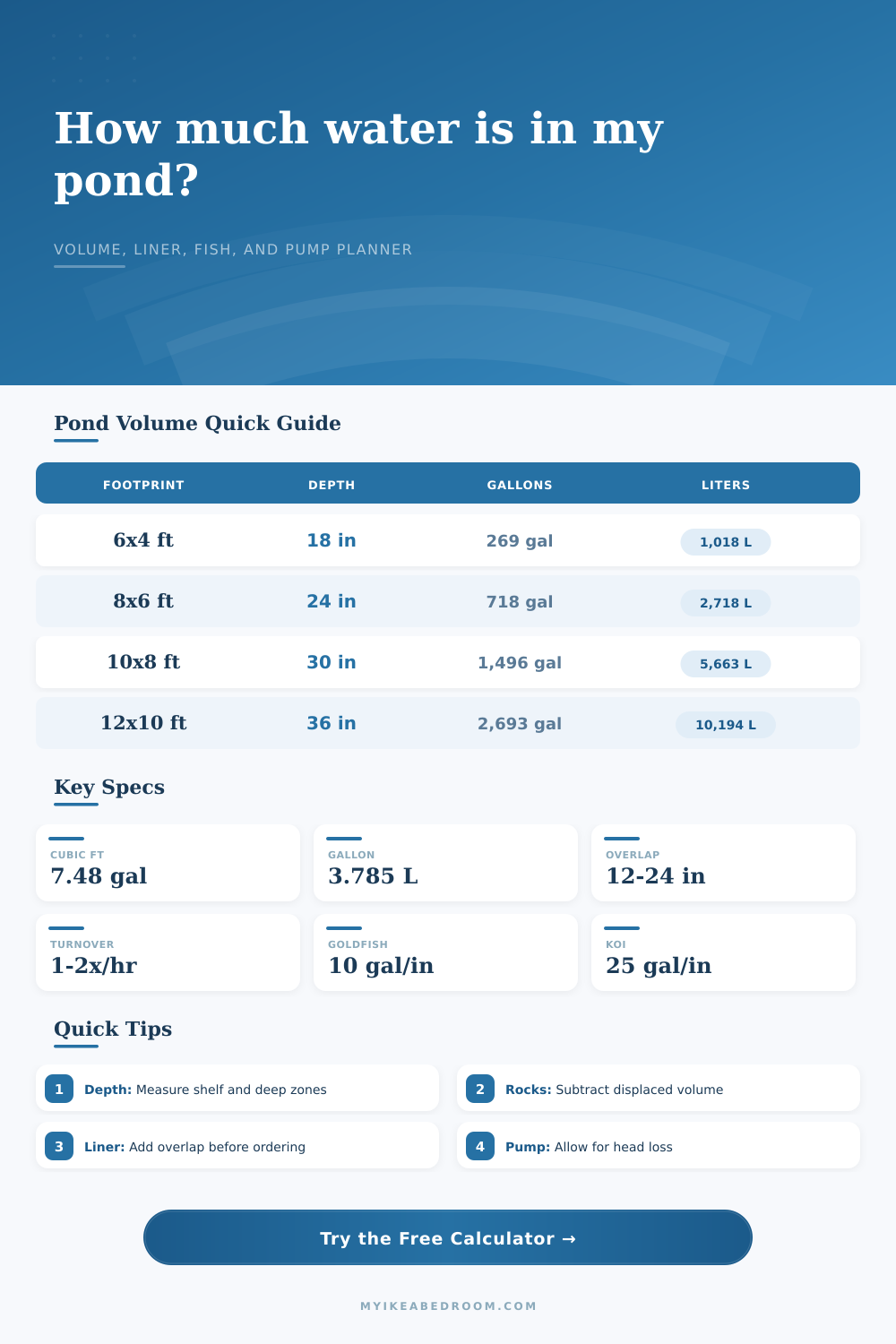
0 GPH / LPH rated| Water surface | 18 in average | 24 in average | 30 in average | 36 in average |
|---|---|---|---|---|
| 25 sq ft / 2.3 m² | 280 gal / 1,061 L | 374 gal / 1,416 L | 467 gal / 1,769 L | 561 gal / 2,123 L |
| 50 sq ft / 4.6 m² | 561 gal / 2,123 L | 748 gal / 2,831 L | 935 gal / 3,539 L | 1,122 gal / 4,247 L |
| 75 sq ft / 7.0 m² | 841 gal / 3,184 L | 1,122 gal / 4,247 L | 1,402 gal / 5,308 L | 1,683 gal / 6,370 L |
| 100 sq ft / 9.3 m² | 1,122 gal / 4,247 L | 1,496 gal / 5,663 L | 1,870 gal / 7,079 L | 2,244 gal / 8,495 L |
| 150 sq ft / 13.9 m² | 1,683 gal / 6,370 L | 2,244 gal / 8,495 L | 2,805 gal / 10,617 L | 3,366 gal / 12,740 L |
| Pond edge condition | Overlap per edge | Metric overlap | Best use |
|---|---|---|---|
| Neat raised timber or block edge | 12 in | 30 cm | Straight-sided ponds with a separate cap or trim board. |
| Typical soil edge with coping stones | 18 in | 46 cm | Most garden ponds where liner is folded and hidden under stone. |
| Wide rock border or beach shelf | 24 in | 61 cm | Irregular edges, larger stones, and extra trimming room. |
| Very uneven freeform excavation | 30 in | 76 cm | Hand-dug edges where the final rim may shift during leveling. |
| Pond type | Fish load rule | Turnover target | Example for 1,000 gal |
|---|---|---|---|
| Plant or wildlife pond | No fish load assumed | 0.5x per hour | 500 GPH delivered / 1,893 LPH |
| Small fish pond | 5 gal per adult inch | 1x per hour | 1,000 GPH delivered / 3,785 LPH |
| Goldfish pond | 10 gal per adult inch | 1 to 1.5x per hour | 1,000 to 1,500 GPH delivered |
| Koi pond | 25 gal per adult inch | 1.5 to 2x per hour | 1,500 to 2,000 GPH delivered |
| Scenario | Surface area | Typical net volume | Liner rectangle | Matched pump range |
|---|---|---|---|---|
| 4 ft round patio bowl | 12.6 sq ft / 1.2 m² | 110 to 150 gal | 8 ft by 8 ft | 100 to 200 GPH |
| 6 ft by 4 ft raised pond | 24 sq ft / 2.2 m² | 250 to 400 gal | 11 ft by 9 ft | 300 to 600 GPH |
| 9 ft by 6 ft oval pond | 42 sq ft / 3.9 m² | 600 to 850 gal | 15 ft by 12 ft | 700 to 1,200 GPH |
| 10 ft by 7 ft kidney pond | 46 sq ft / 4.2 m² | 750 to 1,100 gal | 17 ft by 14 ft | 900 to 1,600 GPH |
| 12 ft by 8 ft koi starter | 96 sq ft / 8.9 m² | 1,800 to 2,500 gal | 20 ft by 16 ft | 2,500 to 5,000 GPH |
The other thing that you should be precise about is the volume of water in your pond. Guessing can cause some pretty big mistakes, just because it looks like it will hold X gallons of water doesn’t mean that it will actualy hold that much. That makes a difference when it comes to pump power, liner size and even life of your fish. That’s why we give you the math so you don’t have to guess the geometry.
Ponds might look like boxes but most is not that simple. They has deep areas in the center and shallow areas for plants which alters the amount of water they can hold. Then there are rocks and other things that take away volume, but if you don’t account for those you’ll overestimate how much it holds. The tool divides up depth into separate zones. It separates the shallow plant shelf section from the deeper fish holding zone and weights each based off its surface area. So the average isn’t some misleading midpoint but rather a true one.
Why You Must Measure Your Pond Water Correctly
So how much is that exactly? Well it’s a lot less than you thought. All you have to do is figure out total volume (which would of be the depth of your tank x 2 since it wraps around on both sides plus the extra you want for overlap). Then you get a roll big enough to go all the way to the bottom and then some and wrap over the sides with slack. If you use any less you will run into leaks and pinholes because there isn’t enough material. Plus they calculates in the overlap for you automatically… No cutting up little pieces of the roll and trying to tape them all together. You simply order a single, giant rectangle.
People also under- and over-spend on pumps. As a general rule of thumb you should turn over your whole pond every hour. But that’s the bare minimum. If you’re keeping fish (koi), you want double that; they puts out more waste so it has to get filtered faster. If all you have are frogs and lilies, half will do. Also, the tool accounts for head loss. That means as the water goes through filters and hoses, the pump lose some pressure. If you don’t account for that, you end up with a trickle instead of a flow. Knowing how many gallons per hour you need before you purchase saves you from having to return a weak pump.
Stocking quantity also counts. Adding fish forever is not an option. Each fish need a certain amount of water per inch, depending on how much waste a fish of that size produces. For example, small minnows has less waste than goldfish do. And koi generate a lot of waste; so they needs plenty of space. The calculator compares the net volume of your water against how much you plan to stock in it. It alerts you when you are overstocked. In other words it helps prevent spring ammonia spikes.
Space is reduced by displacement, which means there is less volume. Your pond has volume, but there are things in it that take up space. There is stacked stones and submerged baskets of plant. If you don’t account for displacement, your calculations assume a full pond, but your real pond has less volume. Enter that displaced volume into the tool. It will subtract it from your estimated amount, allowing you to size pumps accuratly and avoid chemical dosage errors.
Pond planning requires physics and landscaping. You’re building a contained ecosystem. It has to hold water, filter water and allow for breathing. One that has to hold water, filter water and allow for breathing. How do you get it right? You need to make sure you have enough volume. That volume helps the whole thing work well long after the day the hole was dug. Let the numbers lead you into buying the correct materials and measure twice.
The fish will live. The pond will run like clockwork.