Pool Water Volume Calculator
Estimate pool gallons and liters from shape, dimensions, average depth, step or spa displacement, pump flow, and target turnover time.
Choose a common pool setup, then adjust measurements to match your exact shell and equipment.
Your Pool Volume Results
Pool volume
0 gallons after displacementMetric volume
0 liters and cubic metersSurface area
0 sq ft with sq m equivalentTurnover time
0 hours per complete turnover| Pool shape | Area formula | Volume formula | Best use |
|---|---|---|---|
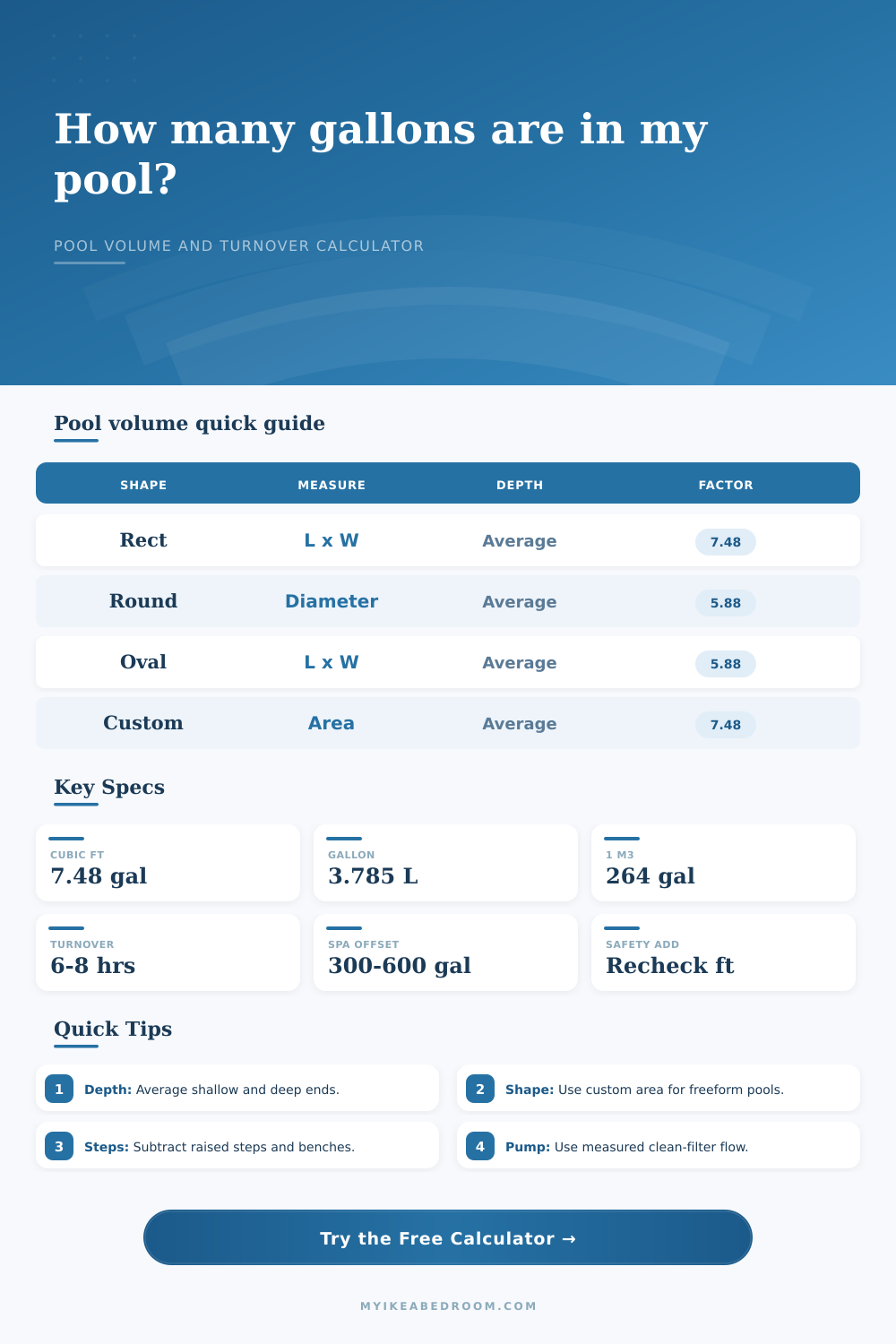
| Rectangle | length by width | area by average depth by 7.48052 | Most in-ground and lap pools |
| Round | pi by radius squared | area by average depth by 7.48052 | Round above-ground pools |
| Oval | pi by half length by half width | area by average depth by 7.48052 | Oval above-ground pools |
| Custom area | entered surface area | area by average depth by 7.48052 | Freeform, kidney, or lagoon pools |
| Depth profile | Shallow end | Deep end | Average depth used |
|---|---|---|---|
| Flat bottom | 4 ft | 4 ft | 4 ft |
| Gentle slope | 3.5 ft | 5 ft | 4.25 ft |
| Standard deep end | 3.5 ft | 8 ft | 5.75 ft |
| Sports pool | 3.5 ft ends | 5 ft middle | 4.25 ft typical |
| Pool volume | 40 gpm pump | 60 gpm pump | 80 gpm pump |
|---|---|---|---|
| 10,000 gallons | 4.2 hours | 2.8 hours | 2.1 hours |
| 15,000 gallons | 6.3 hours | 4.2 hours | 3.1 hours |
| 20,000 gallons | 8.3 hours | 5.6 hours | 4.2 hours |
| 30,000 gallons | 12.5 hours | 8.3 hours | 6.3 hours |
| Pool size | Shape | Average depth | Approximate volume |
|---|---|---|---|
| 12 ft by 24 ft | Rectangle | 4.5 ft | 9,700 gallons |
| 16 ft by 32 ft | Rectangle | 4.75 ft | 18,200 gallons |
| 18 ft round | Round | 4 ft | 7,600 gallons |
| 15 ft by 30 ft | Oval | 4 ft | 10,600 gallons |
Many pool owners estimate the volume of their pool by guessing size of hole that the pool is sitting in or trying to determine its shape. Usually, the shell of the pool isn’t as big as amount of water you’re actualy putting into the pool. If you overestimate, then you’ll be wasting more money on your chemicals. If you underestimate, you won’t have ever properly cycled your water and you’ll be swimming in a cloud of green algae.
Once you input your own dimensions into the calculator, it do all the rest of the math for you. You don’t have to fight with geometry formulae involving square roots and pi. It even figures in the true shape of your pool, whether it is a simple rectangle, a round above-ground pool, or an odd freeform lagoon with no straight lines.
How to Measure Your Pool Correctly
But again, the better the measurements it gets fed, the better the number will be. That’s where knowing what you’re really measuring comes in. First thing that trips folks up is depth. An 8-foot deep end and a 3-foot shallow end on a pool doesn’t make it 4 and a half feet on average. The volume change a lot based off how steeply the bottom slopes down. Did you build that pool with a sports-deep middle? Is there a gentle slope? How much does that change the average depth?
It’s also critical to measure at water level. Do not measure at the deck level or the coping level. Having your pool only be an inch above the tile line mean it contains hundreds of gallons less then if it were full. And that is where most people make a mistake.
Another consideration is displacement. That means all of that cool stuff I mentioned doesn’t magically vanish. There is an attached spa. There are steps into the deep end. Those sweet tanning ledge don’t just evaporate; they take up room where water can’t go. Unless you think of your pool like a solid block of water, you’re going to buy too much shock and chlorine. By subtracting volume of those features, you get closer to reality.
With this tool, you can enter an estimated amount of gallons displaced by a separate spa or steps. That adjusts the grand total. It’s a little tweak but it helps you be super accurate with your chemical dosing.
Knowing the volume isn’t just about buying chemicals. Knowing the volume isn’t just about buying chemicals; it is about understanding your turnover (the time it takes for your pump to push all the water through the filter once). How many gallons of water does your pump move? Does your pool hold twenty thousand gallon? Math can get tedious if you don’t have a helper. The calculator will estimate how long it takes for a complete turnover depending on your pump’s flow rate. Clean water is recommended by most experts with two to three turnovers per day. No matter how much chlorine you dump in, your filter is underperforming if your turnover time is too long.
The good news is that there are presets available, so if you need a rough estimate of gallons in your typical family size rectangular pool, or even a skinny lap pool, just choose one of those. That will be your starting point and then you can increase/decrease the numbers based on water depth, add in the volume for a raised spa, etc., for an exact calculation. There’s also a reference table on the page that shows the conversion factors (i.e., seven and a half gallons per cubic foot), so you can understand where the result comes from.
The next step is to place that number up on the wall in your pool equipment shed. Now, instead of making guesses about what’s going on in there, you know exactly how much water is in your pool. Instead of dosing based off feel, you dose based on calculation. Working with your pool rather than fighting it, is the difference. Accurate volume data. It is the start of everything. This includes knowing if your filter is working as it should and adjusting pH correctly, whether it is your first time or not.
The clearer water is always easier. And knowing how much water you have gives you that knowledge. Starting with an easy measurement leads to an inviting pool, one you want to swim in instead of one that pushes you away with murky water and chemical fumes.