Table Saw Outfeed Space Calculator
Size the clear feed lane behind your blade, compare it with a garage bay, and check whether your outfeed table height is close enough for smooth sheet handling.
Start with a common shop scenario, then tune the dimensions to match your saw, mobile base, and longest planned rip.
Outfeed Space Results
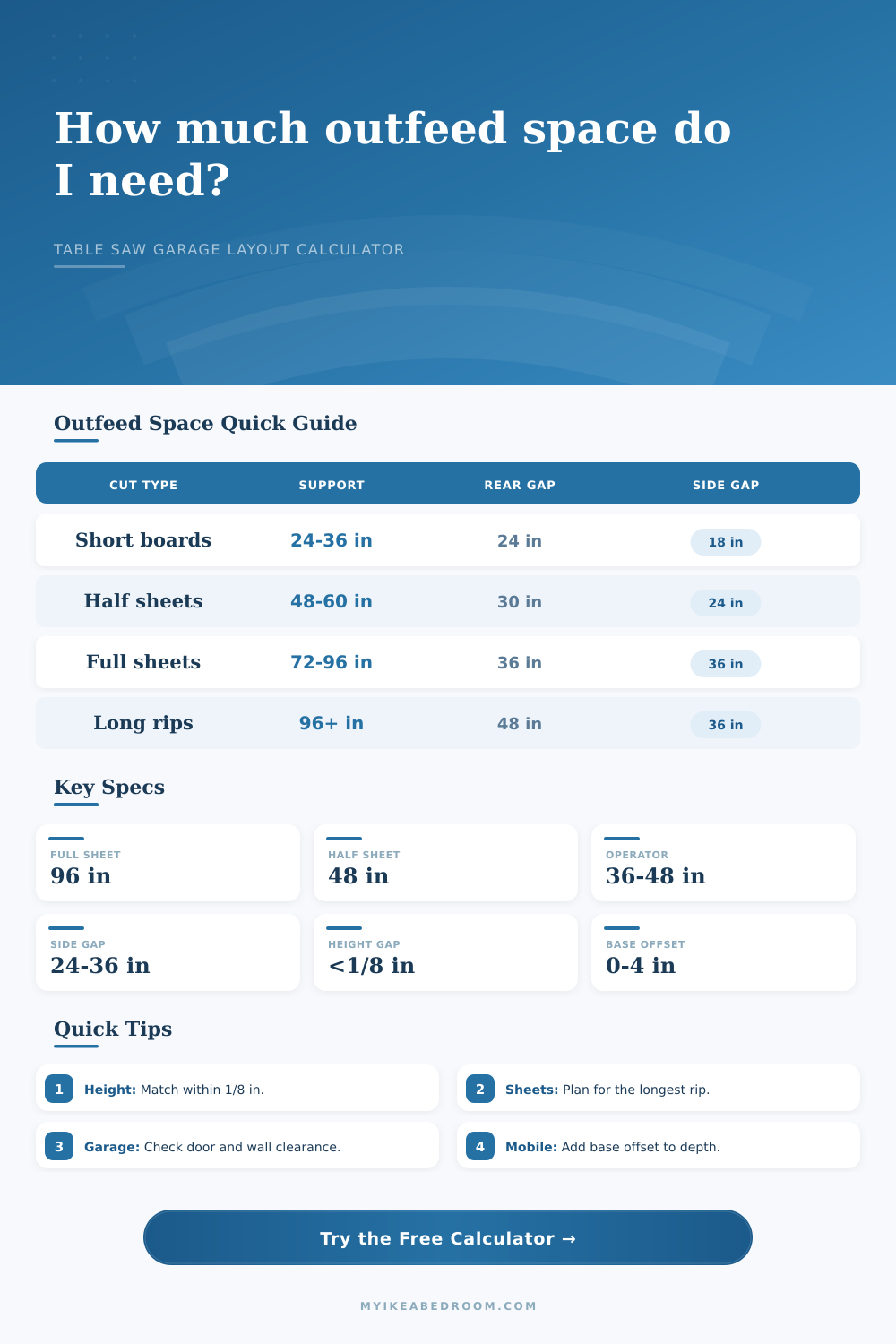
| Material or cut | Typical feed length | Suggested support behind saw | Best use |
|---|---|---|---|
| Small parts and short boards | 24–36 in | 24–36 in | Benchtop saws and compact carts |
| Half sheet panels | 48 in | 36–54 in | Folding table or roller stand |
| Full plywood sheet | 96 in | 72–96 in | Table, island, or long roller line |
| Long trim or face-frame stock | 96–144 in | 96 in or more | Clear straight path through the bay |
| Garage condition | Usable depth | Usable width | Layout note |
|---|---|---|---|
| Single-car bay with storage | 16–18 ft | 8–9 ft | Mobile saw usually needs angled storage after cuts |
| Standard single-car bay | 19–21 ft | 9–11 ft | Full-sheet ripping can fit with careful clearing |
| Two-car shared lane | 20–24 ft | 11–14 ft | Better side clearance for panel handling |
| Dedicated shop bay | 24 ft or more | 12 ft or more | Allows fixed outfeed table plus walk-around space |
| Check | Good target | Watch range | Why it matters |
|---|---|---|---|
| Outfeed table height | Level to 1/16 in low | Up to 1/8 in low | Low is safer than proud, but too low can dip panels |
| Outfeed table too high | 0 in proud | Over 1/16 in proud | A high table can catch the workpiece |
| Rear walking clearance | 36 in | 24–30 in | Needed to move, catch, and rotate material |
| Side clearance per side | 30–36 in | 18–24 in | Wide panels need room before and after the cut |
| Support style | Depth impact | Width impact | Best match |
|---|---|---|---|
| Fixed outfeed table | Permanent length | Usually saw width or wider | Dedicated shop area |
| Folding outfeed table | Deploys only while cutting | Usually saw width | Garage shops with parking needs |
| Roller stand line | Flexible but needs alignment | Narrow support path | Long boards and trim |
| Assembly island | Large fixed footprint | Best sheet support | Full-sheet work and repeat cuts |
You can spend a fortune on a cast iron table and a high tension fence, but none of it matters if your outfeed support is an inch too low or two feet too short. Then all bets are off: the cut falls, the wood binds, and then you’re up to your ass in alligators because there’s a three-hundred pound machine trying to kill you. Your brain will remember, every time you look at your workshop, that one second flash where a sheet of plywood dipped just after clearing the blade, and everything went sideways.
More horsepower aren’t going to help. This takes geometry. Plan the empty space as much as you do the cut. It’s not rocket science, but that’s why I made the calculator. You just input your garage size and saw specs, and it spits out all necessary math. It saves you from thinking too much about complex space planning (see the top of page).
How to Set Up Your Table Saw Safely
Most woodworkers concentrate their attention on fence and the blade because that is where the cut happens. But here’s the thing: It’s only half the equation. The other half is getting the material supported until it is no longer in harm’s way. If you’re ripping full sheets of plywood, you’d better have some decent runway behind you.
This tool also takes into account blade-to-rear-table distance, which can vary significently between small, compact job-site saws and large cabinet saws. A bigger saw table mean you’ll need a shorter support length, so you won’t have as much trouble maneuvering heavy outfeed tables through a tight garage.
And there’s one other quiet assassin: height tolerance. Within an eighth of an inch, your saw table must be aligned with your outfeed surface. Why? Because anything less than this precision, again, seemingly small in sound, is the difference between a sweetly smooth feed and a kickback from hell. If your support is too high, it behaves as a ramp; it raises the workpiece and squeeze it into the whirling blade. If your support is too low, the trailing edge of the sheet sags under its own weight and forms a fulcrum that twists the wood out of position. The calculator checks this match for you.
Then, when you dial in your folding table or roller stand before cutting that first board, it tells you whether they’re right. It’s tiny, but very important to your safe operation.
The other level of complication comes in the form of garage size. Even though you may have the ideal outfeed table and the perfect saw, you may be fighting a losing battle trying to rip full sheets if you’re working with an eight-foot-wide garage bay. The reference table on this page show how different garage sizes affect your workspace. Often times, a one car bay simply doesn’t leave enough room for the workflow, forcing some creative material handling or angled storage solutions. There has to be room to walk away from the cut, there has to be room to feed the wood, and there has to be room for you to stand.
The tool calculates all of this into the total length of the feed lane, including both the rear clearance and your own operator zone. This allows you to determine whether what you have will truly fit in real world.
Then there are mobile bases. These add a few inches of depth to your saw’s footprint that won’t show up on the manufacturer’s spec sheet, such as wheels, handles, and the lift pedal. Plan for this offset and input it into the calculator. This will then show you what kind of wall-to-door space you really need. One thing I’ve found out the hard way, you think you have plenty of room but when you go to back the saw into a tight spot you’ll find the handle will hit the wall before the back of the saw!
The best plan is always to plan for the longest rip. That way, even if you usually cut short boards, you’ll be prepared when you occasionally need to run a full-length panel or a long piece of trim. Planning for the worst case scenario in your shop means that you’ll never be left wanting.
The reference data you get with the tool gives you instant benchmarking on most common cuts. It also lets you know ahead of time what will fit on a simple folding table and what will require its own assembly island.
Your safety with a table saw depend on how it’s set up. So spend some time measuring, checking, and double-checking before unplugging your saw (it’ll pay off with every cut you make). It makes what could be a dangerous operation into something clean and repeatable. When you’ve got that support, you’ll notice the stress of cutting big panels dissapears. Knowing you have a good plan of action provides a peace of mind that goes beyond even an upgrade to your saw. Your future self would of thanked you for taking the time to get ready and standing patiently behind a perfect cut.