Lumber Rack Capacity Calculator
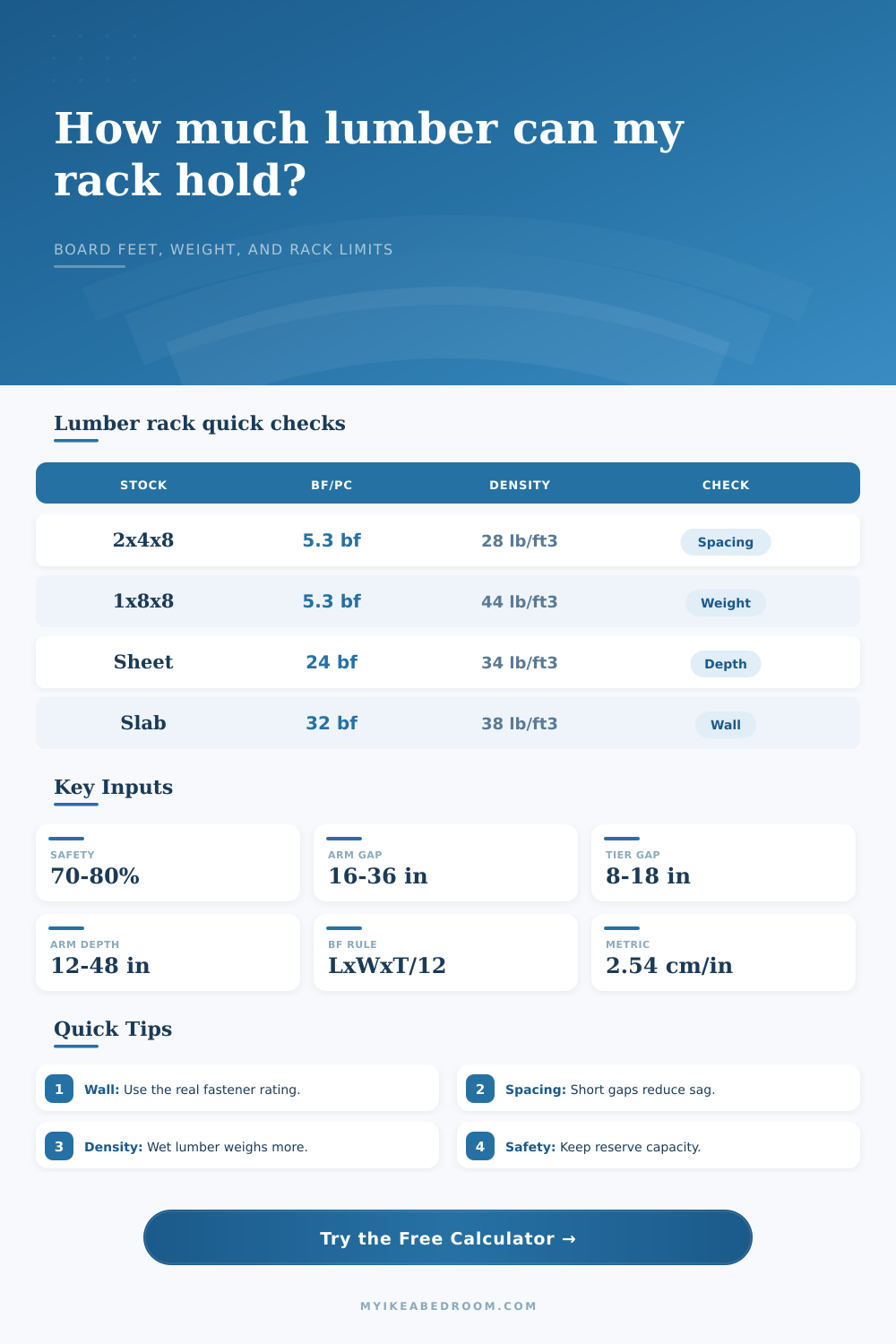
Estimate the board feet, lumber weight, tier fit, arm load, wall rating, support spacing, and practical reserve for a workshop lumber storage rack.
Pick a starting stack, then adjust board size, species, tiers, arms, spacing, wall rating, and safety factor to match the actual rack.
Lumber rack capacity estimate
Common dry lumber density estimates
| Material | Density | Approx lb per board foot | Use note |
|---|---|---|---|
| Cedar | 23 lb/cu ft | 1.9 lb/bf | Light trim and outdoor boards. |
| Pine / SPF | 28 lb/cu ft | 2.3 lb/bf | Common framing and shop lumber. |
| Poplar | 29 lb/cu ft | 2.4 lb/bf | Paint-grade furniture stock. |
| Plywood | 34 lb/cu ft | 2.8 lb/bf | Sheet goods vary by core and glue. |
| Walnut | 38 lb/cu ft | 3.2 lb/bf | Medium-heavy hardwood boards. |
| Birch | 43 lb/cu ft | 3.6 lb/bf | Dense boards and some panels. |
| Oak or hard maple | 44 lb/cu ft | 3.7 lb/bf | Heavy hardwood racks need reserve. |
Board feet examples using actual dimensions
| Stock size | Board feet each | Dry pine weight | Dry oak weight |
|---|---|---|---|
| 1 x 4 x 8 actual 0.75 x 3.5 | 1.75 bf | 4.1 lb | 6.4 lb |
| 1 x 8 x 8 actual 0.75 x 7.25 | 3.63 bf | 8.5 lb | 13.3 lb |
| 2 x 4 x 8 actual 1.5 x 3.5 | 3.50 bf | 8.2 lb | 12.8 lb |
| 2 x 8 x 10 actual 1.5 x 7.25 | 9.06 bf | 21.1 lb | 33.2 lb |
| 3/4 in 4 x 8 sheet | 24.00 bf | 56.0 lb at 28 lb/cu ft | 68.0 lb at 34 lb/cu ft plywood |
Arm spacing and tier planning guide
| Lumber thickness | Suggested arm spacing | Typical tier gap | Planning note |
|---|---|---|---|
| Under 3/4 in | 12-16 in | 6-10 in | Thin stock sags fastest. |
| 3/4 to 1 in | 16-24 in | 8-12 in | Good for cabinet boards. |
| 1-1/2 in framing | 24-32 in | 10-16 in | Use more arms for long spans. |
| 2 in and thicker | 32-36 in | 12-18 in | Weight often limits before sag. |
| Sheet goods | 16-24 in | 36-52 in | Depth and wall load dominate. |
Common rack scenarios
| Rack setup | Typical stock | Main constraint | Best check |
|---|---|---|---|
| Small garage rack | 2x4 and trim boards | Wall fasteners | Compare load to wall rating. |
| Cabinet shop rack | Oak, maple, birch | Weight per board foot | Use hardwood density. |
| Deep sheet rack | Plywood and panels | Arm length | Confirm sheet depth support. |
| Slab storage tier | Thick walnut or maple | Arm rating | Limit count by safe load. |
| Mixed offcut shelf | Short varied boards | Stack height | Leave lift clearance. |
So there’s this packed-in rack. And you pull out a board, and nothing moves. You’ve stacked them nice and neat, but now they’re all a solid block of wood on that shelf. When you go to grab the one you want, the whole thing groan. You can gets the boards to hold, but by gosh, only just barely. They’re wedged together like sardines, requiring more force then physics should allow.
That’s why capacity calculations matter. Capacity isn’t simply a case of getting wood into a space. Capacity is about keeping the rack functional while ensuring the wall remain attached to house.
Why You Need to Calculate Rack Capacity
Plug in your board size/species, and let the calculator do the math for you. No more need to worry about whether your dimensions exceed your capacity and no need to remember coefficient conversions, either. You will still have a chance to go wrong by failing to understand what each input represents.
What is the most common error when building storage systems? The answer are thinking that all weight is the same. It isn’t. Because pine is a softer wood, it’s less dense than others. So if you think a stack of pine studs weigh as much as an equivalent-sized stack of harder woods like red oak or hard maple, you’re mistaken.
And this matters a lot. Designing a rack capable of holding one type of weight (light framing lumber) then switching to a different kind of weight (hardwood cabinet stock) without recalculating your load rating are a recipe for disaster. Sure, the arms may be fine, but the fasteners pulling at the studs/drywall won’t give a damn about your good intentions.
To address this, the tool allow you to pick which species you are using. That determines how dense the wood is. Then it compares those two weights. These are the expected weight per board based off the species you picked and the weight limit based on your wall and arm ratings.
This is where the planning gets interesting. What is the limiting factor? Is it the shelf arm bending under the load? Do the wall anchors max out before total weight is reached? Are the boards just too thick to fit vertically within the tier spacing? The calculator considers all three options.
Did it come back and tell you you’re hitting a physical limitation like space? Or did it say you’ve got a problem with strength? Because those are two completely different issues. The latter one will require beefier hardware or more support points. The former one will require stronger hardware or more support points.
Safety is often overlooked. By default, the calculator sets a reserve amount which typically is 20 percent. This is not a recommendation, but it is a buffer based on what realy happens in the shop. Boards won’t all be distributed perfectly evenly. Some will be irregular and off-cut. A heavy slab may get slapped on a trim tier. If you leave the reserve then the rack can absorbs the punishment that real-world use gives without failure. Leaning on the shelf. The reserve absorbs shocks from things like dropping a board.
Spacing, How far apart should those support arms be? That’s what makes the difference between boards laying flat or sagging with their skinny side up. There’s a table on that page explaining it, basically, closer spacing for thinner stock. Too much spacing and they’ll eventually bow and make using your boards difficult and removing them impossible.
It sounds like a small detail, but it matters. Tighter arm spacing keep things clean and board straight.
Another variable that is not mentioned as often is moisture content. A piece of kiln-dried stock will weigh far less then a comparable piece of green lumber. You can tell the calculator to include such an allowance if you’re stacking recently-milled wood. Don’t do it and you’ll overload the stack. Know when you’re at your limit before reaching it.
So finally, a decent rack is a respecter of gravity. A good rack organizes and protects and makes stuff accessible. A good rack gets you to stop guessing about the load. You should of calculated this earlier.
The back slides out nice; the one on the front comes out easy; the rack doesn’t move from where you left it. Do the math, see what it’s like. Pull out the board you want and let the rest slide right into place.