Dust Collection CFM Calculator
Estimate airflow, static pressure, duct velocity, and collector class for woodworking dust collection runs with ports, branches, gates, filters, and simultaneous tools.
Pick a common tool and duct layout, then adjust the port size, duct run, filter loss, blast gate setup, and number of tools running together.
| Tool type | Common port | Starting CFM | Notes for sizing |
|---|---|---|---|
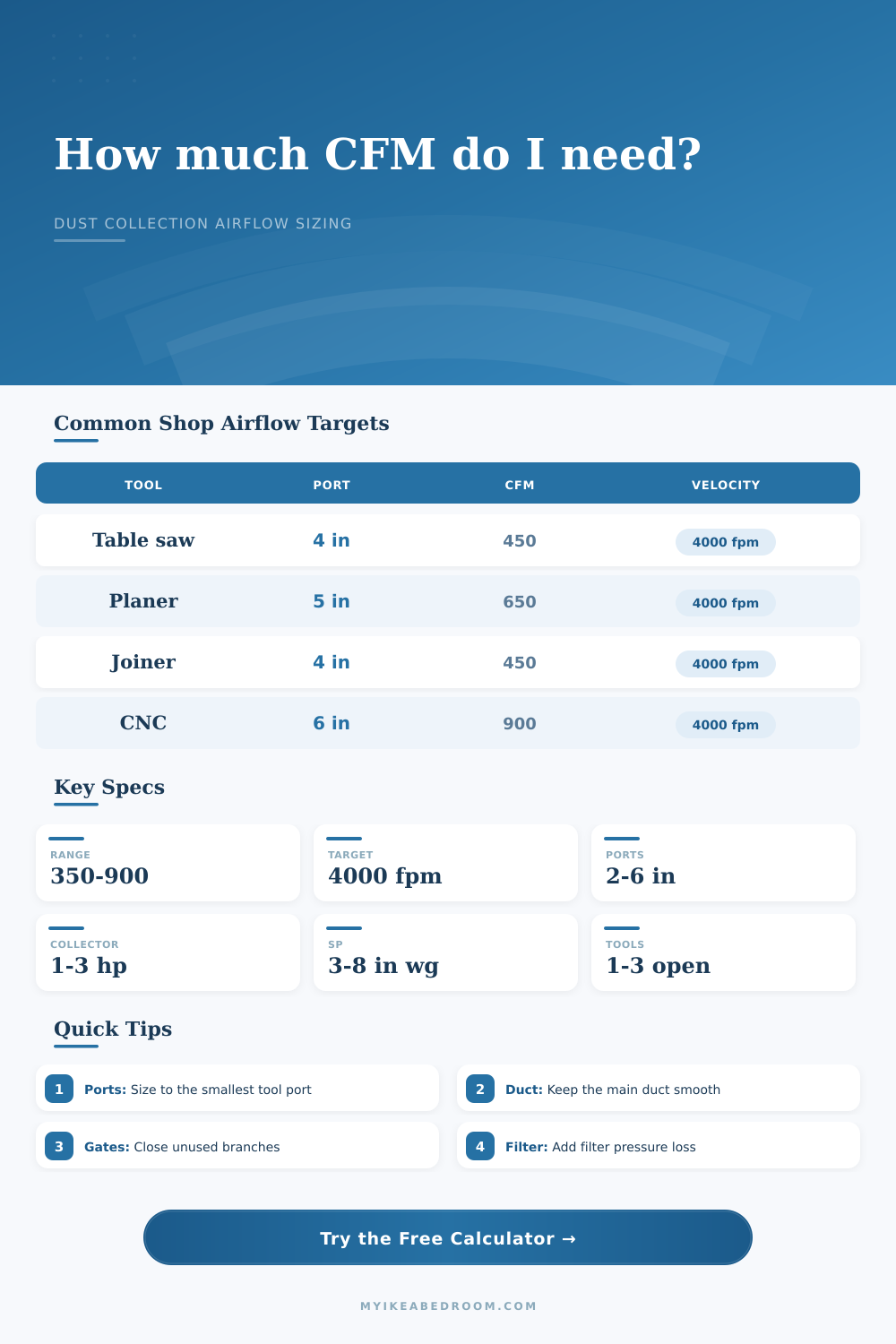
| Table saw or cabinet saw | 4 to 5 in | 350 to 500 CFM | Cabinet capture improves when the blade guard or overarm port has separate flow. |
| Planer or thicknesser | 4 to 5 in | 500 to 800 CFM | Heavy chips need strong transport velocity through the full run. |
| Jointer | 4 to 5 in | 450 to 650 CFM | Use the larger number for wide beds or long runs. |
| Band saw | 4 in | 350 to 500 CFM | Lower wheel collection often benefits from a smooth short branch. |
| Router table | 2.5 to 4 in | 250 to 450 CFM | Fence and cabinet ports may split the total airflow. |
| CNC router enclosure | 5 to 6 in | 700 to 1000 CFM | Large hoods need both capture area and transport velocity. |
| Duct diameter | CFM at 3500 FPM | CFM at 4000 FPM | CFM at 4500 FPM |
|---|---|---|---|
| 2.5 in | 119 CFM | 136 CFM | 153 CFM |
| 3 in | 172 CFM | 196 CFM | 221 CFM |
| 4 in | 305 CFM | 349 CFM | 393 CFM |
| 5 in | 477 CFM | 545 CFM | 614 CFM |
| 6 in | 687 CFM | 785 CFM | 884 CFM |
| 7 in | 935 CFM | 1069 CFM | 1203 CFM |
| Component | Typical entry | Calculator treatment | What raises it |
|---|---|---|---|
| Straight duct | 10 to 60 ft | Friction rises with velocity, duct length, and smaller diameter. | Long runs, small mains, rough hose |
| 90-degree elbows | 1 to 6 elbows | Each elbow adds equivalent length before friction is calculated. | Tight bends and back-to-back turns |
| Blast gates and branches | 1 to 8 branches | Gate condition adds leakage allowance plus fitting resistance. | Open unused branches, loose sliders |
| Filter and separator | 0.8 to 3.5 in wg | User-entered losses are added directly to system pressure. | Dust loading, fine filters, cyclones |
| Collector class | Usable range | Typical shop role | Watch point |
|---|---|---|---|
| Portable extractor | Under 450 CFM | One small tool, very short hose | Often not enough for 4 in chip collection |
| Compact 1 hp collector | 450 to 650 CFM | Single tool with short smooth duct | Filter loss can reduce real airflow |
| 1.5 to 2 hp collector | 650 to 900 CFM | Most one-tool garage shop branches | Needs clean duct layout for higher pressure |
| 2 to 3 hp cyclone | 900 to 1300 CFM | Larger ports and longer mains | Match fan curve at the calculated SP |
| Large cyclone system | 1300 CFM and up | Multiple open tools or 6 in mains | Plan make-up air and noise control |
After installing the new dust collection system, you stand there at the corner of the shop listening for the chips to be sucked away. You wait for the chips to vanish. All you hear is a whisper from the motor. Then you look over at table saw and see all the sawdust gathering around it because the air isn’t moving fast enough.
While horsepower may not often be the issue, speed and amount of airflow is. Just having a big motor can mean nothing if it lacks the ability to move enough cubic feet per minute of air to suspend heavy chips. Instead of cleaning your shop, it’s become a loud vacuum and keeps cleaning its own filters. Noise doesn’t matter as much as size. Focus on speed… How fast the air travels down the pipe.
Why Air Speed Matters More Than Power
I mentioned above a tool that will do this math for you depending based off your setup. Simply put in your information and let the tool save you from guessing about friction losses and coefficients. What most folks start with is checking out the CFM rating printed on the box. This is normaly the free-air volume. However, add a few feet of ductwork and this number means nothing.
What does matter is static pressure. How much resistance do the air encounter while traveling between the tool and collector? Each foot of hose, each elbow and each joint increases the resistance. If you collect enough of them, your airflow decrease dramatically. The tool considers all of this. Put in how long your ducts are, how many elbows and what kind of ducting you have. The tool then figures out total resistance and give you an idea of what your collector produces under load. This tells you what it really does instead of what they claim in their wind tunnels.
The second side of the equation is velocity. The speed at which air moves through your ducts prevent chips from settling. Without adequate velocity, heavy stuff drops out of suspension and plugs your ducts. In general, woodworking dust collection aim for four thousand feet per minute in primary duct. At this speed, even thick planer chips can be carried without pulling your tools off the floor.
The required velocity does change with duct diameter, and those details are shown on tables referenced when laying out the system. For example, a four-inch main has less CFM requirement to achieve the same four thousand FPM than a five-inch main. That’s just basic geometry, but many folks gets confused by it. Using undersized duct work lowers the air speed; you’ll still have a good collector, but it won’t perform well. Using oversized duct work will reduce pressure. It takes some engineering to find the proper balance.
Pay attention to your gates. They need to seal tightly around unused branches. Make sure you seal the branch completely, otherwise the air will take easiest path. That means leaking out through the open ports rather than pulling dust off the active tool. If you leave gates open, the air leaks out before it can pull dust from your active tool. Enter the gate leakage option on the calculator. You’ll notice that poor install habits impacts your performance. What seems like a minor leak impact suction speed right where it matters most. You will notice how much cleaner your shop stay as a result.
The other problem with filters is that they becomes more resistant the fuller they are. As air passes through the filter media it collect and holds on to debris. Eventually your cartridge or bag becomes so saturated that it blocks flow. If you’ve sized your system barely to the minimum requirement, then a plugged filter means no airflow. Plan for some margin of error. Ten or fifteen percent is not too much. When your filter is halfway full you’ll still have enough power to move those chips around. Nothing should of cost anything to plan for this. You won’t have to clean up a mess later.
“It’s all about thinking of it as one piece, your dust collection system. Your ducts are like a circulation system, and your motor is the heart. A blockage in your vessel, or too-narrow ducts, means the heart doesn’t beat for anything. Look at your entire run from the tool port to the collector inlet. Think of that in terms of balance. This is what the calculator can help you see. Is there too much resistance? Is the set-up undersized? Do you know how pressure and velocity interact with each other? If so, then you don’t guess anymore. You design. Flip the switch and the chips go right into the bag. The system works correctly. The air remains clean. That’s the idea.”