Kids Table Height by Age Calculator
Match a child table to age, standing height, chair seat, elbow clearance, tabletop thickness, growth room, activity posture, and shared-table comfort.
Recommended Kids Table Fit
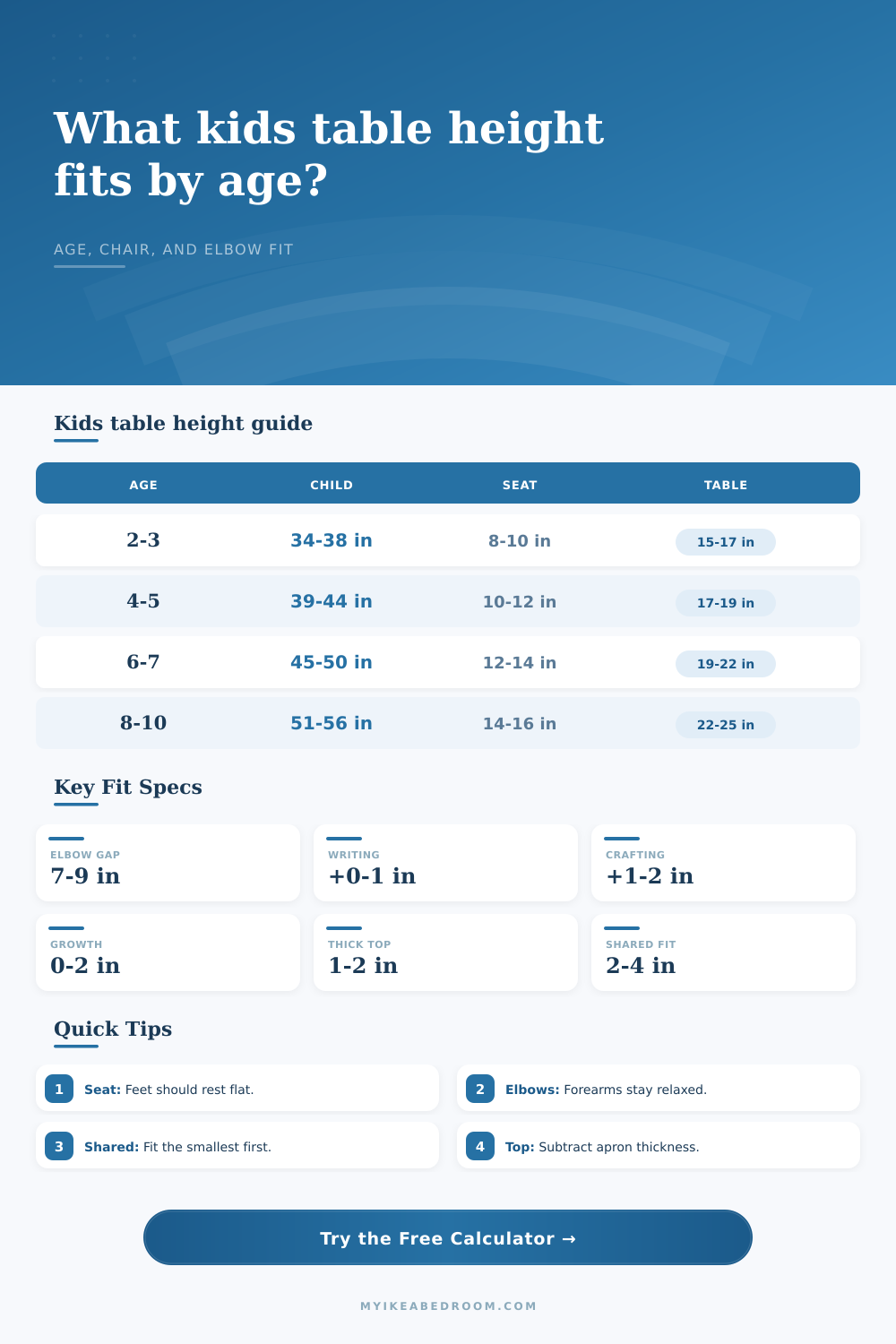
| Age band | Typical child height | Common seat height | Typical table height |
|---|---|---|---|
| 2 to 3 years | 34 to 38 in / 86 to 97 cm | 8 to 10 in / 20 to 25 cm | 15 to 17 in / 38 to 43 cm |
| 4 to 5 years | 39 to 44 in / 99 to 112 cm | 10 to 12 in / 25 to 30 cm | 17 to 19 in / 43 to 48 cm |
| 6 to 7 years | 45 to 50 in / 114 to 127 cm | 12 to 14 in / 30 to 36 cm | 19 to 22 in / 48 to 56 cm |
| 8 to 10 years | 51 to 56 in / 130 to 142 cm | 14 to 16 in / 36 to 41 cm | 22 to 25 in / 56 to 64 cm |
| Activity | Fit priority | Height adjustment | Why it changes |
|---|---|---|---|
| Snack or puzzle play | Easy reach | -0.5 to 0 in | Lower top supports relaxed shoulders. |
| Drawing and writing | Neutral forearm | 0 to +0.5 in | Pencils need a steady elbow position. |
| Craft trays | Extra clearance | +1 to +1.5 in | Thicker supplies sit above the surface. |
| Brick building | Reach across top | -0.25 to +0.25 in | Lower height improves tabletop reach. |
| Tablet or keyboard | Wrist comfort | +0.5 to +1 in | Hands need room without lifted shoulders. |
| Chair seat height | Low table fit | Writing fit | Craft fit |
|---|---|---|---|
| 8 in / 20 cm | 15 in / 38 cm | 16 in / 41 cm | 17 in / 43 cm |
| 10 in / 25 cm | 17 in / 43 cm | 18 in / 46 cm | 19 in / 48 cm |
| 12 in / 30 cm | 19 in / 48 cm | 20 in / 51 cm | 21 in / 53 cm |
| 14 in / 36 cm | 21 in / 53 cm | 22 in / 56 cm | 23 in / 58 cm |
| 16 in / 41 cm | 23 in / 58 cm | 24 in / 61 cm | 25 in / 64 cm |
| Shared setup | Height spread | Table strategy | Chair strategy |
|---|---|---|---|
| Single child | 0 in / 0 cm | Fit measured elbow height. | Use one fixed seat height. |
| Close siblings | Up to 2 in / 5 cm | Use the average fit. | Small cushion is usually enough. |
| Mixed ages | 3 to 4 in / 8 to 10 cm | Favor the smaller child slightly. | Raise the shorter child seat. |
| Wide range | 5 in+ / 13 cm+ | Pick adjustable legs if possible. | Use different chair heights. |
If you’ve ever watched a young student work on homework or other projects at a dining table, I bet you’ve witnessed the same thing: A kid with their head down, their back hunched over to clear the table top, their feet swinging uselessly below. That isn’t a learning position; that’s fighting gravity.
The problem isnt the padding on the chair or the attention span of the child. It is the difference in height between the tabletop and the chair seat itself. If it’s too large, then they’re fighting the structure itself, and if so, the table cease to be a learning tool.
How to Find the Right Table Height for Your Child
Most parents rely on age to determine fit. While that’s a good beginning point, it isn’t very precise. Because of nutrition and genetics, a 5 year old can be anywhere from thirty-eight inches tall to forty four inches tall. Those needs is quite different.
When you know the child’s actual height (standing) and the size of chair, the calculator does all the work for you. You no longer have to guess based off vague age ranges. By entering the actual seat height into the formula, you base the equation on real-world data.
Then it also takes into account the elbow clearance, which is how high the arm rest rises from the seat when your child’s elbow is in a comfortable position. This number matter a lot when it comes to comfort, it recognize the child’s body instead of an arbitrary standard.
It’s about what you’ll do there: Many people might not realize that writing differently at a desk than playing with small blocks on the floor different than stacking large trays. For example, when a child is sitting down to write, their wrist and forearm should stays neutral (parallel to the floor). Sitting up straight means the shoulder doesn’t lift. But if table is too tall, it does; then your hand gets tired fast. If it’s too short, so does your back.
The math takes all this into account as we ask what will the child be doing on the surface. It accounts for things like reaching a little bit better for puzzles. Or having their wrists flat when typing on a keyboard. Micro adjustments which may sound minor…but accumulate across hour after hour of use.
Another thing that affects ergonomics is how thick your tabletop is. While it might be nice and strong sitting on a heavy wooden surface, that heavy piece of wood will lower the height under the table. To account for this, we subtract thickness of the tabletop or the apron when calculating the space under the table so the kids’ knees don’t hit it.
Don’t think you got the perfect height on your tape measure just because the bottom of the table isn’t high enough. That’s what many people get wrong, they measure from the top and don’t realize their legs are taking up room down there, too.
For shared tables: It’s simple, fit the smallest child first. With a table and chairs, a taller kid can always raise their elbows a bit to sit lower, but they can’t keep raising their shoulders to reach a taller table. The shared range check on the calculator shows you whether there’s a single height that will work for both kids in a mixed age group. If not, it recommends raising the table for all (which keeps the older kid comfy) vs. You can raise the chair for the smaller kid to help them keep good posture. That way, big kid still gets to sit comfortabley while playing.
And there are growth buffers. Ideally you’d like to pad things out another inch or two for good measure, extend the life of the table… but then it’s a wall again. The suggestion here is typically a small amount. Perhaps an inch, but enough for longevity without sacrificing usability. Better a nice fitting table today that needs a bit of padding down the road than a table that towers over you on Day 1.
Engagement = comfort. The more comfortabley the kid is sitting at this table, the longer they’ll sit at the table. Eliminate the physical friction. Let ‘em do their mental stuff.
Begin with the chair. Check the elbows. Let the rest fall into place.