Vinyl Record Storage Weight Calculator
Estimate loaded cube weight from LP count, jacket style, bin weight, shelf span, KALLAX-like dimensions, distribution, and safety factor.
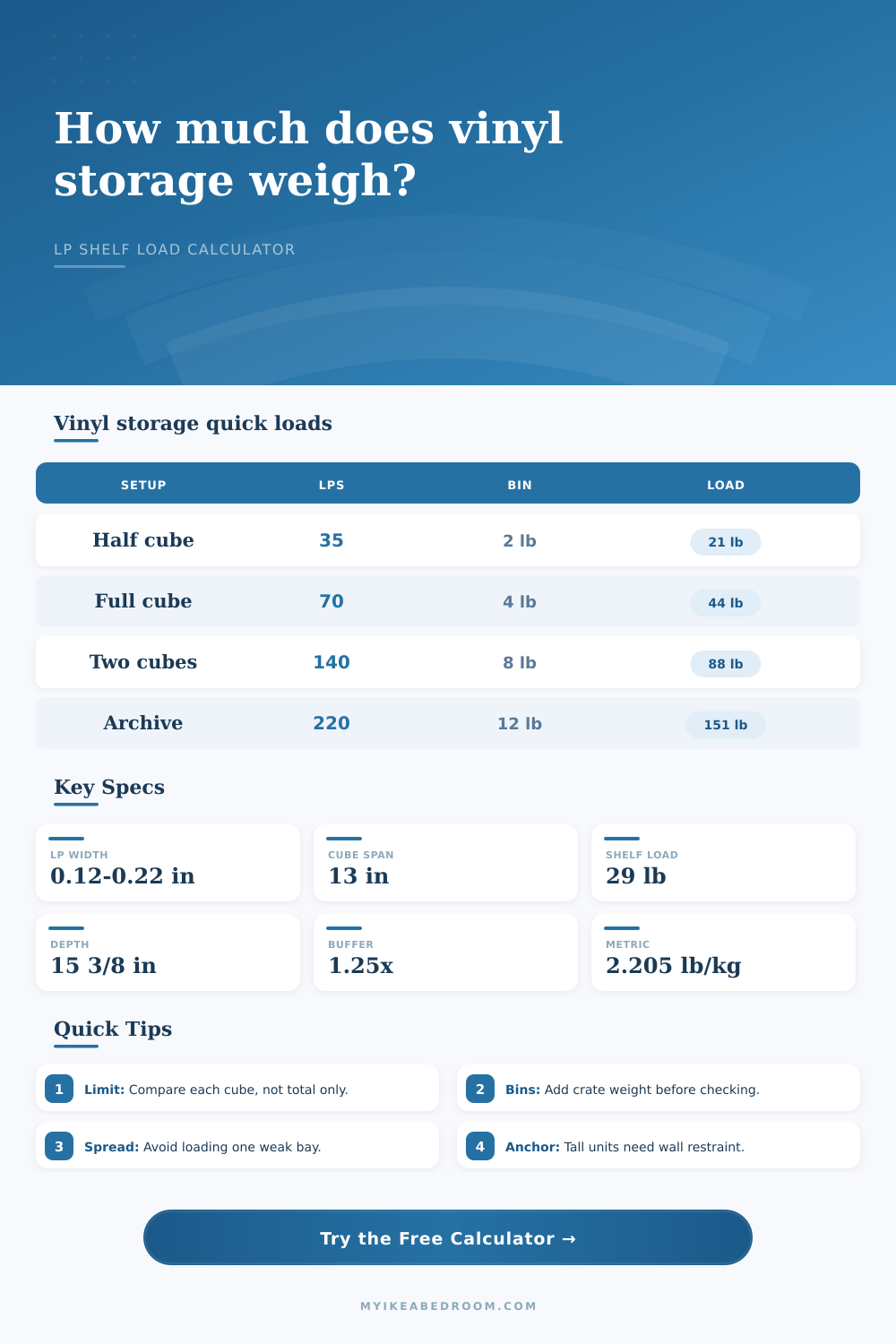
Choose a starting point, then adjust the load rating, cube count, jacket mix, and crate weight for your exact shelf.
Record storage load results
Use these tables as check points when your records vary in thickness, jacket construction, or bin style.
| Jacket type | Typical weight | 70 LP cube | Best use |
|---|---|---|---|
| Paper or generic sleeve | 0.48 lb / 0.22 kg | 33.6 lb records | Temporary sorting |
| Standard LP jacket | 0.58 lb / 0.26 kg | 40.6 lb records | Normal collections |
| Outer sleeve added | 0.62 lb / 0.28 kg | 43.4 lb records | Protected shelves |
| Heavy 180g pressing | 0.68 lb / 0.31 kg | 47.6 lb records | Audiophile rows |
| Gatefold or double jacket | 0.82 lb / 0.37 kg | 57.4 lb records | Thick spines |
| Box-set equivalent | 1.25 lb / 0.57 kg | 87.5 lb records | Dedicated bay |
| Cube setting | Dimension or rating | What it affects | Calculator default |
|---|---|---|---|
| KALLAX-like inside width | About 13.25 in / 33.7 cm | Linear record fit | 13.25 in |
| KALLAX shelf depth | 15 3/8 in / 39.1 cm | Crate clearance | 15.375 in |
| KALLAX max shelf load | 29 lb / 13.2 kg | Per shelf check | 29 lb |
| One cube loaded | 100% worst-cube share | Peak load | Manual locked |
| Two cubes uneven | 65% worst-cube share | Off-center loading | Selectable |
| Front-heavy crate | 75% worst-cube share | Pull-out stress | Selectable |
| Packing style | Width per LP | 13.25 in cube capacity | Load note |
|---|---|---|---|
| Loose browsing | 0.22 in / 5.6 mm | 60 LPs | Easiest to flip |
| Normal jackets | 0.16 in / 4.1 mm | 82 LPs | Common estimate |
| Tight storage | 0.12 in / 3.0 mm | 110 LPs | Heavy for rating |
| Boxy/gatefold mix | 0.24 in / 6.1 mm | 55 LPs | Lower count, higher lb |
| Scenario | Records | Cubes used | Approx loaded weight |
|---|---|---|---|
| Starter single cube | 45 standard LPs | 1 cube | 30 lb with bin |
| Full standard cube | 70 standard LPs | 1 cube | 45 lb with bin |
| Two-cube alphabet row | 140 mixed LPs | 2 cubes | 95 lb total |
| Four-cube archive bay | 220 sleeved LPs | 4 cubes | 153 lb total |
| Box-set bay | 35 box equivalents | 1 cube | 50 lb with bin |
A stack of your favorite records on the coffee table: That’s easy enough. Six months in, you have a messy pile towering against your bookcase, teetering toward collapse at the slightest footfall.
Vinyl looks lightweight, but it feel substantial. Most shelves collapses due to this misperception: the gap between visual weight and material mass. Until you hear the wood creak, you won’t sense the pile getting heavier; you’ll only be able to see how much room it’s taken up.
How to Store Your Records Safely
To estimate your storage space, you can’t count records alone… You also has to account for jacket thickness, crate weight, and, crucially, physical constraints of your furnishings. That’s a messy pile… Something you can easily manage with the help of the calculator above. It’ll do the math for you. But knowing how to get to the final number is far more important than just guessing.
Each LP have a jacket, and those jackets come in all sorts of weights. A budget reissue album in a thin, recycled-paper sleeve weighs much less then a high-end collector’s edition boxed set featuring a thick gatefold. You’re able to choose the average weight per record with the tool, and that updates the overall load. Audiophile pressings on 180-gram vinyl? Heavy cardboard outer sleeves? Your weight per inch go up a lot.
Otherwise, you may visually be able to cram seventy records into a cube… But structurally speaking, you’ve already overextended the shelf capacity.
One key aspect of storing your records correctly involve distribution. You may have a record collection that’s well under the capacity of an entire shelving unit, but it could still be a disaster if you pile all of those record into just one or two bays. Shelving units is rated by compartment, not as a total unit. When using the calculator, it ask about the distribution of records throughout the cubes. For example, it’s possible to have a barely off-center distribution where one bay hold fifty-five percent of the total weight. People make this mistake when dividing the total weight by the number of shelves. They think it’s safe. It isn’t. The strength of the entire system is only as strong as its weakest link, one overloaded cube will bring down the whole unit even with lighter bays on either side.
This is why there are safety factors. Filling a shelf to its structural rating isn’t advisable, even if that’s 29 pounds per bay. Ratings aren’t usage guidelines (they’re engineering limits). You add a buffer to account for the settling of the furnitures (over time), the moving weight of pulling records in and out, and the inevitable creep of wood under sustained pressure. Using a higher safety factor in the tool lowers your safe capacity, but saves the shelf. Collapsing your collection is worse then having a slightly smaller collection.
That’s what the page’s reference table makes clear, and it also shows how jacket type affect the bottom line.
There are physical factors too: normal cube shelving has a certain interior depth and width. You can pack records in as snugly as possible to use every bit of space, but this increases side friction/stress. Alternatively, you can leave records with a little breathing room so they’re easy to browse, but this wastes capacity. The tool accounts for how much volume each record uses based off packing style (a loose packing style will need more volume than tight). This is a trade-off between density and access. You’ll want to be able to reach in and grab an album without displacing its neighbors… but you’d also like to squeeze as many into a given square footage as possible. You test how things fit, not just how much they weigh.
The bottom line: There is no wrong or right way to store your vinyl; it’s all about physics and taste. It’s about capacity vs. Distribution, strength of materials vs. Weight, and density vs. Accessibility. The numbers take you there, but you’re trying to preserve the records. You should of checked the math earlier. As you get close, the wood speaks. Listen to it before the math. Sure, that tower on the coffee table looks cool, but a calculated shelf is where your collection livig out its days.