Wine Cooler Bottle Capacity Calculator
Estimate realistic cooler capacity from interior width, depth, shelf spacing, bottle diameter, bottle height, shelf angle, and clearance.
Use a preset as a starting point, then adjust the interior dimensions and bottle type to match your cooler.
Wine Cooler Capacity Estimate
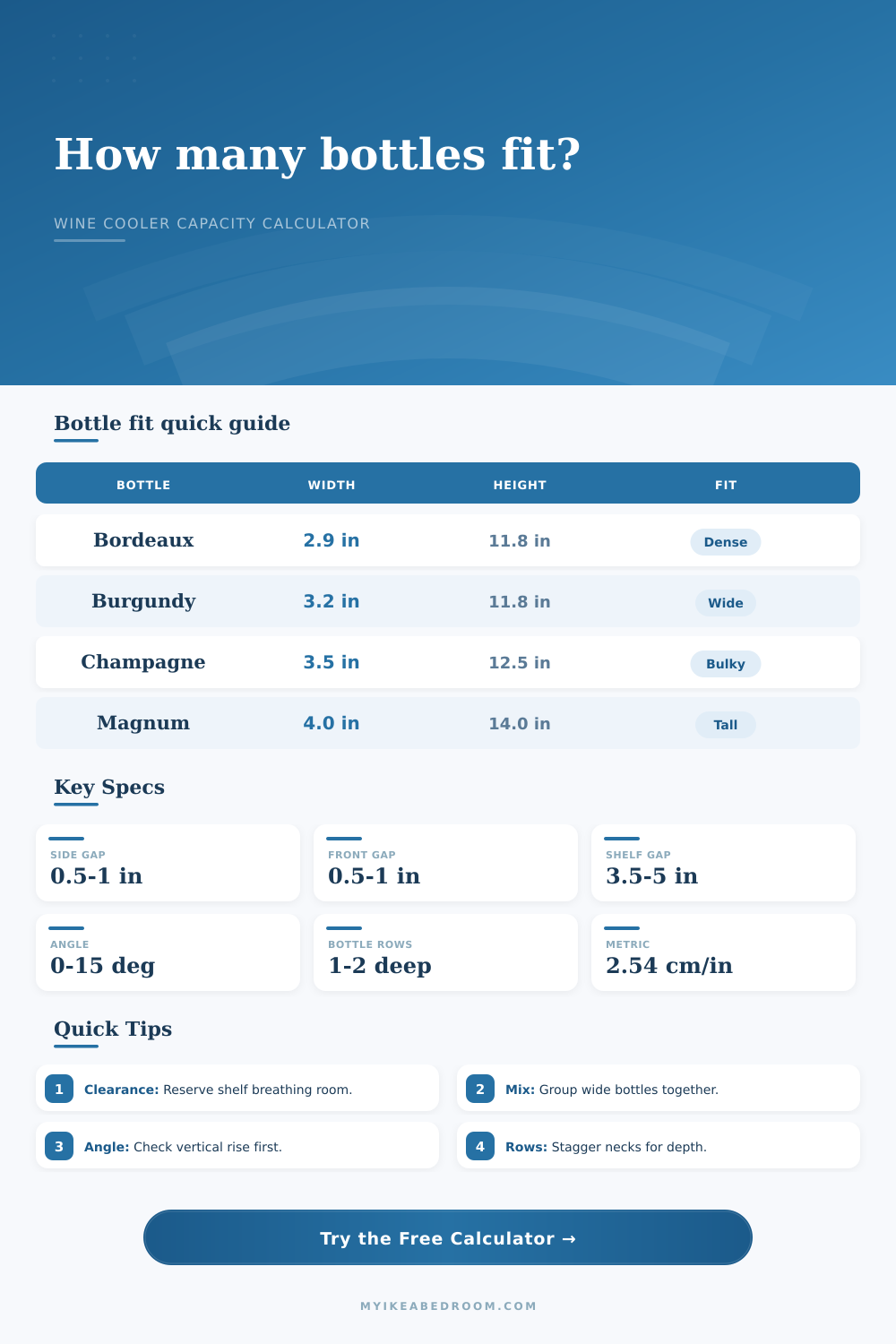
| Bottle family | Typical diameter | Typical height | Capacity impact |
|---|---|---|---|
| Bordeaux 750 ml | 2.85-3.00 in / 7.2-7.6 cm | 11.6-12.0 in / 29.5-30.5 cm | Best baseline for advertised cooler capacity. |
| Burgundy 750 ml | 3.15-3.35 in / 8.0-8.5 cm | 11.6-12.1 in / 29.5-30.7 cm | Wider shoulders can remove one column per shelf. |
| Champagne 750 ml | 3.40-3.65 in / 8.6-9.3 cm | 12.2-12.9 in / 31.0-32.8 cm | Needs more shelf opening and depth clearance. |
| Riesling or flute | 2.85-3.05 in / 7.2-7.7 cm | 12.8-13.2 in / 32.5-33.5 cm | Narrow enough for columns, but depth can fail first. |
| Magnum 1.5 L | 3.85-4.20 in / 9.8-10.7 cm | 13.8-14.5 in / 35.1-36.8 cm | Often fits only on removable or lower shelves. |
| Shelf setup | Useful opening | Works best for | Watch point |
|---|---|---|---|
| Tight flat shelf | 3.2-3.6 in / 8.1-9.1 cm | Bordeaux only, one layer | Champagne and Burgundy can scrape above. |
| Comfort flat shelf | 3.7-4.3 in / 9.4-10.9 cm | Bordeaux, Burgundy, light mixed storage | Still confirm label and shoulder thickness. |
| Wide bottle shelf | 4.4-5.1 in / 11.2-13.0 cm | Champagne and broad Burgundy bottles | Fewer total shelves may reduce capacity. |
| Angled display shelf | 5.0-6.6 in / 12.7-16.8 cm | Label display and opened-bottle visibility | Angle raises the bottle neck into the shelf above. |
| Pattern | Depth factor | Width factor | Best use |
|---|---|---|---|
| Straight horizontal | 1.00 bottle length | 1.00 diameter | Simple single-row shelves and fast access. |
| Alternating neck-to-base | 0.88 bottle length | 0.92 diameter | Gains small fit room when shoulders nest cleanly. |
| Deep double row | 0.78 bottle length | 0.95 diameter | Deep coolers where rear labels are harder to reach. |
| Angled display | Angle projection | 1.05 diameter | Lower capacity, better front label visibility. |
| Cooler type | Interior width | Interior depth | Typical capacity factor |
|---|---|---|---|
| Countertop compact | 12-15 in / 30-38 cm | 12-15 in / 30-38 cm | Usually one row and three to four columns. |
| 15 in undercounter | 11-13 in / 28-33 cm | 17-20 in / 43-51 cm | Narrow width limits columns before depth does. |
| 24 in undercounter | 19-21 in / 48-53 cm | 17-21 in / 43-53 cm | Often reaches two rows with bottle overlap. |
| Tall cabinet cooler | 19-24 in / 48-61 cm | 18-22 in / 46-56 cm | Capacity depends heavily on shelf count and spacing. |
Capacity specs for wine coolers are often a stunt. “It holds 40 bottles,” says the brochure; “Don’t exceed 30 bottles,” cautions the manual. Then when you go to count your bottle, there’s not quite enough room for all of them. That’s never because the cooler can’t handle it. It’s always because someone assumed all the bottles were the same size. They’re not.
A Bordeaux is a well-behaved rectangle, while a Burgundy are wide. Then there’s Champagne, which has a bulkier shape. There is also Magnums, which aren’t small shapes at all; they don’t stack neatly. Mix-and-match shapes in a space of limited size and things get mathematical quick.
How to Count Your Wine Bottles
To help you do this without pulling out a calculator, I created the thing at top of the page. It makes you face the physical facts of the situation.
When most folks measure their cabinets they measure around the outside. Then they figure that’s what the interior will be. It won’t. What you want is the inside, wall-to-wall dimension within the cooling cavity itself. Everything steal space: the shelf lip, the back fan cover, the door gasket, and the rails. Measuring inside to outside inflates your potential capacity right there. The tool request interior measurements because that’s where the bottles live.
It also wants to know shelf thickness. Seems unimportant? Nope. Every half-inch of shelf stock add up after six levels.
The second thing is bottle shapes. A Bordeaux bottle is about three inches across. A Burgundy bottle are wider at more than three and a quarter inches. That quarter inch make a huge difference in how many columns you get to fit onto a shelf. It might be the difference between getting six bottles and seven.
The calculator takes that into account: there’s a drop down list of bottle families and you can enter your own custom diameters if you want. It does the same for height. Riesling bottles is long and skinny, while Champagne bottles are tall. If the opening to your shelf isn’t very wide, a tall bottle may knock on the next shelf up from it. Again, you’ll know right away if you have the wrong clearance vertically. The page shows it all nicely in a reference table, with diameter and height relating to shelf spacing.
Then there’s clearance, which cut down the load considerably. No sardine-packed rows of bottles here; they must have breathing room and has to come out without breaking. This tool has a place for both front to back clearance and side gaps. The standard is half an inch on either side. That way no bottle will touch another one or rub up against metal rails. Depending on what you’re stashing in there, you may want more than that. For some of those higher-end labels, maybe.
Then there’s the option to add a mixed-bottle buffer. Ignore this if all your bottles is alike. Otherwise, add that extra percentage for having a few flutes next to some wider-shouldered beauties. That lowers the total to account for the empty space made by the odd-shaped bottle.
The other wrinkle is angle. Shelves angled up display nicely and do make label visible. But tilting a shelf take much more vertical space. A bottle at twelve degrees occupies more height then a bottle lying flat. As you raise the angle the tool also adjust how far down or up the vertical fits. So what was one layer of flat bottles on a shelf may be just half a layer if the shelf is tipped. It is a choice between looks and volume. Most folks value looks above capacity til they go to cram things in.
The preset buttons helps as a place to start. They load common sizes for common styles of coolers; from small countertop to large tall cabinet. From there, tinker away. It’s not so much about coming up with a number. It’s more about knowing why that number is what it is. Seeing how many Bordeaux bottles fit in one row compared to fewer Burgundy bottles will make you think differently about how you lay things out. Instead of throwing a mix of wide and narrow bottles randomly into the same shelf, you may want to put all the wide ones on one side. If you’re a mixed bag then perhaps an adjustable shelf cooler is right for you.
Packing bottles in tight like sardines is a mistake until you realize they need room to breathe. That’s where the numbers come in. Planning wins over packing hands down. You should of seen that the numbers is important. That’s where the numbers come in. Planning wins over packing hands down.