Ironing Board Height Calculator
Set a practical ironing board height from elbow level, standing or sitting posture, board thickness, shoes, task force, and fatigue allowance.
⚙ Unit System
Use measured elbow height when you have it. If it is blank, the calculator estimates elbow level from height and posture.
📌 Real Presets
📏 Height Inputs
Your Ergonomic Ironing Height
📊 Ergonomic Rule Cards
📘 Reference Tables
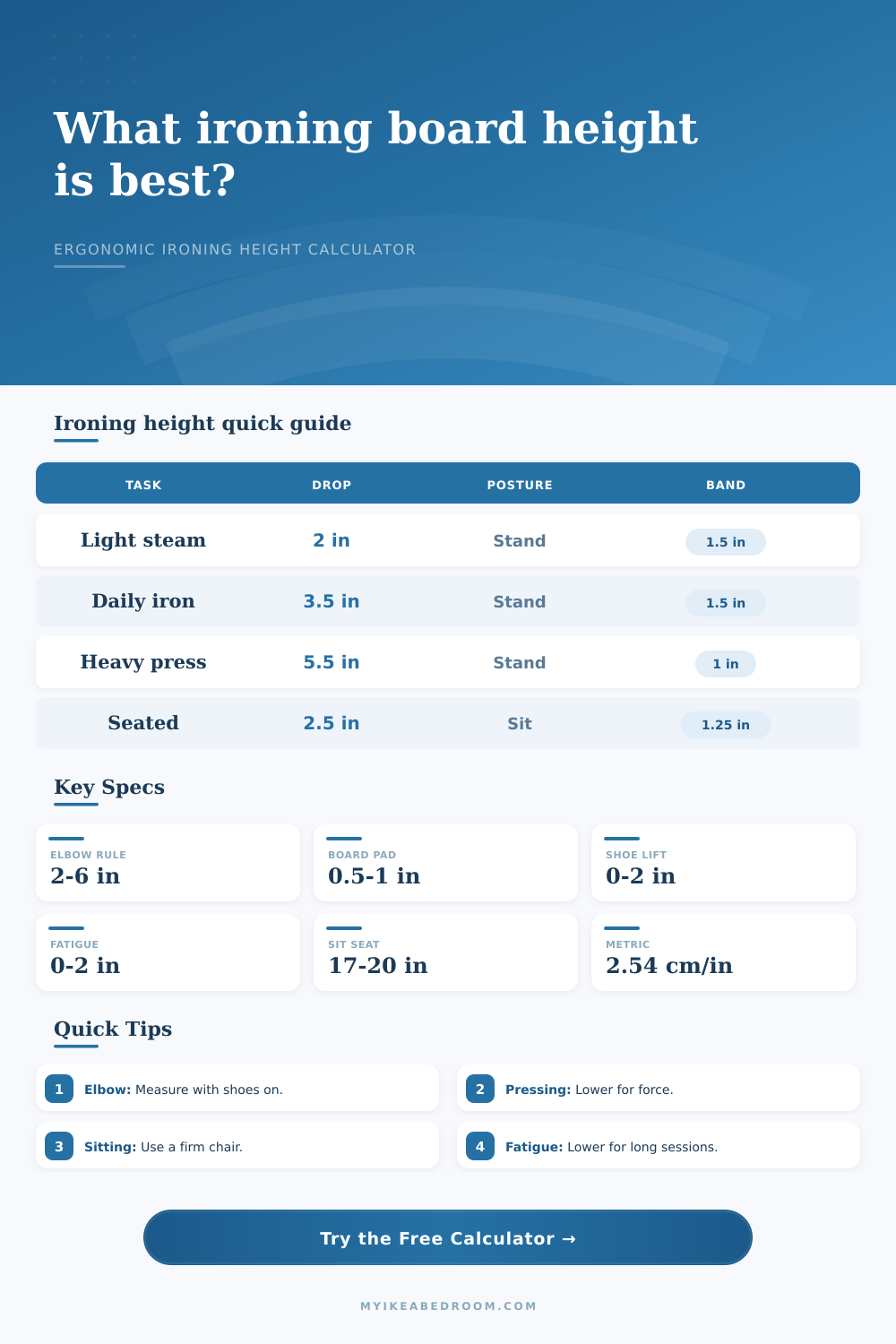
| Ironing task | Board top target | Why it changes | Best use |
|---|---|---|---|
| Light steaming and touch-ups | About 2 in below elbow | Minimal downward force, more visual control | Delicates, quick refreshes, hanging wrinkles |
| Daily ironing | About 3.5 in below elbow | Balanced wrist angle and light pressure | Shirts, school uniforms, everyday laundry |
| Detail seams and cuffs | About 4.5 in below elbow | Closer eye line and stable hand control | Cuffs, collars, pleats, sewing work |
| Heavy cotton or linen pressing | About 5.5 in below elbow | Lets body weight assist without shoulder shrug | Linen, denim, thick cotton, fused seams |
| Seated close-reach ironing | About 2.5 in below seated elbow | Keeps shoulders down while the lap stays clear | Small garments, recovery days, accessible setup |
| User height | Estimated standing elbow | Daily board top | Heavy press top |
|---|---|---|---|
| 5 ft 0 in / 152 cm | 37.4 in / 95 cm | 33.9 in / 86 cm | 31.9 in / 81 cm |
| 5 ft 6 in / 168 cm | 41.1 in / 104 cm | 37.6 in / 96 cm | 35.6 in / 90 cm |
| 6 ft 0 in / 183 cm | 44.8 in / 114 cm | 41.3 in / 105 cm | 39.3 in / 100 cm |
| 6 ft 4 in / 193 cm | 47.3 in / 120 cm | 43.8 in / 111 cm | 41.8 in / 106 cm |
| Posture setup | Reference point | Board range to check | Adjustment cue |
|---|---|---|---|
| Standing barefoot | Bent elbow from floor | Board top, not underside | Wrists neutral, shoulders relaxed |
| Standing in slippers | Elbow rises with footwear | Add shoe lift if estimating | Measure in the footwear you iron in |
| Sitting on chair | Seat height plus elbow rise | Low board or tabletop board | Knees fit under the board edge |
| Wheelchair seated | Measured seated elbow preferred | Clear armrests and wheels | Keep the work close to avoid reaching |
| Allowance | Use this value | Effect on board | When it helps |
|---|---|---|---|
| None | 0 in / 0 cm | Uses pure task height | Short sessions and light garments |
| Small | 0.5 in / 1 cm | Slightly lowers the shoulders | Most weekly household ironing |
| Moderate | 1 in / 3 cm | Reduces shoulder elevation | Long baskets or mild fatigue |
| High | 2 in / 5 cm | Favors rest over precision | Back or shoulder tiredness days |
💡 Practical Tips
Use the padded top of the board, not the metal frame underneath. A thick cover can add enough height to change wrist angle during detailed ironing.
If shoulders creep upward, lower the board slightly. If you are rounding your back or leaning hard, raise it or bring the garment closer.
So most folks position their ironing board at a comfortable-ish height (usually about hip level). That’s wrong, and if this make your shoulders ache when you’re done ironing one basket of laundry, I bet that’s why. It has nothing to do with the steam or the iron. It’s all about leverage.
If your elbows sits above the ironing board, each time you push the iron across fabric, you’re lifting it with your trapezius muscles. If they’re below the board, you’re pushing with your arms and core. It is a tiny mechanical adjustment, but it make a big difference in how many hours you can spend without aching.
Why Ironing Board Height Matters
Here’s the thing about that math: This tool does the math for your body, but here’s the logic. The padded part of the board should be positioned below your elbow joint. And how far? Well…that depends on the job.
Do you need to see exactly where the iron is hitting the fabric (think: silk blouse)? Close the board to your elbow joint and position it high up so there’s very little pressure downwards. Are you ironing denim jeans or cotton towels? Then the board needs to be lower. You can apply your body weight to really press the iron down. Pressing doesn’t require brute strength; it requires adjusting height. Most folks overlook this.
What about footwear? It is more important then you’d imagine. Ironing in slippers with a foot of cushion? Your elbow is higher. The calculator takes this into account. And the resulting target height is still correct. Always consider what shoes you will be wearing for the task and measure your elbow then. Bare feet? Enter zero for shoe height. Chunky house sandals add that extra inch to your working level? That’s why your board has got to go down to match. Failure to do so will result in a set-up that seems too high, forcing your shoulders to creep up and your neck muscles to tighten to support your arms.
Now sit down and things change completely. When you’re ironing from a chair, you don’t have the floor as a reference point. Now it’s your chair plus how high your elbow sits above the seat. Unless your board is up high and/or you use some sort of cushion, a regular dining chair will be too low for comfortably ironing. The reference tables in the tool can help you see this shift.
They indicate that when doing heavy pressing jobs, you want more drop under the elbow than when doing light steaming. Why? Physics. Can you press hard well with an arm outstretched up at a right angle? No. To put force into something, you want a little bit of a downward slope so you can get your bigger muscle groups engaged.
People often forget about one other factor: fatigue. Sometimes after a long day at work, your back is sore, or maybe there’s a giant mound of laundry that needs attention, dropping the board just an inch or two can feel like a godsend. It takes the strain off those tiny movements your shoulders make to hold yourself upright all day. That’s why there’s a fatigue allowance in the calculator. On difficult days, slide it down an inch or two. Is that cheating? No! That’s adjusting your workspace to match your body’s current condition.
If a stationary workstation assumes that your body is also in a steady state… well, it isn’t. Your energy levels change. So does your posture. Ideally, so too would the best standing desk height.
It also takes into account how thick the board itself is. Most new ones has a thick cushy cover. A half-inch or an inch of padding lifts the usable area up from metal frame. When you set the legs based off the frame height, you’re not accounting for that cushion. You rest your hands on the pad and not the metal. The calculator subtracts that thickness to give you your true leg setting. It’s one of those small details but will keep your wrists in a neutral position. Bending at the wrist is bad news when it comes to strain. Glide away with straight wrists.
In conclusion, ironing is a sport in which repetition is key. Hundreds of little passes back-and-forth. Each pass burns your body a fraction of energy if you’re out of alignment; multiply that by hundreds, and it adds up quickly. What is the cheapest fix here? Adjust the height. It only takes a couple of seconds to measure, and it costs zero dollars. After you discover the place where your arms feel strongest and your shoulders feel most loosest, you’ll never know how you ironed another way. It’s all about working with your skeleton, not against it.